

Key Takeaways
Why Passengers Are a Bigger Risk Than Most Drivers Admit
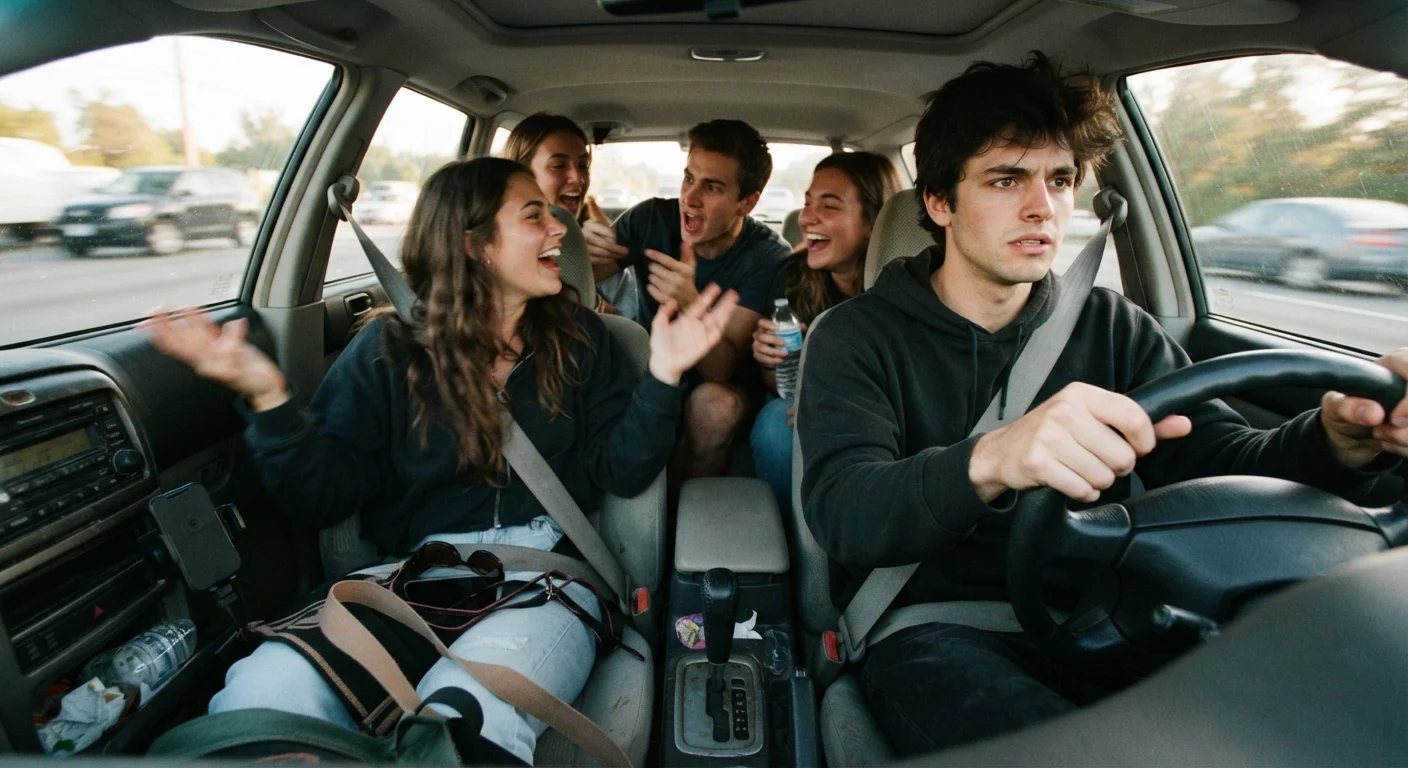
Conversations about distracted driving tend to focus on smartphones, but research consistently shows that passengers rank among the most potent distractions inside a vehicle. A driver managing a heated discussion or responding to backseat requests is diverting cognitive resources away from the road — often without realising it. As our comparison of distraction sources explains, phones receive the most regulatory attention, but passengers produce a similarly disruptive cognitive load.
The AAA Foundation for Traffic Safety has documented that passenger-related distraction is implicated in a significant share of teen driver crashes. For newly licensed drivers especially, the presence of peer passengers measurably increases crash risk — an effect strong enough that most U.S. states restrict the number of teen passengers a new driver may carry during the first months of licensure.
4x
Elevated crash risk for teen drivers with peer passengers
AAA Foundation research has found that the presence of multiple teen passengers can roughly quadruple crash risk for newly licensed young drivers.
~8%
Fatal crashes involving passenger distraction
The NHTSA's distracted driving data consistently identifies passenger-related distraction as a factor in a meaningful share of fatal crash reports each year.
Common Passenger Behaviours That Compromise Safety
Understanding which specific actions create risk is the first step toward managing them. The following mistakes are drawn from road safety research and collision data.
Holding emotionally engaging conversations that monopolise the driver's attention.
Why it happens: Passengers assume that because talking is "hands-free," it is safe. They don't realise that emotional or complex dialogue creates a significant cognitive tunnel effect.
Reaching over to adjust controls — radio, climate, GPS — from the passenger seat.
Why it happens: Passengers mean to be helpful, but unexpected movements near the steering column or the driver's field of view can startle the driver or cause a reflexive reaction.
Encouraging the driver to speed, run yellow lights, or take risks to arrive sooner.
Why it happens: Social pressure and impatience make passengers underestimate how much influence their words carry on driver decision-making.
Allowing children or pets to move freely in the cabin without proper restraint.
Why it happens: Short trips feel low-risk, and securing a child seat or pet carrier takes time. Many families underestimate the distraction an unrestrained animal or child creates.
Showing the driver videos, photos, or content on a phone while the vehicle is moving.
Why it happens: The passenger is bored or excited to share something and assumes a quick glance is harmless. Even a two-second visual diversion at 60 mph covers the length of a football field.
How Drivers Can Manage In-Car Dynamics
Setting expectations before the engine starts is far more effective than trying to correct behaviour at highway speed. A brief, calm statement — "I need quiet when I'm merging or parking" — is socially easy and safety-critical. Drivers should not feel embarrassed to ask passengers to lower their voices, pause a conversation, or wait until the vehicle has stopped before showing something on a phone screen.
Peer Pressure Inside the Car Is a Real Hazard
Research on teen crashes shows that peer passengers can actively encourage risky driving behaviour — faster speeds, later braking, more aggressive lane changes. This social influence operates even when nothing explicit is said; the presence of peers alone shifts some drivers toward riskier decisions. If you are a passenger in any vehicle, be conscious that your reactions and comments shape the driver's behaviour more than you may intend.
For parents of teen drivers, the message matters beyond the immediate trip. Modelling good passenger behaviour as an adult — not pointing at your phone, not shouting directions, not grabbing the wheel — reinforces the habits young drivers will carry forward. For a broader framework on building safe habits across every driving scenario, see our complete safe driving overview.
On longer or more demanding drives — at night, in heavy rain, on unfamiliar roads — drivers should communicate the elevated need for focus. Night driving conditions change the risk profile significantly, and passengers who understand this are generally willing to adapt.