

Key Takeaways
Option A
Antifreeze
The concentrated chemical base — full-strength ethylene or propylene glycol.
Best for: Drivers who want to mix their own solution or need to top off a system with a specific glycol-to-water ratio.
Option B
Coolant
The ready-to-use mixture of antifreeze and water that circulates through your engine.
Best for: Drivers who want a plug-and-play solution that's ready to pour directly into the reservoir without additional mixing.
If you want a straightforward, no-mixing solution for routine top-offs
Coolant (pre-mixed)
Pre-mixed coolant eliminates guesswork about ratios and is ready to pour directly into the reservoir, reducing the chance of dilution errors.
If you need precise control over the freeze protection level for extreme climates
Antifreeze
Concentrated antifreeze lets you dial in the exact glycol-to-water ratio — say, 70/30 for severe winter conditions — that pre-mixed solutions don't offer.
If you're doing a full coolant system flush
Antifreeze
Starting with concentrate gives a mechanic or experienced DIYer full control over the fresh mix going into a clean system. A licensed mechanic should handle this task if you're unsure.
Why the Terminology Confusion Matters
Walk into any auto parts store and you'll see shelves labeled interchangeably with both terms. That confusion isn't harmless — pouring the wrong product in the wrong concentration can leave your engine vulnerable to overheating in summer or freeze damage in winter. Just as common car maintenance myths can lead drivers astray, misunderstanding what's in your cooling system is an easy mistake with real consequences.
The short version: antifreeze is the raw concentrate — typically ethylene glycol or propylene glycol — that is formulated to lower the freezing point and raise the boiling point of water. Coolant is the working fluid that actually circulates through your engine, and it's almost always a mixture of antifreeze and distilled water. When someone says their car needs coolant, they mean this ready-to-use solution, not the undiluted concentrate.
| Criterion | Antifreeze | Coolant (Pre-Mixed) |
|---|---|---|
| What it is | Concentrated glycol compound | Antifreeze + distilled water blend |
| Ready to use? | No — must be diluted | Yes — pour directly in |
| Typical ratio | Varies; user-controlled | Usually 50/50 pre-set |
| Heat transfer efficiency | Lower at full concentration | Optimized when properly mixed |
| Use case | Custom mixing, extreme climates | Routine top-offs, general maintenance |
| Risk of misuse | Higher — dilution errors possible | Lower — ratio already set |
How the Cooling System Actually Uses Both
Your engine generates enormous heat during combustion. The cooling system draws that heat away by circulating coolant through the engine block, through the radiator where the heat dissipates into outside air, and back again. This loop depends on fluid that won't boil at high engine temperatures and won't freeze in cold climates — which is exactly what a properly mixed antifreeze-water solution provides.
Pure water would boil at 212°F and freeze at 32°F. A typical 50/50 mix of ethylene glycol and distilled water raises the boiling point to around 223°F and drops the freeze point to roughly -34°F. Counterintuitively, pure antifreeze performs worse than the mixed solution — its boiling point is actually lower than a properly diluted mixture, and it transfers heat less efficiently. That's why dilution isn't optional; it's chemically necessary.
-34°F
Freeze point of a 50/50 ethylene glycol–water mix
Compared to 32°F for plain water, this is the protection a standard mix delivers in cold climates.
223°F
Approximate boiling point of standard coolant mix
A 50/50 antifreeze-water solution raises the boiling point significantly above that of plain water at sea level.
2–5 years
Typical coolant service interval range
Interval varies widely by coolant type — IAT formulas wear out faster than modern OAT or HOAT blends.
Coolant Types Are Not Interchangeable
Beyond the antifreeze-versus-coolant distinction, there's another layer drivers often overlook: coolant formulation. Three primary types exist:
- IAT (Inorganic Additive Technology): The traditional green formula, typically rated for about 2 years or 30,000 miles. Older vehicles were designed around this chemistry.
- OAT (Organic Acid Technology): Common in many vehicles made since the late 1990s and often colored orange, red, or pink. Generally rated for 5 years or 150,000 miles.
- HOAT (Hybrid OAT): A blend of the two, used by a number of European and Asian manufacturers. Often yellow or turquoise.
Mixing incompatible coolant types — say, adding green IAT to a system that uses OAT — can cause additive chemistry to conflict, reducing corrosion protection and potentially forming a gel-like sludge. Always verify your vehicle's required coolant specification in the owner's manual before adding anything to the reservoir.
Distilled Water, Not Tap Water
When mixing antifreeze concentrate yourself, always use distilled water rather than tap water. Tap water contains minerals and chlorine that can corrode metal cooling system components over time and reduce the effectiveness of the inhibitor package in the antifreeze. Distilled water costs very little and is widely available at grocery and hardware stores.
What You Should Actually Do at the Reservoir
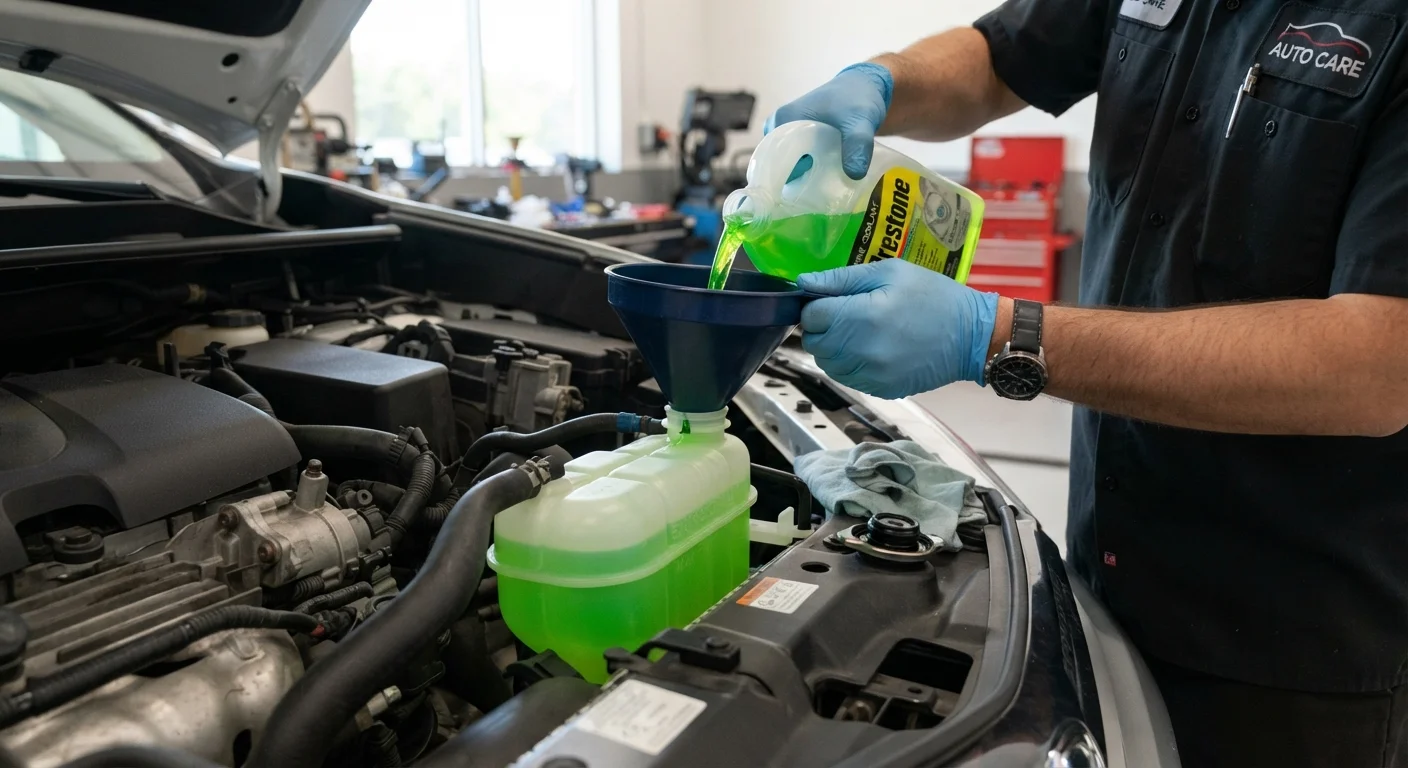
For routine low-level top-offs between service intervals, a pre-mixed coolant matched to your vehicle's specification is the safest choice. It eliminates ratio errors and is ready to use immediately. If the reservoir is significantly low and you suspect a leak, topping off is a temporary measure — have a mechanic inspect for the underlying cause.
For a full flush and refill — which most manufacturers recommend every 2 to 5 years depending on coolant type — the job involves draining the old fluid completely, flushing the system with distilled water, and refilling with the correct mixture. This is work that many drivers choose to hand off to a qualified mechanic, and that's a reasonable call: cooling system work on some vehicles requires bleeding air pockets from the lines, which can be tricky without the right procedure.
Whatever you do, never open a hot radiator cap. Coolant under pressure can reach temperatures well above the normal boiling point of water. Always wait until the engine has fully cooled before checking or adjusting coolant levels.