

Key Takeaways
Brake Fluid
Brake fluid is a hydraulic fluid that transfers the force from your foot pressing the brake pedal to the brake components at each wheel. Without it, your brakes simply cannot function. It lives in a sealed reservoir under the hood and travels through brake lines to actuate the calipers or wheel cylinders that slow your vehicle.
Most passenger vehicles use glycol-ether-based brake fluid, classified by the U.S. Department of Transportation into grades such as DOT 3, DOT 4, and DOT 5.1, which differ primarily in their dry and wet boiling points.
How Brake Fluid Actually Works
Your brake system is hydraulic, meaning it uses liquid under pressure to transmit force. When you press the brake pedal, a component called the master cylinder pushes brake fluid through a network of rigid and flexible lines to the brakes at each wheel. At the wheel, that pressurized fluid squeezes brake pads against rotors — or activates wheel cylinders in drum brake systems — creating the friction that slows your vehicle.
Because the fluid must transmit force reliably in a sealed, pressurized system, its physical properties matter enormously. Specifically, it must resist vaporizing under heat. When brake components get hot during heavy braking, the fluid can reach very high temperatures. If it boils, it forms compressible gas bubbles — and a compressible fluid cannot transmit pressure effectively, causing a sudden and dangerous drop in braking power.
“The hydraulic brake system depends on fluid that doesn't compress. The moment vapor enters that system — from boiled or moisture-laden fluid — you lose the direct mechanical link between your foot and your brakes.”
— SAE International, Engineering standards body for the automotive industry
Why Brake Fluid Degrades Over Time
The central problem with brake fluid is that it is hygroscopic — it naturally absorbs water vapor from the surrounding environment. Even in a well-sealed system, small amounts of moisture enter over time through microscopic permeation in rubber hoses and seals.
As water content increases, the fluid's boiling point drops significantly. Fresh DOT 4 fluid, for example, has a minimum dry boiling point of 446°F (230°C). Once it absorbs just 3.7% water by volume — its rated wet boiling point — that threshold falls to 311°F (155°C). Under demanding conditions such as mountain descents or repeated hard stops, this difference can become safety-relevant.
3.7%
Water content that hits DOT 4 wet boiling point
The DOT 4 specification sets a minimum wet boiling point at just 3.7% water content by volume, illustrating how little moisture is needed to meaningfully reduce fluid performance.
135°F
Drop in DOT 4 boiling point when saturated
The difference between DOT 4's dry boiling point (446°F) and wet boiling point (311°F) represents a 135°F reduction in heat resistance as moisture accumulates in real-world use.
Beyond the boiling point concern, moisture in brake fluid also promotes internal corrosion. Brake calipers, wheel cylinders, and ABS (anti-lock braking system) components contain metal parts that rust in the presence of water. This can lead to costly repairs that a regular fluid flush might have prevented.
Recognizing When Brake Fluid Needs Attention
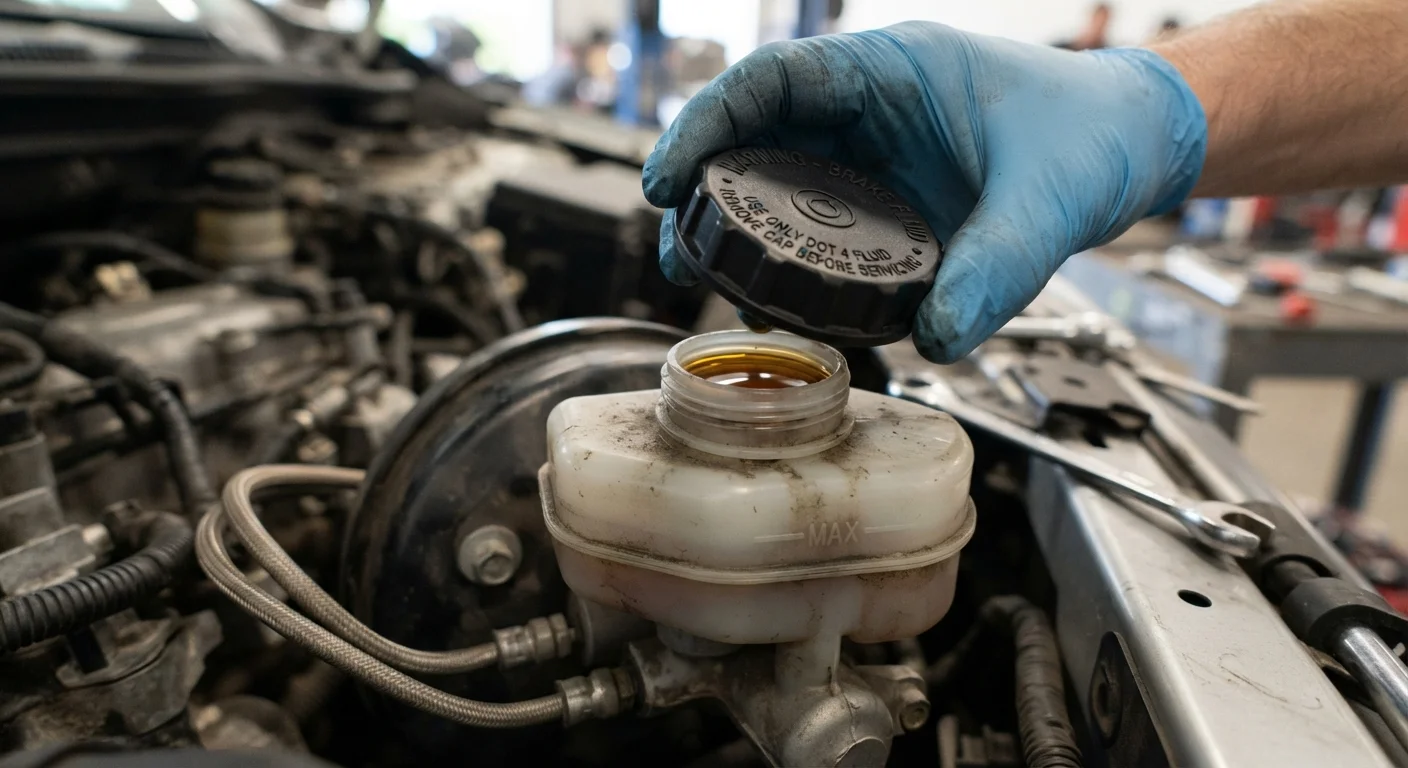
Fresh brake fluid is typically clear or very pale yellow. As it ages and absorbs moisture, it gradually darkens — often turning amber, then brown. While color alone isn't a definitive test, noticeably dark or murky fluid is a reasonable prompt to consult a mechanic.
Check Fluid Color Without Opening the Cap
Most brake fluid reservoirs are translucent, so you can assess fluid color simply by looking at the outside of the reservoir. There's no need to open it for a visual check. Opening the cap unnecessarily exposes the fluid to additional moisture — so save that for when a mechanic needs to test or service it.
Some repair shops use electronic testers or test strips that measure the moisture percentage in the fluid directly. This takes only a few minutes and gives a precise reading rather than a visual estimate. The National Highway Traffic Safety Administration (NHTSA) notes that brake system maintenance, including fluid condition, is a key factor in overall braking reliability.
Also pay attention to these signs during normal driving: a spongy or soft-feeling brake pedal, a pedal that sinks closer to the floor than usual, or a brake warning light. While these can have other causes, degraded or low brake fluid is among them and should be ruled out promptly by a professional.
Brake Concerns Warrant Prompt Attention
Any noticeable change in how your brakes feel — including a softer pedal, longer stopping distances, or unusual sounds — should be evaluated by a qualified mechanic as soon as reasonably possible. Brake system issues fall under safety-critical vehicle maintenance and are not suitable for a 'wait and see' approach.
Making Brake Fluid Part of Your Maintenance Routine
The most reliable guide for replacement intervals is your vehicle's owner's manual. Many manufacturers call for a brake fluid inspection or flush every two years or 30,000 miles, though some modern vehicles extend this. Because this interval is less intuitive than an oil change, it tends to get skipped — which is precisely why brake fluid earns the title of most overlooked fluid in the car.
A brake fluid flush — where old fluid is fully expelled and replaced with fresh fluid — is a relatively affordable service. It protects both the hydraulic components and your stopping performance. If your vehicle is approaching two to three years since the last flush and you aren't sure when it was last done, asking your mechanic to test the fluid at your next service visit is a straightforward starting point.
Routine brake maintenance is one of the most direct ways everyday drivers can protect both their safety and their vehicle's long-term reliability.