

Key Takeaways
Start here
Why Strength Training Matters Beyond the Gym
Understand the basics
How Bodyweight Training Actually Builds Strength
Learn the movements
The Core Movement Patterns to Know
Gear up (minimally)
Minimal Equipment Worth Considering
Take action
Putting It Together: A Simple Starting Point
Why Strength Training Matters Beyond the Gym
Strength training is often pictured inside a gym — barbells, mirrors, and membership cards. But the underlying goal has nothing to do with the building you're in. It's about asking your muscles to work against resistance so they adapt, grow stronger, and support everything from carrying groceries to climbing stairs without strain.
The benefits are well-documented. Regular resistance exercise is associated with improved bone density, better metabolic health, reduced risk of injury, and greater functional independence as we age. The American College of Sports Medicine and similar bodies recommend muscle-strengthening activity for adults of all fitness levels — and none of those guidelines specify where you have to do it.
If you've been curious about strength training but felt the gym wasn't for you, the honest answer is: you don't need it. You need a basic understanding of how the body responds to resistance, a few reliable movement patterns, and a plan you can actually stick to. See our overview of cardio vs. strength training if you're weighing which type of exercise to prioritize first.
How Bodyweight Training Actually Builds Strength
Muscle adapts to demand. When you repeatedly challenge a muscle close to its current capacity, it responds by getting stronger — a process sometimes called progressive overload. This principle works regardless of whether the load is a dumbbell or your own body.
Bodyweight training applies resistance through leverage, angle, and volume. A standard push-up is easier than a slow, pause-at-the-bottom push-up with feet elevated. A two-legged squat is less demanding than a single-leg squat. By manipulating these variables, you can keep providing a sufficient challenge as you get stronger.
Progressive overload
Gradually increasing the difficulty of exercise over time so your muscles continue to be challenged and adapt. Without it, strength gains typically plateau.
Reps and sets
A 'rep' (repetition) is one complete performance of an exercise. A 'set' is a group of consecutive reps performed before resting. For example, three sets of ten squats means 30 total squats with rest breaks in between.
Bodyweight training
Exercise that uses your own body as the primary source of resistance, with no free weights or machines required. Push-ups, squats, and planks are common examples.
Unilateral movement
An exercise that trains one side of the body at a time — such as a single-leg squat or a one-arm row. Helps correct strength imbalances and improve balance.
Movement pattern
A fundamental category of human movement (like pushing, pulling, or hinging) that groups exercises by how the body moves rather than by muscle name. Training across patterns helps ensure balanced strength.
The limitation is real but manageable: at some point, the most advanced bodyweight variations may not be challenging enough for experienced lifters chasing peak strength. For most everyday people, though — especially beginners — bodyweight training offers more than enough room to grow for months or years.
The Core Movement Patterns to Know
Rather than memorizing a list of exercises, it helps to think in movement patterns — the fundamental ways the human body is designed to move. A well-rounded routine covers most of these:
- Push — moving a load away from your body (push-ups, pike push-ups)
- Pull — drawing a load toward your body (rows using a table edge or resistance band)
- Hinge — bending at the hips while keeping the back neutral (hip hinges, Romanian deadlift variations)
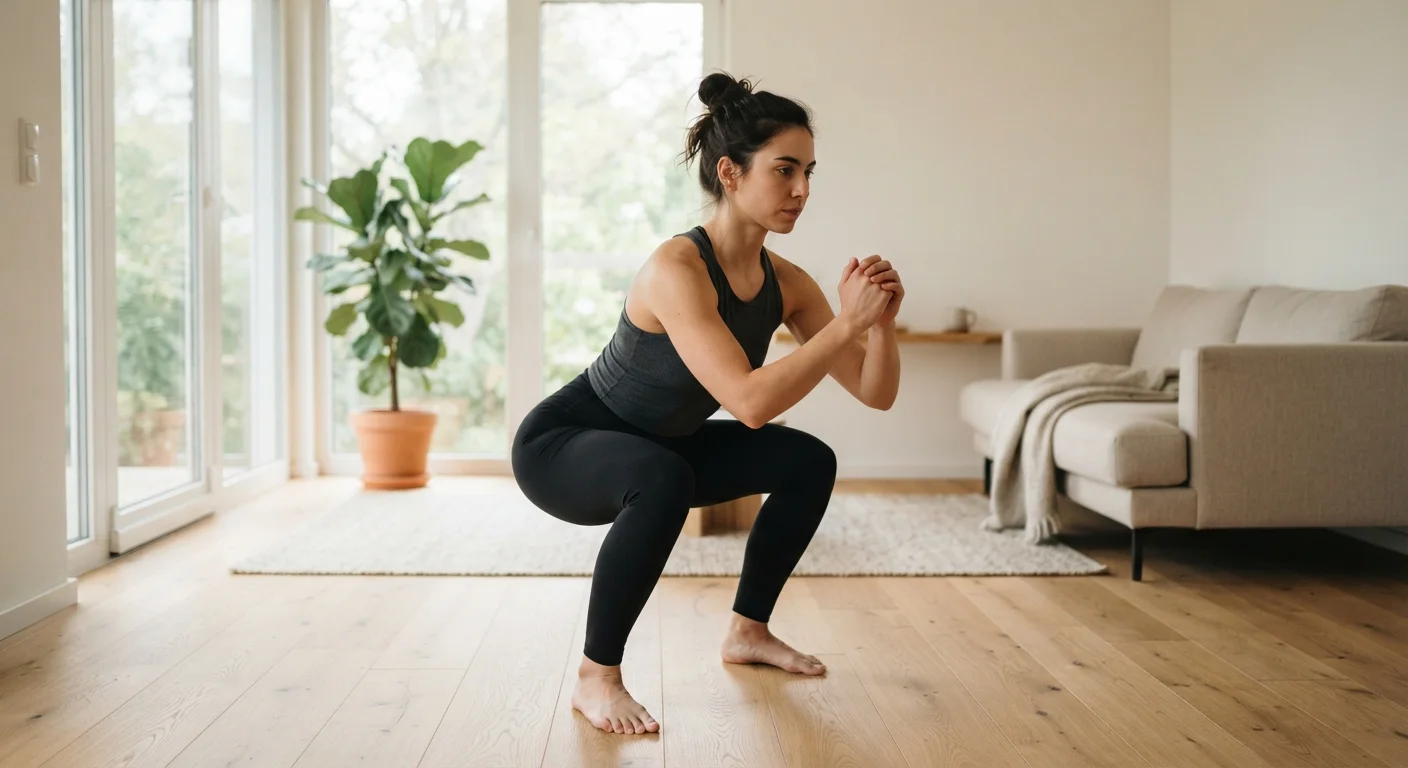
- Squat — lowering and raising the body through knee and hip flexion (bodyweight squats, split squats)
- Carry / Brace — stabilizing the core under load or movement (planks, dead bugs, farmer-carry variations)
- Lunge / Step — single-leg loading for balance and unilateral strength
You don't need to hit every pattern in every session, but a balanced weekly routine should touch most of them. If any of the terminology feels unfamiliar, the fitness terms glossary is a useful plain-language reference.
Start with two patterns per session
Beginners often get better results by mastering a few movements well than by cycling through many exercises poorly. Choose one lower-body and one upper-body pattern, practice them with control, and build from there. Complexity can come later — consistency comes first.
Minimal Equipment Worth Considering
You can train effectively with zero equipment, but a few low-cost tools meaningfully expand what's possible — especially for pulling movements, which are difficult to replicate with pure bodyweight alone.
- Resistance bands — versatile, inexpensive, and portable. Useful for rows, pull-aparts, hip work, and assisted progressions toward harder movements.
- A sturdy chair or step — enables incline or decline push-up variations, step-ups, and supported single-leg work.
- A door-frame pull-up bar — if budget and space allow, opens up vertical pulling (pull-ups, chin-ups), which are otherwise hard to replicate at home.
None of these are prerequisites. Start with what you have and add tools only when a clear need emerges — not before. Buying equipment before establishing a routine is a common pitfall; the routine comes first.
Pulling movements deserve attention
Many beginners focus heavily on pushing exercises (push-ups) while neglecting pulling, which trains the upper back and helps maintain good posture. Even simple rows using a resistance band or the underside of a sturdy table can fill this gap without any special equipment. Aim to balance pushing and pulling volume over the course of a week.
Putting It Together: A Simple Starting Point
The most effective routine is one you'll actually do consistently. For beginners, that often means keeping sessions short (20–30 minutes), repeating them two to three times per week, and focusing on quality of movement over quantity of exercises.
A basic session might include one pushing movement, one lower-body movement, one hinge or core exercise, and — if possible — one pulling movement. Rest between sets, keep form deliberate, and track what you did so you can make it slightly more challenging next time. That last part — progressing incrementally — is what separates a routine that works from one that stalls.
Consistency across weeks matters more than any single perfect session. See how to build a movement habit that actually sticks for evidence-informed strategies on making exercise a durable part of your life, not just a temporary effort. And if past routines have fallen apart, understanding the real reasons fitness routines fail can help you set better conditions this time.
This article is for general informational and educational purposes only and is not a substitute for professional medical advice. Consult a qualified healthcare provider before starting a new exercise program, particularly if you have any existing health conditions or physical limitations.