

| Typical prelims percentage | 10–15% of total build value |
| Standard contingency range | 5–15% |
| Provisional sum (PS) | Estimated placeholder; final cost varies |
| Prime cost (PC) item | Client-selected finish with a budget allowance |
| Variation documentation | Must be agreed in writing before proceeding |
Why Builder's Quotes Can Be Confusing
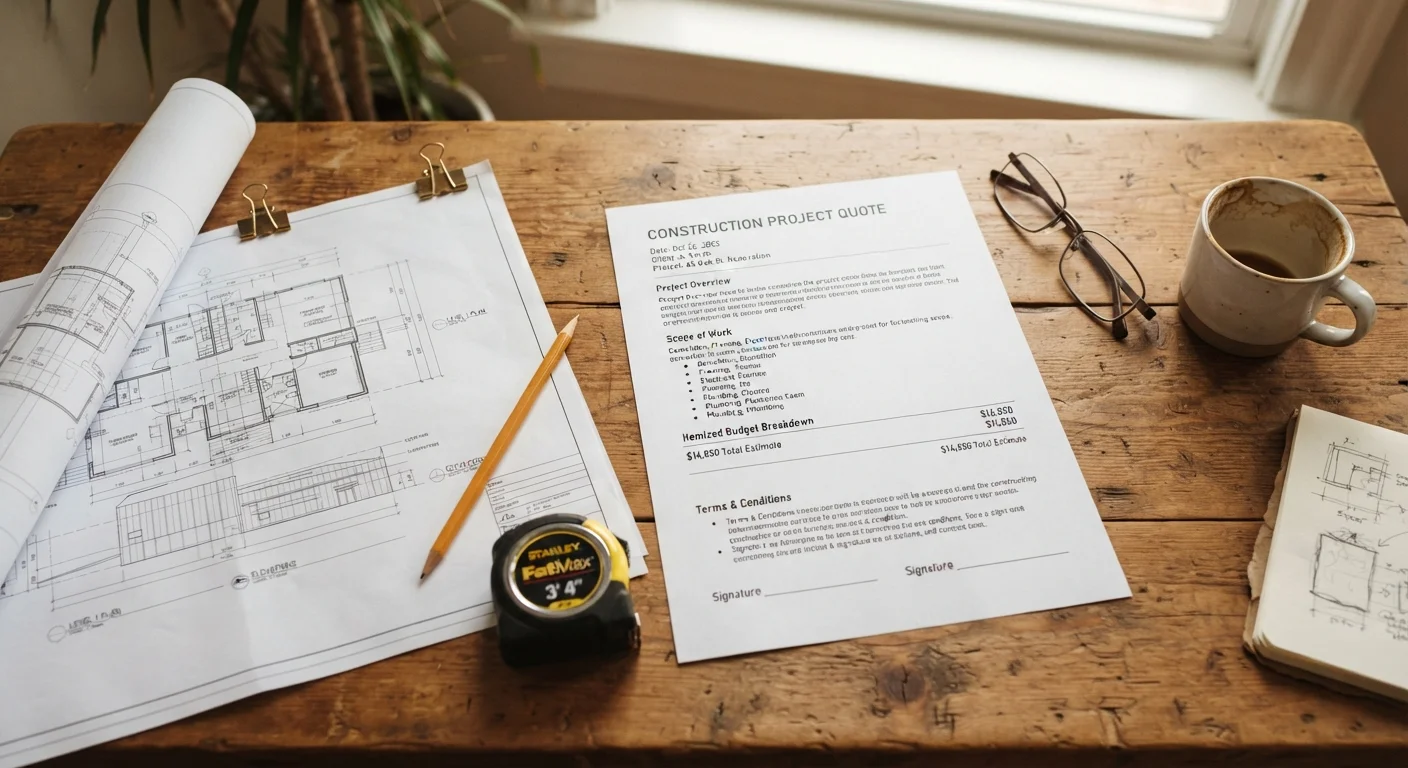
Receiving a builder's quote for the first time can feel like reading a foreign language. Terms like provisional sum, prime cost item, and contingency allowance appear alongside line-item costs that may seem arbitrary or inflated — but each has a specific meaning, and understanding them helps you compare quotes accurately and ask the right questions.
A well-structured quote isn't just a price; it's a map of how your project will be organized and where uncertainty lives. The more clearly you understand each section, the better positioned you are to negotiate, plan your budget, and avoid scope-creep disputes later. See our guide to common renovation myths for context on how misreading quotes can lead to expensive assumptions.
| Typical prelims percentage | 10–15% of total build value |
| Standard contingency range | 5–15% |
| Provisional sum (PS) | Estimated placeholder; final cost varies |
| Prime cost (PC) item | Client-selected finish with a budget allowance |
| Variation documentation | Must be agreed in writing before proceeding |
Key Line Items Decoded
Most residential builder's quotes follow a recognizable structure. Here are the terms you're most likely to encounter:
Preliminaries (Prelims)
This covers the builder's overhead costs for running your specific project — site setup, scaffolding, skip hire, project management time, insurance, and site security. Prelims are legitimate costs and typically represent 10–15% of the total build value. If a quote lists no prelims at all, ask the builder how these costs are accounted for elsewhere.
Provisional Sum (PS)
A provisional sum is an estimated allowance for work whose full scope can't yet be determined — for example, excavation where ground conditions are unknown, or structural work pending an engineer's report. It's essentially a placeholder. Provisional sums are not fixed costs. The final charge will be higher or lower depending on what is actually encountered or specified later. Always ask how many PS items appear in a quote and what drives their final cost.
Prime Cost (PC) Item
A prime cost item is an allowance for a specific product the homeowner will select later — a tapware set, a light fixture, or floor tiles. The builder includes a budget figure; if you choose something more expensive, you pay the difference. If cheaper, you're credited. PC items are common in quotes issued before finishes are finalized.
Contingency Allowance
Reputable builders include a contingency — typically 5–15% — to absorb genuinely unforeseen costs like rotted subfloor revealed during demolition or asbestos discovered in an older home. A quote with no contingency may look cheaper, but it often means unexpected costs will arrive as variation claims mid-project.
Variations
A variation is any change to the agreed scope after the contract is signed — whether requested by you or triggered by an unforeseen condition. Variations should be documented in writing and priced before work proceeds. Verbal agreement on variations is a common source of disputes.
Preliminaries (Prelims)
Overhead project costs covering site setup, scaffolding, insurance, and management. Typically 10–15% of the build value and listed separately from labor and materials.
Provisional Sum
An estimated allowance for work whose full scope is not yet known. The final cost may be higher or lower; it is not a fixed price.
Prime Cost Item
A budget allowance for a specific fixture or finish the homeowner will select later. Overruns or savings versus the allowance are passed directly to the client.
Contingency Allowance
A reserved percentage — typically 5–15% — built into a quote to cover genuinely unforeseen costs that arise during construction.
Variation
Any change to the original agreed scope after contract execution. Variations should be priced and approved in writing before work begins.
Scope of Works
The written description of exactly what the builder is contracted to do. Items outside the scope of works are not included in the quoted price.
Exclusions
Work or costs explicitly not covered by the quote, such as landscaping, permit fees, or appliance connections. Always request a written exclusions list.
Progress Payment
An installment payment tied to a defined project milestone (e.g., frame complete, lock-up stage). Milestone-based payments protect both parties.
What to Query Before You Sign
Once you understand the terminology, focus your review on a few critical questions:
- How many provisional sums are included, and how firm are the estimates? A quote heavy with PS items carries more financial risk than one with fixed prices.
- What triggers a variation? Clarify whether design changes, material substitutions, or access issues are automatically treated as variations.
- Is GST included? In many US renovation contexts, quotes may exclude applicable sales tax or local fees. Confirm whether the total is all-inclusive.
- What is and isn't in scope? Landscaping, painting, appliance installation, and permit fees are frequently excluded from base quotes. Ask for an explicit exclusions list.
- When is payment due? A legitimate progress-payment schedule ties installments to defined milestones — not arbitrary dates.
For a more detailed breakdown of structural terms that often appear alongside cost items in renovation documents, see the homeowner's glossary of structural terms. And if you're managing a tight budget, these approaches for making the most of a small renovation budget can help you prioritize spend once you've decoded where costs actually sit.
Get Every Change in Writing
One of the most common sources of renovation disputes is verbal agreement on variations or additions. Before any out-of-scope work begins, request a written variation order that includes a clear description, revised cost, and any impact on the timeline. This protects both you and the builder and provides a clear record if questions arise later.