

Key Takeaways
Our Verdict
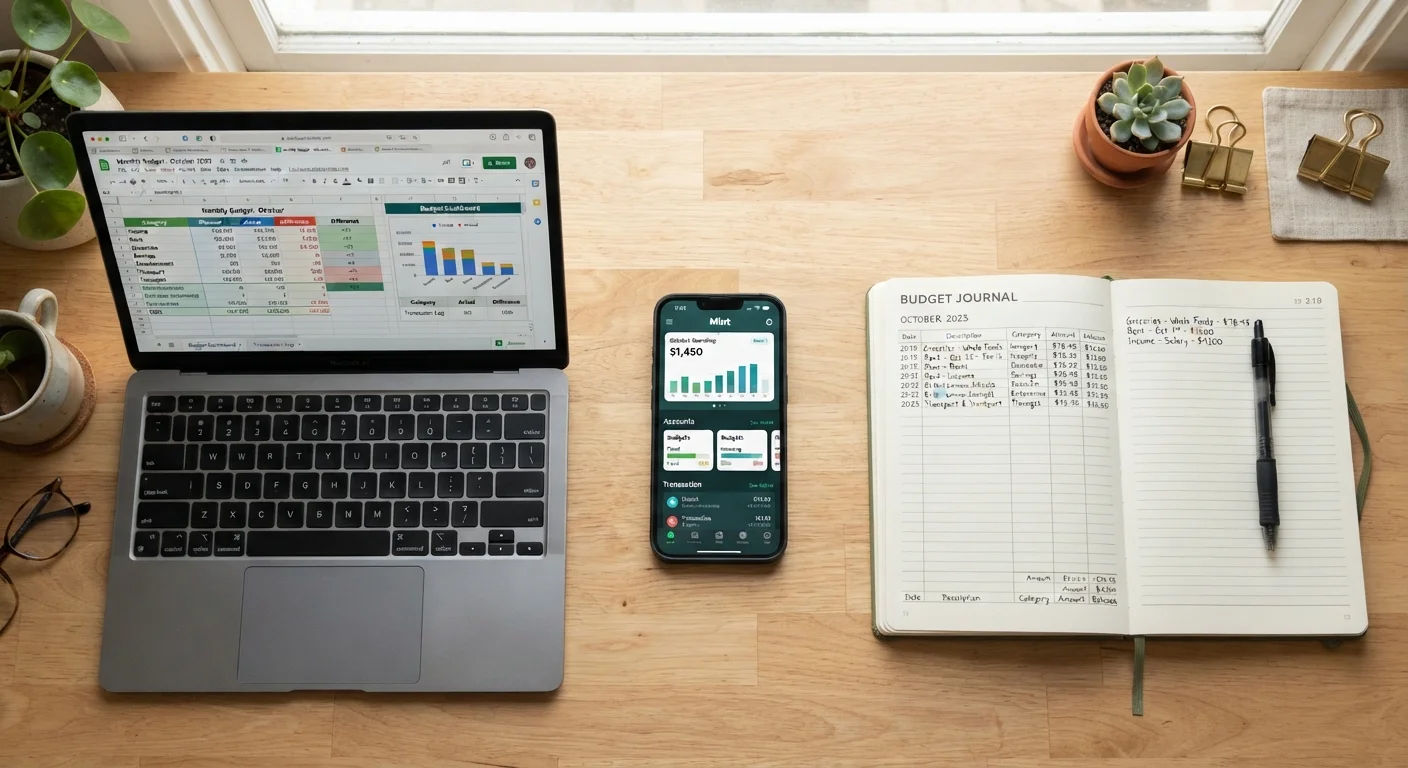
The best budgeting method is the one you'll return to week after week. Spreadsheets suit detail-oriented people who want full control; apps work well for those who need automation to stay consistent; and pen and paper remains a powerful choice for anyone who benefits from the friction of writing things down. Many successful budgeters borrow from more than one approach.
| Best for | Recommended |
|---|---|
| People who want granular control and customization | Spreadsheet |
| Those who struggle to track spending manually | Budgeting App |
| Anyone seeking a mindful, low-tech relationship with money | Pen and Paper |
| Budgeters who want both daily awareness and monthly analysis | Hybrid Approach |
Why Your Budgeting Format Actually Matters
Personal finance advice often focuses on what to budget — how to categorize spending, which percentages to target, which method to follow. But a frequently overlooked question is how you track it. Your format shapes whether you actually sit down with your budget at all.
Research on habit formation consistently shows that friction is the enemy of follow-through. A system that feels like a chore gets abandoned. That's why understanding the real trade-offs between spreadsheets, apps, and pen and paper is a genuinely practical decision — not just a preference. For a deeper look at how budgeting habits develop and fail, see what separates budgeters who stick with it.
It's also worth distinguishing between a budget (your spending plan) and a tracker (the record of what actually happened). Both matter, and your format choice affects both. Understanding how the two work together is a useful foundation before committing to any tool.
Spreadsheets: Power and Flexibility, With a Learning Curve
A spreadsheet — whether in a desktop program or a cloud-based alternative — gives you complete control over structure. You decide the categories, the formulas, and the layout. Nothing is hidden behind a software company's design choices.
Strengths: Spreadsheets are highly customizable. They're well-suited to people with variable income streams or complex financial pictures, such as freelancers managing estimated taxes alongside everyday expenses. They're also transparent — you can see every formula and understand exactly how your numbers are calculated. Spreadsheets don't require linking bank accounts, which many privacy-conscious users prefer.
Limitations: The setup burden is real. A spreadsheet requires you to build (or adapt) a template, enter data manually, and maintain it over time. If you miss a week, catching up can feel overwhelming. And for people who aren't comfortable with basic formulas, the learning curve can stall momentum before good habits form.
| Spreadsheet | Budgeting App | Pen and Paper | |
|---|---|---|---|
| Setup effort | High — requires building or adapting a template | Low — guided onboarding, account sync | Very low — start immediately |
| Ongoing time commitment | Moderate — manual data entry required | Low — auto-categorization available | High — everything entered by hand |
| Customization | Very high — fully user-controlled | Limited — constrained by app design | Unlimited — blank page freedom |
| Data privacy | Strong — no account linking needed | Varies — depends on app's data practices | Complete — fully offline |
| Error risk | Formula errors possible | Miscategorization by algorithms | Manual math errors |
| Cost | Free to low-cost | Free tiers available; paid tiers common | Minimal — cost of a notebook |
| Best for | Detail-oriented, analytical users | Busy people needing automation | Mindful spenders, beginners |
If your income varies month to month, a spreadsheet's flexibility can be an advantage — see budgeting strategies for irregular income earners for approaches that work well with custom setups.
Budgeting Apps: Automation With Trade-Offs
Mobile and web-based budgeting apps promise to do the heavy lifting — syncing with bank accounts, auto-categorizing transactions, and sending spending alerts. For people whose biggest obstacle is remembering to record anything at all, automation is a meaningful advantage.
Strengths: Apps reduce the manual data entry that causes many people to give up. Notifications and dashboards make it easier to check in frequently. Many apps visualize your spending patterns in ways that are genuinely illuminating.
Limitations: Connecting financial accounts to a third-party app involves granting access to sensitive data. Users should research an app's data practices carefully before linking accounts. Many apps also move useful features behind paid subscription tiers — a cost that should be weighed honestly against the value provided. For context on what paid tiers typically deliver, see what you genuinely get for the upgrade.
Review Auto-Categorized Transactions Regularly
Budgeting apps are convenient, but their automatic transaction categorization is imperfect. A restaurant charge might be filed under entertainment, or a pharmacy purchase under household goods. Set a brief weekly habit of reviewing your app's categories to ensure your spending picture is accurate. Small corrections now prevent large misunderstandings at month-end.
Apps also sometimes auto-categorize transactions incorrectly, which can give a false sense of where money is going. Periodic manual review is worthwhile even with the most automated setup.
Pen and Paper: Friction as a Feature
Writing budget figures by hand is slow — and that's precisely the point. The cognitive act of recording a number manually tends to make it register more deeply than a passively synced transaction ever will. Studies in learning science suggest that handwriting engages memory and reflection in ways that typing does not, and many budgeters report that going analog made them genuinely more conscious of spending decisions.
Strengths: No software to learn, no subscriptions, no privacy concerns. A notebook is always available, never crashes, and doesn't require a signal. The deliberateness of writing creates a natural pause that can interrupt impulse spending habits.
Limitations: Pen and paper doesn't scale well for complex financial situations. Totaling figures manually is error-prone, and there's no automated backup if a notebook is lost. Running calculations across months requires meaningful time investment.
For readers considering whether a more structured, disciplined approach is right for them, the honest trade-offs of strict budgeting offers a balanced perspective on what that commitment actually involves.
Choosing What You'll Actually Use
The right format is the one that minimizes friction for your specific situation. A few questions can help clarify the decision:
- How much manual effort will you realistically sustain? If the answer is very little, automation-forward apps may be worth the trade-offs.
- How important is data privacy to you? If linking financial accounts feels uncomfortable, spreadsheets or pen and paper sidestep that concern entirely.
- Do you need granular customization? Complex income structures or detailed tracking categories favor spreadsheets.
- Are you building awareness from scratch? The deliberate slowness of pen and paper can be genuinely useful early in a budgeting journey.
There's no rule against blending approaches. Using a notebook for daily spending awareness while running a monthly spreadsheet review is a legitimate — and often effective — strategy. The goal is a sustainable routine, not format purity. For broader context on how budgeting methods fit into a complete financial plan, this complete budgeting resource covers the full picture.
This article is for general informational purposes only and does not constitute personalized financial advice. Consult a qualified financial professional for guidance specific to your situation.