

Key Takeaways
Pre-Sleep Circling Behavior
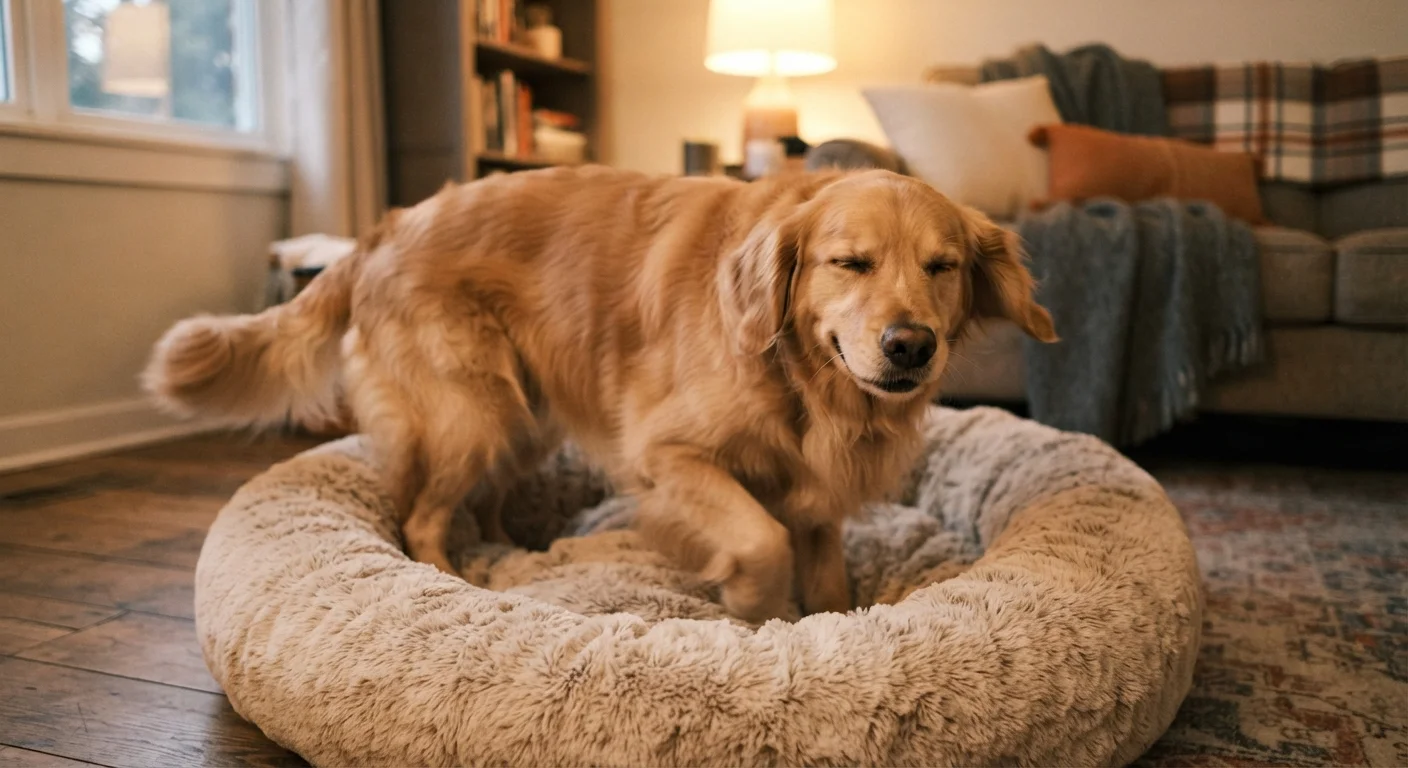
Pre-sleep circling is the instinctive behavior in which a dog walks in one or more tight circles before lying down. It's a deeply ingrained habit rooted in survival instincts inherited from wild ancestors. Almost all domestic dogs do it, and it is generally considered a normal, healthy behavior.
The behavior is sometimes called "denning behavior" in veterinary and ethology literature, and it persists in domestic dogs despite their environments making it practically unnecessary.
An Ancient Habit in a Modern Home
Watch your dog get ready for a nap and you'll almost certainly see it: a deliberate, focused spin — sometimes once, sometimes four or five times — before they finally drop down with a satisfied thud. It can look quirky or even a little obsessive, but this behavior has nothing to do with confusion. It's a survival mechanism encoded into canine DNA over thousands of years.
Domestic dogs share a common ancestor with wolves and other wild canids that lived without the luxury of cushioned beds or climate-controlled rooms. For those animals, the moments before sleep were a vulnerability. Pre-sleep rituals evolved to reduce that risk as efficiently as possible.
“Many behaviors we see in pet dogs today are evolutionary hangovers — actions that were once adaptive in a very different environment. Understanding that origin helps owners respond with patience rather than puzzlement.”
— Alexandra Horowitz, Canine cognition researcher and author of 'Inside of a Dog'
What the Circling Actually Accomplished
In the wild, a dog's sleeping area wasn't pre-prepared. Beds were patches of tall grass, leaf litter, or soil. Circling served several practical purposes simultaneously:
- Flattening vegetation: Turning in tight circles matted down grass and brush, creating a more level, comfortable surface and making it easier to curl into a compact sleeping position for warmth.
- Checking for hazards: The rotation gave the animal a 360-degree visual scan of the immediate environment — a final check for snakes, insects, or other threats before lowering their guard.
- Temperature regulation: In warmer climates, scraping away the top layer of ground exposed cooler soil underneath. In cold conditions, compacted grass provided better insulation.
- Scent marking: Glands in a dog's paw pads release scent. Circling may have also served to lightly mark a resting spot as their own territory.
~15,000
Years dogs have lived alongside humans
Archaeological and genetic research broadly places dog domestication at roughly 15,000 years ago, yet many ancestral behaviors like pre-sleep circling remain largely unchanged.
360°
Visual scan achieved by one full circle
A single rotation allows a dog to visually survey its entire immediate surroundings before settling — an instinctive safety check retained from wild ancestors.
These functions are largely irrelevant on a memory-foam dog bed in a suburban living room — but the behavior persists because instincts don't update as quickly as environments do.
When Circling Becomes a Health Signal
In the vast majority of dogs, pre-sleep circling is harmless and requires no intervention. However, there are situations where a change in this behavior is worth paying attention to.
Give Your Dog Room to Circle
Make sure your dog's bed is large enough for them to comfortably turn in a full circle before lying down. A bed that is too small can lead to prolonged circling as the dog tries to satisfy the nesting instinct without enough room to complete it.
Senior dogs may begin circling more frequently or for longer periods due to arthritis or joint pain, which makes finding a comfortable position harder. In some cases, increased circling or circling without settling can be an early sign of canine cognitive dysfunction — a condition in aging dogs sometimes compared to dementia in humans — or vestibular disease, which affects balance.
If your dog's circling behavior changes noticeably in frequency, duration, or character — especially if it's accompanied by whimpering, disorientation, or difficulty lying down — a veterinary evaluation is a reasonable next step. This is general informational guidance, not a substitute for professional veterinary advice tailored to your specific animal.
How Owners Can Respond
Understanding the instinctual basis of circling helps owners respond practically rather than anxiously. The simplest thing you can do is make sure your dog's sleeping space supports the behavior rather than works against it.
A sleeping surface that is too small, too slippery, or too firm may cause a dog to circle repeatedly without ever settling. Providing a bed that is appropriately sized — large enough for the dog to turn freely and lie stretched out if they choose — satisfies the nesting instinct more effectively. Dogs that sleep on smooth floors sometimes circle more out of difficulty finding traction than out of instinct alone.
If your dog is a dedicated circler, think of it less as a quirk to manage and more as a window into their behavioral heritage. That little spin before sleep connects your pet to thousands of years of canine history — playing out quietly every night on your living room floor.