

Key Takeaways
Option A
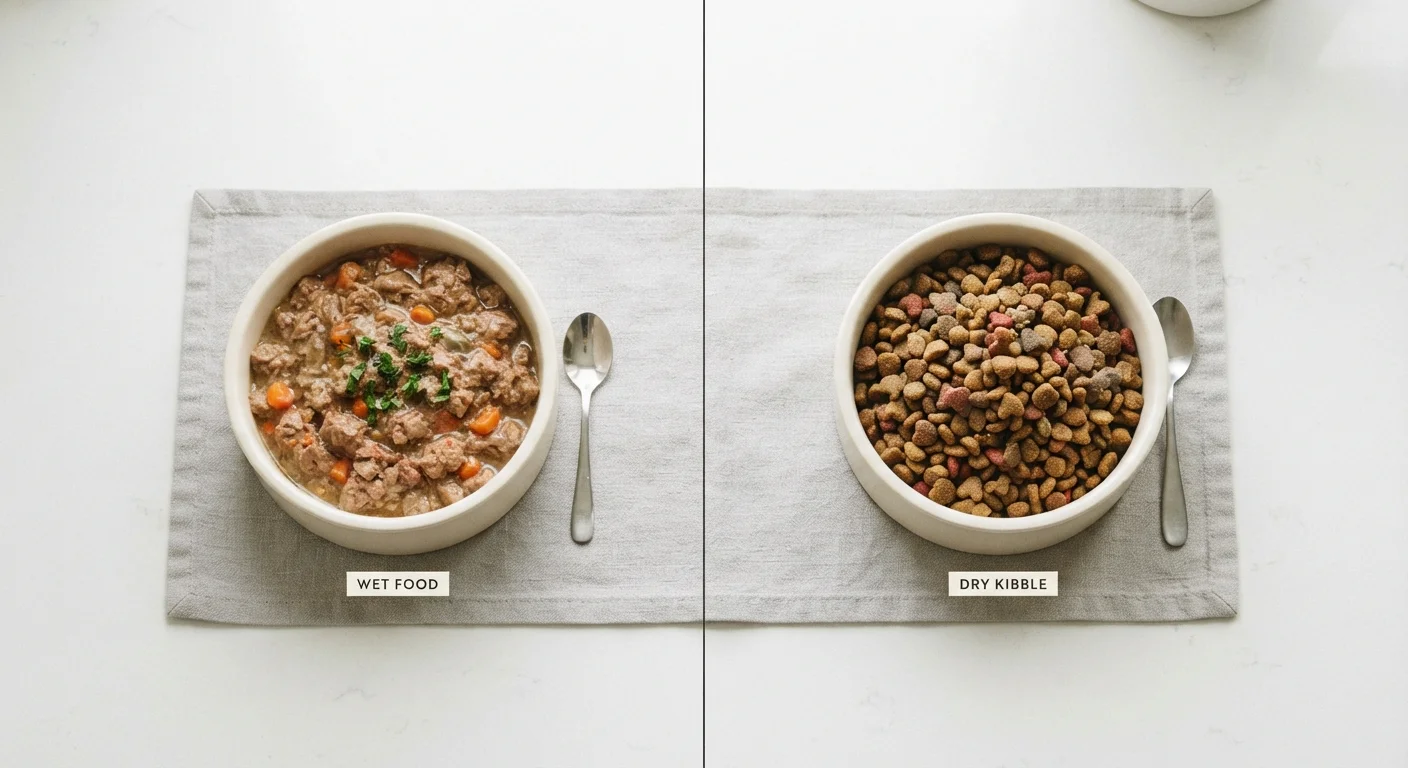
Wet Pet Food
The moisture-rich, highly palatable option.
Best for: Pets with hydration challenges, picky eaters, dental sensitivity, or urinary health concerns.
Option B
Dry Pet Food (Kibble)
The convenient, shelf-stable everyday staple.
Best for: Pet owners seeking cost-effective, easy-to-store feeding options with straightforward portion control.
If your pet struggles to drink enough water
Wet Pet Food
Its high moisture content contributes meaningfully to daily fluid intake, which supports kidney and urinary tract health. Learn more in our guide on pet hydration.
If convenience and budget are your primary concerns
Dry Pet Food (Kibble)
Kibble is shelf-stable, easy to portion, and generally more cost-effective per calorie than wet food.
If your pet is a senior with dental issues or reduced appetite
Wet Pet Food
Softer texture is easier to chew, and stronger aroma can help stimulate appetite in older animals whose senses have dulled.
If your pet is prone to weight gain
Dry Pet Food (Kibble)
Precise portion control is easier with kibble, which supports consistent calorie management as part of a weight care plan.
If you want a flexible, well-rounded approach
A combination of both
Mixing wet and dry food can balance hydration benefits with convenience — discuss ratios with your vet to suit your pet's specific needs.
How Wet and Dry Foods Actually Differ
At the most basic level, wet and dry pet foods differ in water content, ingredient processing, and caloric density. Wet food — sold in cans or pouches — typically contains between 70% and 80% moisture. Dry kibble, by contrast, usually contains only 8–12% moisture, meaning it delivers far more calories and nutrients per gram.
This difference in water content has real downstream effects. Because cats and many dogs do not naturally drink large amounts of water, inadequate hydration can quietly contribute to urinary and kidney problems. Wet food provides a built-in hydration boost that dry food simply cannot match.
Dry kibble, on the other hand, undergoes a high-heat extrusion process that makes it more shelf-stable and easy to handle. Wet food requires refrigeration after opening and has a much shorter window before spoilage. Understanding these foundational differences helps put the nutrition debate in proper context.
| Criterion | Wet Food | Dry Kibble |
|---|---|---|
| Moisture content | 70–80% | 8–12% |
| Caloric density | Lower per gram | Higher per gram |
| Shelf life (opened) | 1–3 days refrigerated | Weeks in sealed container |
| Cost per calorie | Generally higher | Generally lower |
| Palatability | High aroma, often preferred | Variable; less aromatic |
| Portion control ease | Moderate | Easy to measure |
| Dental benefit | Minimal | Modest mechanical effect |
| Suited to urinary health | Strong advantage | Less supportive |
Nutritional Considerations for Each Format
Both wet and dry foods can be nutritionally complete — the format alone does not determine quality. What matters most is whether the food meets the standards set by organizations such as the Association of American Feed Control Officials (AAFCO), which establishes nutrient profiles for pet foods sold in the United States.
Protein content is one area where wet food often has an advantage in raw terms: it frequently lists a named meat source as the primary ingredient, and less processing can preserve more natural amino acid structures. However, dry foods can be formulated with equivalent or higher protein concentrations on a dry-matter basis — a calculation that removes water from the equation to allow fair comparison.
Caloric density also matters for weight management. Because kibble is more concentrated, it is easier to overfeed without realizing it, particularly with free-feeding setups. Our article on why pets gain weight explores how feeding habits contribute to this common problem.
70–80%
Moisture in typical wet pet food
This is the primary nutritional distinction between formats, according to AAFCO nutrient guidelines and standard pet food labeling.
~10%
Moisture in typical dry kibble
The low moisture content of kibble means pets relying solely on it must drink more water to compensate for the difference.
3–4x
Cost premium of wet vs. dry per calorie
Veterinary nutrition references consistently note that wet food costs significantly more per calorie delivered than dry food.
Which Format Suits Different Life Stages and Health Conditions
A pet's nutritional needs are not static. Kittens and puppies often benefit from the softer texture and higher protein density of wet food during early development. Adult pets in good health can generally thrive on either format, or a mix. Senior pets — who may experience reduced appetite, dental pain, or kidney changes — frequently do better with wet food's palatability and moisture. For a broader look at how care needs evolve, see our guide on senior pet care.
Specific health conditions can also guide the choice. Pets diagnosed with chronic kidney disease are often advised by veterinarians to consume more moisture-rich food. Conversely, pets prone to dental disease may receive some benefit from the mechanical action of chewing kibble, though this effect is modest and not a substitute for regular dental care.
The key principle here is that no single format is right for every animal. Feeding approaches shift across life stages, and your veterinarian is the best resource for tailoring food choices to your specific pet's needs.
Transitioning Between Food Types
If you decide to switch your pet from one format to another — or introduce a mixed approach — do so gradually over seven to ten days. Abrupt dietary changes can cause digestive upset, including loose stools or vomiting. Mix the new food in increasing proportions with the old food to allow your pet's digestive system to adjust comfortably. Your veterinarian can advise on the pace of transition based on your pet's individual sensitivity.
Practical Factors: Cost, Storage, and Everyday Use
Beyond nutrition, everyday practicality shapes most pet owners' decisions. Dry kibble wins on convenience: it can be stored for weeks or months in a sealed container, making bulk purchasing straightforward. Wet food requires refrigerated storage after opening and is typically more expensive per calorie.
For multi-pet households or owners who travel, the logistics of wet food can add up. Free-feeding — leaving food out throughout the day — is only feasible with dry kibble, since wet food left at room temperature spoils quickly and can attract pests.
A common and veterinarian-supported strategy is to combine both: using dry kibble as the base diet for cost and convenience, while adding wet food at one meal to boost palatability and moisture intake. If you're sorting through broader nutritional questions, our piece on common pet nutrition myths can help separate evidence from folklore.
This article is for general informational purposes only and is not a substitute for professional veterinary advice. Always consult a licensed veterinarian before making significant changes to your pet's diet, particularly if your animal has an existing health condition.