

Key Takeaways
Why Georgia Catches Travelers Off Guard
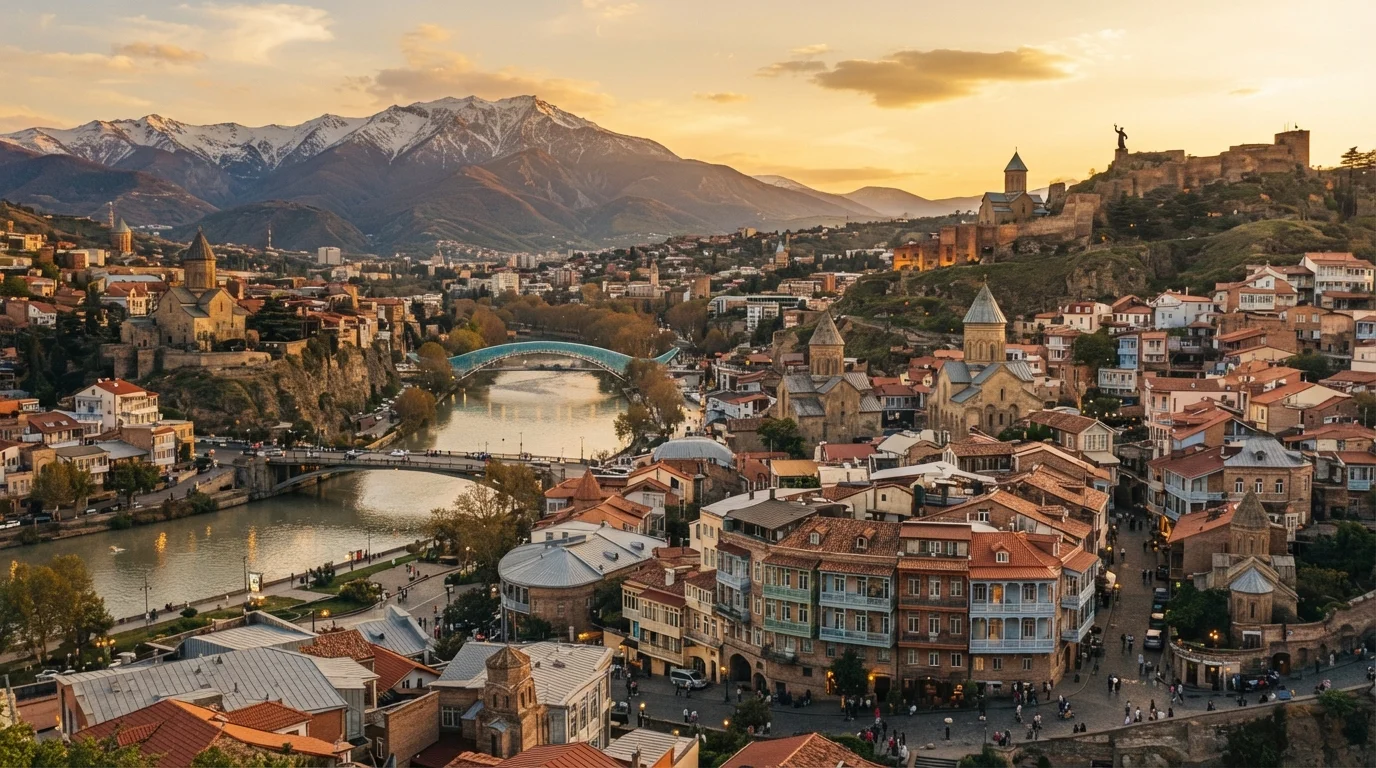
Ask most Americans to picture Georgia and the Caucasus Mountains are probably not what comes to mind. Yet the country wedged between the Black Sea and the Caspian — bordered by Russia to the north, Turkey and Armenia to the south — has been quietly astonishing visitors who stumble onto it for the first time. Tbilisi's old town looks like a fever dream of carved wooden balconies, sulfurous bathhouses, and medieval Persian fortresses stacked above a river gorge. Drive two hours east into the Alazani Valley and you're in wine country that may predate viticulture anywhere else on Earth. Push north into Svaneti and stone towers built to repel medieval raiders still stand in villages that feel genuinely remote.
The disconnect between expectation and reality is the whole point. Georgia is not a well-worn European destination with predictable infrastructure and familiar landmarks. It is a place with its own alphabet, its own polyphonic musical tradition, its own way of eating and celebrating — and it rewards visitors who show up with curiosity rather than assumptions.
That said, the gap between expectation and reality can also catch travelers flat-footed in ways that aren't entirely pleasant. The mistakes below are the ones most commonly made by first-time visitors — not out of bad intention, but out of not knowing what to expect.
Assuming Georgia is similar to other European destinations and skipping research on local customs.
Why it happens: Georgia has been growing in popularity through word-of-mouth and travel media, often framed simply as an 'affordable European gem,' which glosses over how culturally distinct it genuinely is.
Treating Georgia's regions as interchangeable rather than planning around their distinct characters.
Why it happens: Short itineraries encourage visitors to stay near Tbilisi and assume they've seen the country, when in reality the landscapes, architecture, and pace change dramatically between Kakheti, Svaneti, Adjara, and the capital.
Underestimating how challenging driving and road conditions can be outside Tbilisi.
Why it happens: Georgia looks compact on a map, and distances seem manageable — but mountain roads, unpaved passes, and seasonal closures can turn a two-hour Google Maps estimate into a four-hour journey.
Visiting without any awareness of regional political sensitivities and current travel advisories.
Why it happens: Travelers focused on the country's hospitality and scenery sometimes don't realize that parts of Georgia — including South Ossetia and Abkhazia — are subject to ongoing disputes and carry serious safety and legal implications for travelers.
Approaching Georgian wine as though it works the same as European wine.
Why it happens: Visitors who enjoy wine often arrive with a French or Italian frame of reference and find qvevri-fermented amber wines confusing, tannic, or 'off' — and may dismiss them rather than understanding the intentional difference in method.
Getting the Most Out of a Georgia Trip
Once you've cleared the misconceptions, Georgia opens up in remarkable ways. Tbilisi alone can absorb several days without repetition — the Narikala fortress, the Abanotubani sulfur bath district, the covered Deserter's Bazaar, and the contemporary art scene clustered near Fabrika are all radically different experiences within walking distance of each other.
8,000+
Years of winemaking tradition in Georgia
Archaeological evidence from sites in present-day Georgia suggests grape cultivation and wine production dating back approximately 8,000 years, making it one of the world's earliest known wine regions.
~4M
International visitors annually in recent years
Georgian tourism has grown substantially over the past decade, with the country receiving millions of international arrivals annually, according to the Georgian National Tourism Administration.
Beyond the capital, the road to Kazbegi in the Greater Caucasus offers some of the most dramatic mountain scenery accessible by standard vehicle — though road conditions shift seasonally, and travelers should check current route status and weather before heading up. The cave city of Vardzia, carved into a volcanic cliff face in the twelfth century, and the cathedral at Mtskheta, Georgia's ancient capital, are both UNESCO-recognized sites that reward a slower pace.
Food is a constant delight: khinkali (soup dumplings), khachapuri (cheese-filled bread), churchkhela (walnut-and-grape-juice candy), and the country's distinctive amber-colored natural wines are all worth seeking out with genuine attention rather than as a checklist. Georgia's wine tradition uses whole-cluster fermentation in clay vessels called qvevri — a method now recognized by UNESCO — and the resulting wines taste unlike anything produced by conventional European methods.
Verify Entry and Regional Rules Before You Go
Georgia's entry requirements, visa rules, and regional travel advisories can shift. Parts of the country carry specific warnings from the U.S. Department of State that travelers must take seriously. Always consult official government travel information — including your own country's foreign affairs or state department — before booking and before departure. Do not rely solely on travel blogs or social media for safety-critical information.
Wherever your itinerary takes you, give yourself margin for spontaneity. Some of the most memorable Georgian experiences — an impromptu supra feast hosted by strangers, a side road that leads to a frescoed church no one told you about — are the ones you couldn't have planned.