

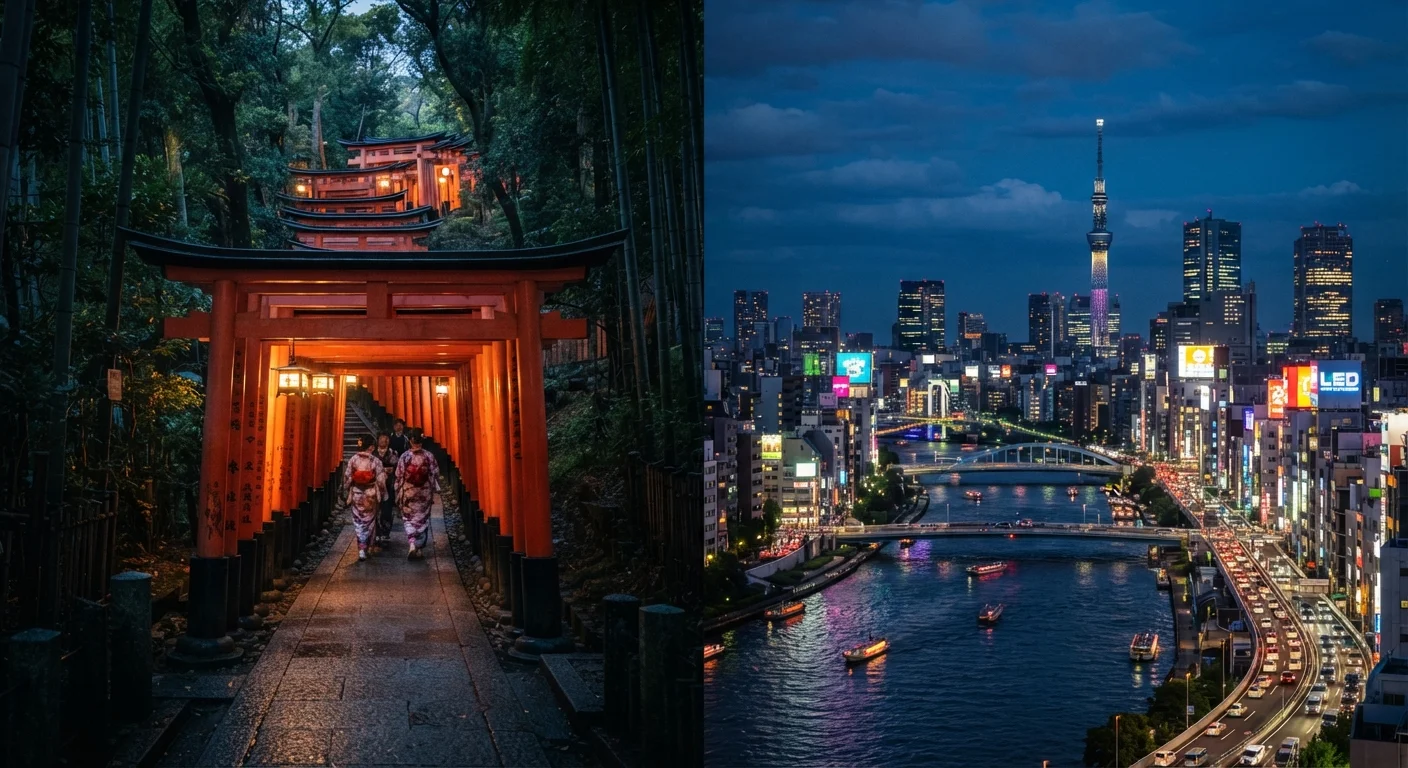
Key Takeaways
Option A
Kyoto
The living museum of traditional Japan.
Best for: Travellers drawn to ancient temples, quiet gardens, geisha districts, and a slower, more contemplative pace.
Option B
Tokyo
The electric pulse of modern Japan.
Best for: Travellers who crave urban energy, world-class food variety, cutting-edge pop culture, and non-stop discovery.
If you want to immerse yourself in Japan's cultural and historical legacy
Kyoto
Kyoto's density of UNESCO-listed sites, traditional tea houses, and preserved machiya townhouses makes it unrivalled for cultural depth.
If you thrive on big-city energy and endless urban exploration
Tokyo
Tokyo's sheer scale means there is always a new neighbourhood, cuisine, or subculture to discover around the next corner.
If you are a first-time visitor to Japan
Both
The Shinkansen makes visiting both cities straightforward; experiencing the contrast is itself one of Japan's great travel rewards.
If you prefer slower travel and meaningful over busy sightseeing
Kyoto
Kyoto's walking-pace neighbourhoods, garden meditation spots, and seasonal rituals suit travellers who value depth over volume.
If food variety and contemporary design are your top travel priorities
Tokyo
Tokyo hosts more Michelin-starred restaurants than any other city on Earth, alongside extraordinary street food and avant-garde architecture.
Two Cities, Two Japans
Ask seasoned Japan travellers which city defines the country and you will get two passionate, incompatible answers. For some, Japan lives in Kyoto's moss-covered stone steps, in the hush of a bamboo grove at dawn, in the shuffle of maiko apprentices along Gion's cobbled lanes. For others, Japan is Tokyo — a city so relentlessly alive that even its convenience stores feel like a kind of theatre. Both perspectives are completely correct, which is what makes planning a Japan trip so compelling and occasionally overwhelming.
Kyoto served as Japan's imperial capital for over a millennium, and the city carries that history in its bones. More than 1,600 Buddhist temples and 400 Shinto shrines are scattered across its valleys and hillsides. Tokyo, by contrast, rose to national prominence in the Edo period and exploded into global megacity status across the 20th century. It now functions as the nerve centre of Japanese commerce, culture, and innovation. Understanding what each city genuinely offers — rather than what travel clichés suggest — is the first step to a trip that actually fits who you are. See our honest look at who Japan suits best for a broader lens on this question.
Atmosphere and Pace: The Feel on the Ground
Walking through central Kyoto — particularly the Higashiyama district or the lanes of Arashiyama — carries a particular quality of stillness that is rare in any major city. Streets narrow, bicycle bells replace car horns, and wooden facades of old merchant houses (called machiya) line quiet alleyways. The city is designed, in many ways, around the experience of slowing down. Even Kyoto Station, one of the boldest pieces of modern architecture in Japan, empties into neighbourhoods that quickly feel ancient.
Tokyo resists stillness almost categorically. The neighbourhoods of Shinjuku, Shibuya, and Akihabara operate at a pace that can feel genuinely astonishing on arrival — layered rail systems, vertical shopping towers, digital signage covering entire building faces. Yet Tokyo also contains some of the most serene green spaces in Asia: the vast Imperial Palace gardens, the forested grounds of Meiji Shrine in Harajuku, the quiet waterside paths of Yanaka. The city rewards the traveller who learns to alternate between its intensities and its unexpected pockets of calm.
| Criterion | Kyoto | Tokyo |
|---|---|---|
| City character | Historic, contemplative, traditional | Futuristic, energetic, cosmopolitan |
| Population | ~1.5 million residents | ~14 million (metro: ~37 million) |
| Primary draws | Temples, shrines, geisha districts | Neighbourhoods, food, pop culture |
| Culinary identity | Kaiseki, tofu cuisine, matcha | Global variety, Michelin density, street food |
| Typical pace | Slow, walkable, seasonal | Fast, layered, constantly evolving |
| Best season to visit | Spring (cherry blossom) and autumn | Year-round; spring and autumn ideal |
| Transit complexity | Moderate — bus and subway | High — extensive but efficient rail |
Food, Culture, and What You Actually Do Each Day
Kyoto's culinary identity is rooted in kaiseki — a refined, multi-course tradition that emphasises seasonal ingredients, aesthetic presentation, and restraint. Tofu-based dishes, pickled vegetables, and matcha in every form are woven into the local food culture. The city's covered shopping arcade, Nishiki Market, offers a condensed introduction to Kyoto flavours and is worth an unhurried morning.
Tokyo's food scene operates on a different scale entirely. The city holds a remarkable concentration of Michelin-recognised restaurants, but equally compelling are its neighbourhood ramen shops, standing sushi bars, and the extraordinary basement food halls — known as depachika — found in department stores across the city. Culturally, Tokyo pulses through its many distinct districts: Harajuku for youth fashion, Yanaka for old-Edo atmosphere, Odaiba for futuristic waterfront design, and Akihabara for electronics and anime culture. Kyoto's cultural calendar revolves around its festival cycle, with events tied to its shrines and temples throughout the year — the Gion Matsuri in July being among the most celebrated.
1,600+
Buddhist temples in Kyoto
Kyoto's temple and shrine count reflects its role as Japan's imperial capital for over 1,000 years.
~37 million
People in the greater Tokyo metro area
The Greater Tokyo Area is widely cited as the most populous metropolitan region in the world.
~2h 15m
Shinkansen travel time between cities
The Tokaido Shinkansen connects Kyoto and Tokyo, making day trips and combined itineraries practical.
Practical Realities: Getting Around and Setting Expectations
Both cities are exceptionally well connected by public transit. Kyoto's bus and subway network covers most major sights, and many key areas — particularly around Fushimi Inari and the Philosopher's Path — are best explored on foot or by rental bicycle. The city is compact enough that a week allows genuine depth rather than frantic ticking-off of a checklist.
Tokyo's rail network is famously complex and equally efficient. The JR Yamanote Line loops through most major hubs, and IC transit cards simplify navigation across subway and train lines. The city's sheer size means visitors benefit from choosing a base neighbourhood that suits their interests rather than trying to cover everything from a single point.
The Shinkansen bullet train between Kyoto and Tokyo takes roughly 2 hours and 15 minutes, making it entirely feasible to experience both during a single trip. Most travellers who attempt just one city tend to leave feeling the other was a missed opportunity — and that feeling is hard to shake.
Visa and Entry: Always Verify Before You Travel
Entry requirements, visa policies, and travel advisories for Japan can change. US citizens should consult the US Department of State's travel information pages and Japan's official immigration authority before finalising plans. Do not rely solely on third-party sources for current entry rules.