

Key Takeaways
The Caribbean Island Spectrum
The Caribbean is not a single, uniform destination but a diverse collection of islands that differ dramatically in landscape, language, governance, and cultural character. Some islands rise steeply from volcanic origins; others sit almost level with the sea on ancient coral platforms. Their histories — shaped by Spanish, French, British, Dutch, and Danish colonial influences — have produced strikingly different societies, cuisines, and travel experiences.
Geographers divide the Caribbean into the Greater Antilles (larger islands including Cuba, Hispaniola, Jamaica, and Puerto Rico) and the Lesser Antilles (the smaller arc of islands stretching southeast), plus the low-lying Bahamas and Turks and Caicos archipelagos.
Two Kinds of Islands, Radically Different Worlds
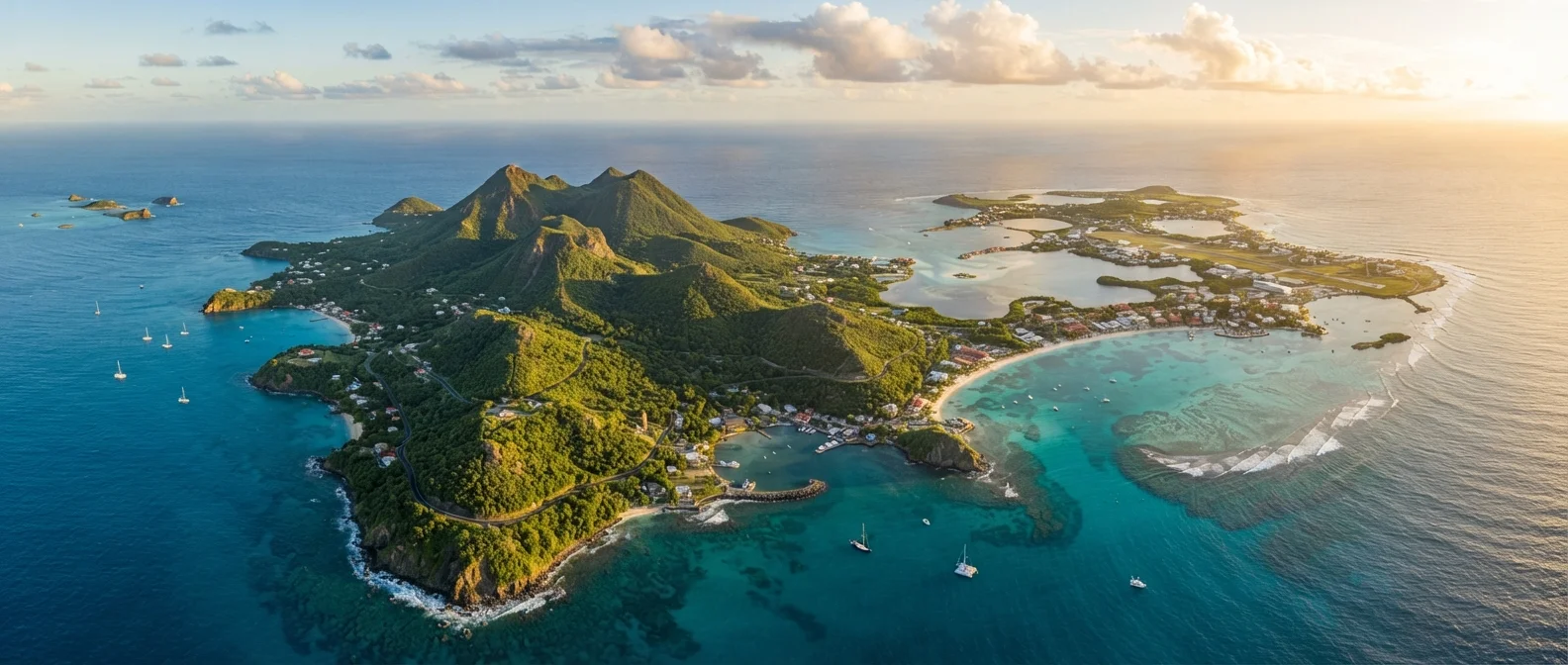
Imagine stepping off a plane onto an island where towering green peaks disappear into clouds — then imagine a second flight where the land barely clears the horizon, flat and sun-bleached in every direction. Both landscapes exist within the same Caribbean Sea, and understanding why they look so different is the first step toward understanding the region itself.
Volcanic islands, part of an active geological arc, include Dominica, St. Kitts, St. Vincent, and Martinique. Their mountains capture moisture from trade winds, feeding rivers and dense forest. Older, geologically quieter islands like Anguilla, Grand Cayman, and Barbados are composed of coral limestone. They tend to be flatter, drier, and surrounded by wide shallow banks — which explains why their famous beaches are often powdery and pale.
Island Classification Is Fluid
Geographic and political classifications of Caribbean islands vary by source. Some definitions include the Bahamas and Bermuda; others focus strictly on the Antillean arc. When researching a specific island, it's worth confirming its current political status and official entry rules, as these can change. Always consult official government travel resources for the most up-to-date information.
This geological split also affects agriculture, economy, and even architecture. Volcanic islands historically grew sugar, coffee, and spice crops on fertile hillside soil. Coral islands leaned more heavily on fishing, salt harvesting, and trade — shaping very different economic trajectories that still influence each island's character today.
Colonial History as a Cultural Blueprint
More than geography, it is colonial history that most visibly distinguishes one Caribbean island from another. Europeans arrived in successive waves beginning in the late 15th century, and each empire left a distinct imprint that persists in language, law, food, and architecture.
Spanish-colonized islands — Cuba, Puerto Rico, and the Dominican Republic — share a Latin cultural foundation, including Catholicism as a historical anchor, Spanish as the primary language, and a culinary tradition built around rice, beans, and roasted meats. British-influenced islands such as Jamaica, Barbados, and Trinidad brought cricket, afternoon tea culture, and a common-law legal system. French islands like Guadeloupe and Martinique remain administratively part of France, meaning residents vote in French elections and the euro circulates alongside creole culture. Dutch-affiliated islands — Aruba, Bonaire, Curaçao — carry yet another overlay, visible in the pastel-painted Dutch colonial architecture of Willemstad.
“The Caribbean is not a place but a plurality — a constellation of societies that happen to share a sea, each with its own accent, its own wound, its own way of celebrating survival.”
— Sidney Mintz, Anthropologist and author known for foundational research on Caribbean societies
These layered histories are not just academic. They shape what a traveler hears, tastes, and sees at every turn — from the Creole patois spoken in a market stall to the rhythm of a steel pan in a Port of Spain side street.
Governance, Infrastructure, and What It Means for Travelers
Whether an island is an independent nation or an overseas territory has direct, practical implications for visitors. US territories like Puerto Rico and the US Virgin Islands use the US dollar, operate under US federal law, and require no passport for American citizens — making them accessible first stops for travelers new to international travel. French territories use the euro and follow EU consumer protections. Independent nations maintain their own currencies, visa policies, and entry rules.
700+
Islands, cays, and islets in the Caribbean
The Caribbean region encompasses more than 700 islands of varying size, geology, and political status, according to general geographic references.
~30
Distinct sovereign nations and territories
The Caribbean contains roughly 30 separate political entities, ranging from large independent nations to small overseas territories of European countries and the United States.
5+
Major colonial languages still spoken today
English, Spanish, French, Dutch, and various creole languages derived from these are all actively spoken across the Caribbean, reflecting centuries of colonial history.
Infrastructure follows a similar pattern. Islands with deep ties to wealthier parent nations often have more developed airports, hospitals, and road networks. Smaller independent nations may offer a more intimate, less commercialized experience — but travelers should prepare for variable road conditions, limited ATM access, and fewer medical facilities in remote areas.
None of this makes one island better than another. It simply means that what you need — and what you should plan for — differs meaningfully depending on where you go.
Culture, Music, and the Spirit of Each Island
Perhaps the richest layer of Caribbean diversity is cultural expression. The region has produced some of the world's most influential music: Jamaica gave the world reggae and dancehall; Trinidad is the birthplace of calypso and soca; Cuba's contributions to jazz, salsa, and son are woven into the global musical fabric. Carnival traditions — elaborate costumed street festivals rooted in both African and European heritage — take different forms across islands, each with its own calendar and character.
Food tells the same story of layered influence. A Trinidadian doubles (a street snack of fried bara and curried chickpeas) reflects the island's large South Asian descended community, an outcome of post-emancipation indentured labor history. Jamaican jerk seasoning carries African culinary memory. Martinican cuisine blends French technique with Creole spice. Every plate is, in a sense, a short history lesson.
Research Before You Book
Before choosing a Caribbean destination, look into its language, currency, entry requirements, and typical terrain — not just its beach photos. The US Department of State's travel advisory pages and official tourism boards are reliable starting points. Matching the island's character to your travel style will make the experience far more rewarding.
Understanding what makes each Caribbean island distinct doesn't diminish the region's coherence — it deepens it. The Caribbean is unified by climate, by the sea, and by a shared history of resilience and creativity. But it rewards curious travelers most when approached not as a single, interchangeable backdrop, but as a spectrum of genuinely different worlds, each worth exploring on its own terms.