

Key Takeaways
Why Uzbekistan's Silk Road Cities Still Captivate the World
Long before container ships and air freight, the world's most coveted goods — silk, spices, glass, and ideas — moved overland through Central Asia. The ancient trade routes we collectively call the Silk Road were not a single path but a web of corridors, and Uzbekistan sat at its beating heart. The cities that rose from this commerce became among the most sophisticated urban centers of the medieval world, drawing scholars, merchants, artists, and conquerors alike.
Today, those same cities — Samarkand, Bukhara, and Khiva — remain standing in a form that can still produce genuine wonder. The azure-tiled domes that shimmer across Uzbekistan's skylines are not reconstructions built for tourists; many date back six centuries or more. Walking through them feels less like sightseeing and more like stumbling into a world that simply never left.
3
UNESCO World Heritage Sites in Uzbekistan
Samarkand, Bukhara, and Khiva's Ichan-Kala are each individually listed by UNESCO for their outstanding universal value.
2,750+
Years of documented settlement in Samarkand
Samarkand is one of the oldest continuously inhabited cities in Central Asia, with roots in at least the 7th century BCE.
140+
Architectural monuments in Bukhara's old city
UNESCO estimates Bukhara's historic center contains more than 140 registered monuments spanning multiple centuries.
Samarkand: The Crown Jewel of Central Asia
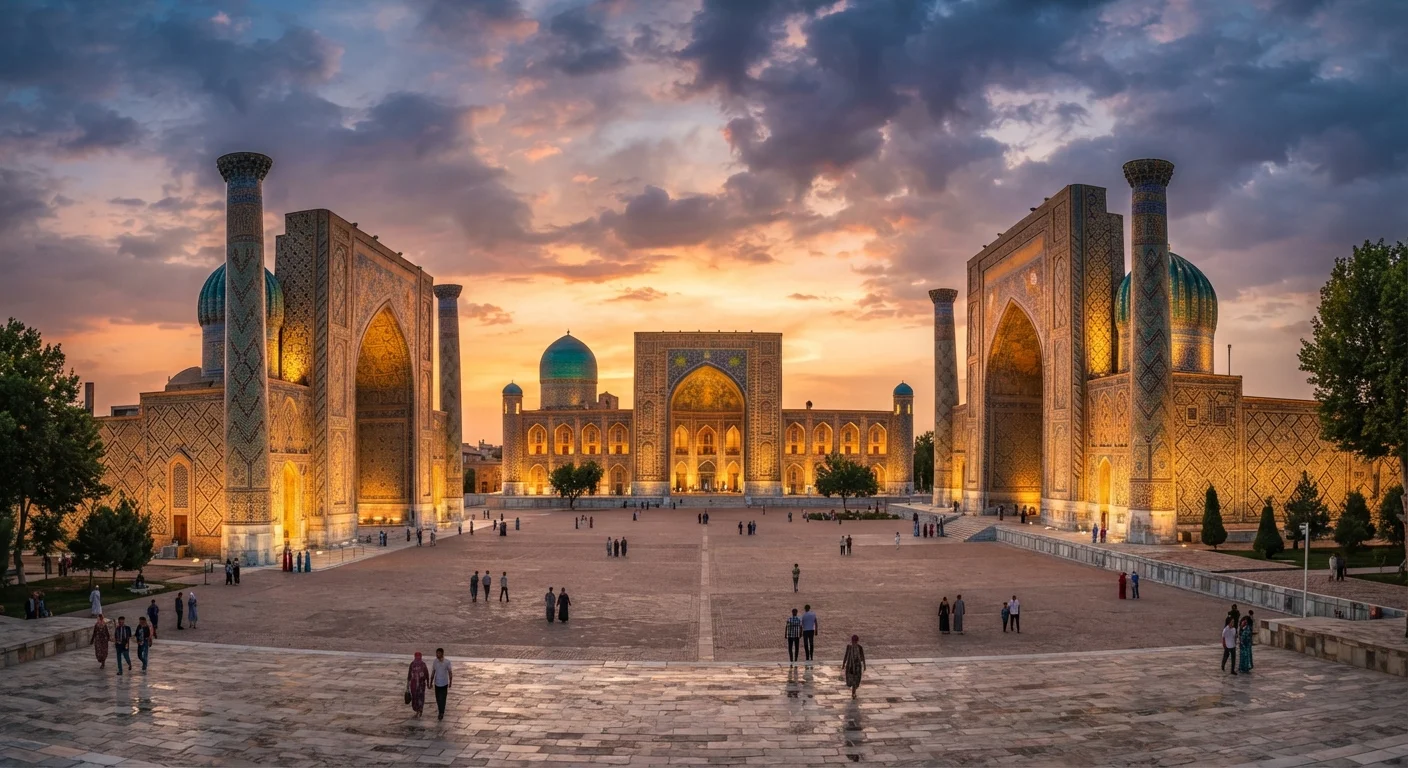
Few public squares in the world carry the same weight as Registan Square. Flanked by three monumental madrasas — the Ulugbek, the Sher-Dor, and the Tilya-Kori — the plaza was once the city's commercial and ceremonial center. Each facade is layered with geometric mosaic work in cobalt, turquoise, and gold, executed with a precision that still challenges contemporary craftspeople to replicate.
Beyond Registan, Samarkand rewards wanderers. The Bibi-Khanym Mosque, built at the command of Timur (Tamerlane) in the early 15th century, was once the largest mosque in the Islamic world. Shah-i-Zinda — a necropolis stretching along a narrow lane — contains some of the finest tilework anywhere, its mausoleums forming an almost overwhelming corridor of color.
Visit Registan Square both at sunrise and after dark — the lighting conditions transform the experience completely, and early mornings see far fewer visitors.
Crowd patterns at major heritage sites shift dramatically by time of day, and lighting quality affects both the visual experience and photography.
Hire a local guide for at least one day in each city; the architectural details and historical layering require context that signage alone rarely provides.
Many of Uzbekistan's monuments carry stories — political, dynastic, and artistic — that significantly deepen appreciation of what you're seeing.
Samarkand is also home to a thriving craft tradition. Paper made using a centuries-old mulberry technique is still produced at a workshop on the city's edge, and the local market near the Siab Bazaar offers saffron, dried fruits, and hand-embroidered textiles in abundance.
Bukhara: A Living Museum of Islamic Architecture
If Samarkand impresses with grandeur, Bukhara seduces with intimacy. The old city has over 140 architectural monuments concentrated within a walkable core, and the pace of life here feels distinctly unhurried. Bukhara's skyline is dominated by the Kalon Minaret — a 12th-century tower so impressive that Genghis Khan, on seeing it, reportedly ordered it spared while demolishing the rest of the city.
The Ark Fortress, which served as the residence of Bukhara's emirs for centuries, tells a more complicated story — one of power, imprisonment, and eventual Russian conquest. The bazaar domes (called toki) scattered through the old city were purpose-built trading halls, each designated for specific goods like money changers, silks, or jewelers. Wandering between them still gives a tangible sense of how commerce once organized urban space.
Make Time for Bukhara After Dark
The historic core of Bukhara is beautifully illuminated at night, and the crowds that gather around Lyabi-Hauz pool in the evenings offer a warm, sociable atmosphere. Many visitors find the evening hours as memorable as any daytime monument visit — bring comfortable shoes and plan to linger.
Bukhara is also a place to eat well. Plov — a rice dish layered with carrots, lamb, and chickpeas — reaches an art form here, and the covered tea houses around Lyabi-Hauz pool provide a genuinely lovely place to pause.
Khiva: The Walled City Frozen in Time
Khiva's inner walled city, known as Ichan-Kala, is one of the most complete surviving examples of a Central Asian medieval urban environment. Unlike Samarkand and Bukhara, where modern cities have grown up alongside ancient monuments, Ichan-Kala feels genuinely encapsulated — a tightly packed ensemble of mosques, minarets, caravanserais, and palaces contained within earthen walls.
The unfinished Kalta Minor Minaret — squat and brilliantly tiled in turquoise — stands as a reminder that even the most ambitious architectural visions sometimes outlast their patrons. The Juma Mosque, by contrast, has an interior unlike any other: 212 carved wooden columns, each salvaged from different eras, support its ceiling in a forest of intricate craftsmanship.
Khiva is more remote than the other two cities, and that relative solitude is part of its appeal. Visitor numbers tend to be lower, particularly outside peak season, giving the place an atmospheric quiet that can feel rare in more celebrated destinations.
Practical Tips for Visiting Uzbekistan
US citizens can currently enter Uzbekistan without a visa for stays up to 30 days, though travelers should always verify current entry requirements with the official Uzbek government portal and the US State Department before departure, as policies can change. The country has invested significantly in tourism infrastructure over the past decade, and the Afrosiyob high-speed train connecting Tashkent, Samarkand, and Bukhara makes multi-city travel comfortable and efficient.
The best times to visit are spring (roughly April through May) and autumn (September through October), when temperatures are moderate. Summers in the Fergana Valley and desert regions can reach extreme heat, and winter, while quieter, can be bitterly cold.
Verify Entry Requirements Before You Travel
Visa and entry policies for Uzbekistan have evolved quickly in recent years and may continue to change. Always confirm current requirements through the official Uzbek e-visa portal and the US State Department's Uzbekistan travel page well before your departure date. The same applies to any required travel vaccinations or health documentation.
Uzbekistani som is the local currency. ATMs are available in cities, but carrying sufficient cash is advisable for smaller towns, bazaars, and guesthouses. Many travelers find that family-run guesthouses — called mehmonxona — offer a more authentic experience than larger hotels, often including home-cooked meals. Dress modestly when visiting religious sites, and ask permission before photographing individuals.