

Key Takeaways
Consistent hydration noticeably reduces fatigue
Drinking water regularly throughout the flight counteracts the cabin's low humidity and can reduce the headaches and dry-eye discomfort that many passengers attribute to travel itself.
Movement breaks actively support circulation
Standing and light walking every 60–90 minutes helps maintain healthy blood flow, reducing discomfort and the low-level risk of DVT associated with extended immobility.
Noise-canceling headphones reduce nervous system load
Constant engine noise creates a form of low-grade stress; blocking it out has a measurable effect on relaxation and makes it easier to rest or focus.
Strategic light management aids onboard rest
An eye mask blocks the light changes that come with window shades and cabin lighting cycles, giving the brain the darkness it uses as a sleep cue.
Pre-adjusting sleep schedule eases arrival adjustment
Shifting your bedtime even slightly toward your destination's time zone before departure gives your circadian rhythm a head start on adapting.
Economy sleep is genuinely limited, not just inconvenient
Upright seating, ambient noise, and cabin lighting cycles combine to make deep, restorative sleep difficult for most passengers regardless of preparation.
Many popular remedies lack strong evidence
Melatonin, herbal teas, and aromatherapy sprays are widely marketed for in-flight use but have limited clinical support for the specific conditions of a pressurized cabin.
Jet lag cannot be fully prevented on the plane
The body's circadian adjustment happens over days, driven by light and meal timing — what you do mid-flight is only one small variable in a larger recovery process.
Sedative use in-flight carries underappreciated risks
Taking sleep medications in an environment with reduced mobility and lower cabin oxygen levels is different from taking them at home — a physician's input is worthwhile before trying this.
Arrival-day functioning is often overestimated
Even with good preparation, most travelers operate at reduced cognitive and physical capacity for the first day or two after a long-haul flight across multiple time zones.
Our Verdict
Long-haul flights are a genuine endurance challenge, and no single hack transforms them into a fully comfortable experience. What does help is a combination of honest preparation, modest expectations, and a few evidence-supported habits around hydration, movement, and light management. The goal isn't perfection — it's arriving functional.
Travelers heading on international journeys of six hours or more who want clear, realistic guidance on what genuinely improves the experience.
The Reality of Spending 10+ Hours in a Metal Tube
There's a whole industry built around "long-haul flight hacks" — compression socks, melatonin, elaborate sleep kits, strategic seat-selection spreadsheets. Some of it helps. A lot of it is oversold. Before diving into what works, it's worth setting an honest baseline: a long-haul flight in economy class is a physiologically taxing event, and no amount of preparation fully erases that.
Cabin altitude is typically pressurized to simulate conditions at 6,000–8,000 feet above sea level. That mild altitude reduces blood oxygen saturation slightly and contributes to fatigue. Relative humidity in the cabin often drops below 20% — far lower than a typical indoor environment — which is why your skin, eyes, and throat feel parched before you've even hit your connecting hub. Preparing well before departure matters, but knowing what you're actually walking into helps frame every choice you'll make once you're onboard.
Consistent hydration noticeably reduces fatigue
Drinking water regularly throughout the flight counteracts the cabin's low humidity and can reduce the headaches and dry-eye discomfort that many passengers attribute to travel itself.
Movement breaks actively support circulation
Standing and light walking every 60–90 minutes helps maintain healthy blood flow, reducing discomfort and the low-level risk of DVT associated with extended immobility.
Noise-canceling headphones reduce nervous system load
Constant engine noise creates a form of low-grade stress; blocking it out has a measurable effect on relaxation and makes it easier to rest or focus.
Strategic light management aids onboard rest
An eye mask blocks the light changes that come with window shades and cabin lighting cycles, giving the brain the darkness it uses as a sleep cue.
Pre-adjusting sleep schedule eases arrival adjustment
Shifting your bedtime even slightly toward your destination's time zone before departure gives your circadian rhythm a head start on adapting.
What Genuinely Helps (With Caveats)
Hydration is the clearest win available to any traveler. Drinking water consistently — rather than waiting until you feel thirsty — counters the cabin's drying effect. Alcohol and caffeine both accelerate dehydration and can fragment sleep, so moderation pays off on long flights even if you'd normally enjoy them.
Movement matters more than most people act on. Extended sitting affects circulation in measurable ways, and the risk of deep vein thrombosis (DVT), while statistically low for most healthy travelers, increases with prolonged immobility. Standing, stretching, or walking the aisle every 60–90 minutes is consistently recommended by aviation medicine specialists. Compression socks also support venous circulation and are particularly useful for people with varicose veins, a history of clotting, or flights over eight hours — but consult a healthcare provider if you have related conditions.
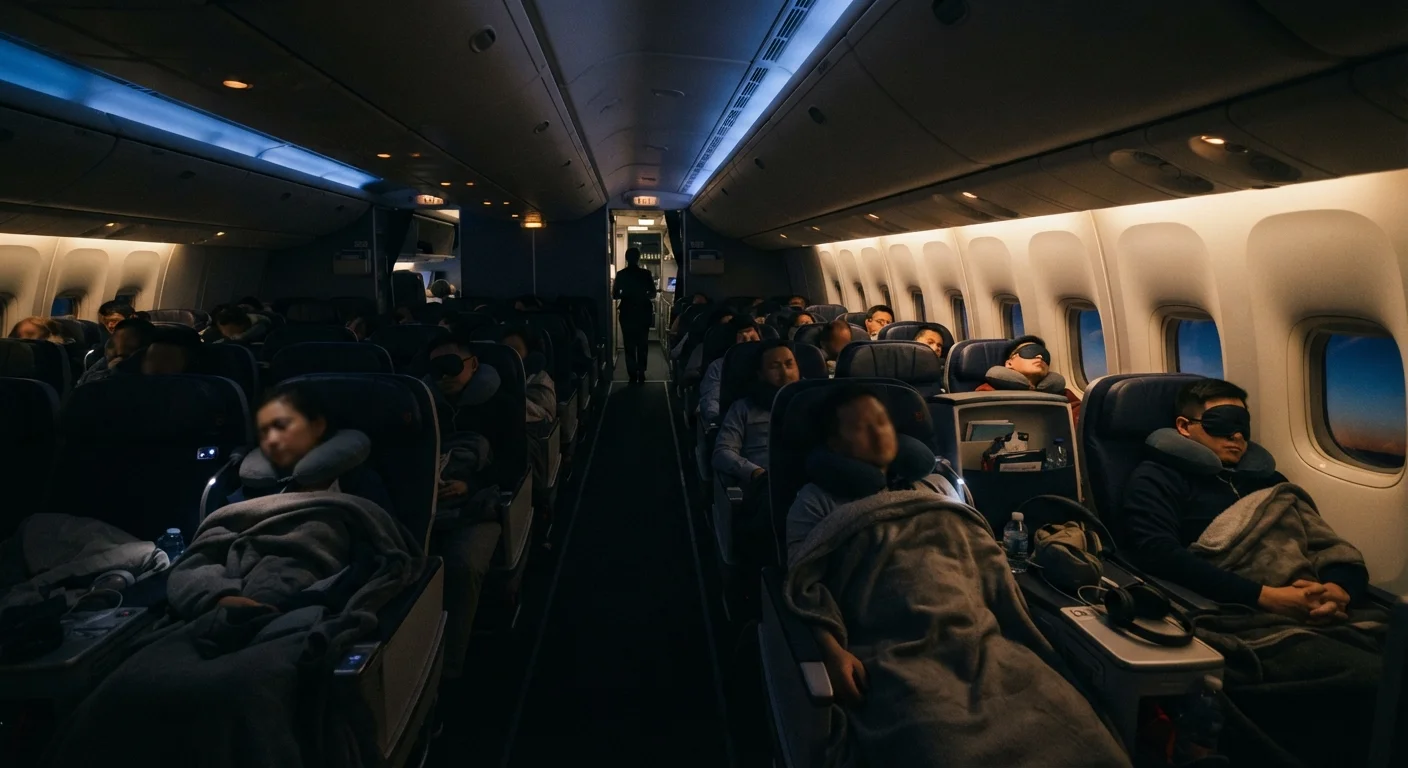
For sleep, blocking out stimuli is more effective than chasing deep rest. A quality eye mask eliminates window light changes and cabin lighting. Noise-canceling headphones or earplugs meaningfully reduce the constant engine drone that keeps your nervous system subtly stimulated. A neck pillow helps prevent the muscle soreness that comes from dozing upright without support. None of these guarantee sleep, but they remove barriers to it.
<20%
Typical cabin relative humidity
Aviation health researchers note that aircraft cabin humidity commonly falls below 20%, compared to the 30–60% range typical in most indoor environments.
6,000–8,000 ft
Equivalent cabin pressurization altitude
Most commercial aircraft cabins are pressurized to simulate conditions at this altitude range, which mildly reduces blood oxygen saturation compared to sea level.
What Doesn't Work as Well as Advertised
Sleeping pills and sedatives are sometimes used by travelers, but their effects in pressurized cabins, combined with reduced mobility and lower oxygen levels, raise concerns that go beyond a normal night at home. These are decisions worth discussing with a physician — not something to experiment with mid-flight for the first time. Over-the-counter sleep aids vary widely in effectiveness and can cause grogginess that lingers well into your arrival day, compounding jet lag rather than easing it.
Melatonin is worth understanding accurately. It's not a sedative — it signals to the body that it's time to sleep based on light cues. On a plane, where light exposure is inconsistent and timing is unclear, melatonin's benefit is modest at best unless used as part of a deliberate, timed jet lag strategy. Understanding how your body clock works is genuinely useful here.
Lavender sprays, "calming" teas, and various wellness supplements have minimal evidence behind them for in-flight use. They're not harmful, but they're also not substitutes for the basics: water, movement, and darkness.
Economy sleep is genuinely limited, not just inconvenient
Upright seating, ambient noise, and cabin lighting cycles combine to make deep, restorative sleep difficult for most passengers regardless of preparation.
Many popular remedies lack strong evidence
Melatonin, herbal teas, and aromatherapy sprays are widely marketed for in-flight use but have limited clinical support for the specific conditions of a pressurized cabin.
Jet lag cannot be fully prevented on the plane
The body's circadian adjustment happens over days, driven by light and meal timing — what you do mid-flight is only one small variable in a larger recovery process.
Sedative use in-flight carries underappreciated risks
Taking sleep medications in an environment with reduced mobility and lower cabin oxygen levels is different from taking them at home — a physician's input is worthwhile before trying this.
Arrival-day functioning is often overestimated
Even with good preparation, most travelers operate at reduced cognitive and physical capacity for the first day or two after a long-haul flight across multiple time zones.
Managing Jet Lag Starts Before You Land
What happens on the plane influences jet lag, but it doesn't determine it. Your body's circadian rhythm — the internal clock that governs sleep, digestion, and alertness — responds primarily to light exposure and meal timing. Shifting your sleep schedule one or two days before a long-haul flight toward your destination's time zone can reduce adjustment time. Jet lag disrupts more systems than most travelers realize, and recovery is rarely instant.
On eastward flights — typically harder for the body to adjust to — it helps to stay awake until local nighttime at your destination rather than napping immediately after arrival. A well-paced itinerary for your first days can accommodate the reality that you'll likely be functioning at 70–80% for your first 24–48 hours, no matter how well you slept on the plane.
A Note on Medical Considerations
Travelers with cardiovascular conditions, a history of blood clots, pregnancy, or chronic illness should consult a healthcare provider before any long-haul flight. This article provides general travel information only and is not medical advice. Compression socks, medication timing, and in-flight activity levels may need to be tailored to individual health circumstances.
Setting Expectations That Actually Serve You
The most underrated long-haul strategy isn't a product or a routine — it's expectation calibration. Travelers who board a twelve-hour flight hoping to sleep eight hours and arrive refreshed are setting themselves up for disappointment. Travelers who plan to get four hours of broken rest, drink consistently, move a few times, and arrive tired-but-functional end up managing the experience far better.
Seat selection matters within the constraints of what's available and affordable. A window seat offers a wall to lean against; an aisle seat allows easier movement without disturbing others. Neither is objectively superior — it depends on your personal priorities. Layovers can be recovery opportunities too, especially if they're long enough to allow a stretch, a meal, or a shower at an airport lounge.
Long-haul travel is one of the most democratizing features of modern life — it makes the world reachable. Treating it as an endurance event to survive rather than a luxury experience to perfect keeps your energy where it belongs: on what waits at the other end.