

Key Takeaways
Why Medication Rules at the Border Catch Travelers Off Guard
Most travelers think of customs as the place where you declare souvenirs and food. Medication rarely crosses their minds — until a border officer pulls a pill bottle from their bag and asks questions they aren't prepared to answer. The reality is that carrying medicine across international borders involves a separate, often poorly understood layer of regulations, and the stakes can range from a brief inconvenience to a genuinely serious legal situation.
The core challenge is that there is no universal global standard for how medications are classified. A drug that is freely available over the counter in the United States may be a tightly controlled substance in Japan, the United Arab Emirates, or Indonesia. Some countries restrict not just opioids and controlled substances but also common items like certain decongestants, codeine-based cough medicines, or even specific herbal supplements. Travelers who assume their US prescription automatically grants them permission to carry medication anywhere are frequently surprised.
This isn't an obscure edge case. The US Centers for Disease Control and Prevention (CDC) and the US State Department both flag medication rules as a common gap in pre-travel preparation. See our guide to common first-time international travel mistakes for other frequently overlooked border rules. A little research before you pack can save you significant stress at the airport.
What you will need
What to Prepare and How to Travel Smoothly
The good news is that preparation is straightforward if you start early. The steps below walk you through everything from documenting your medications to declaring them correctly on arrival. The core principle is simple: documentation, transparency, and advance research are your best tools.
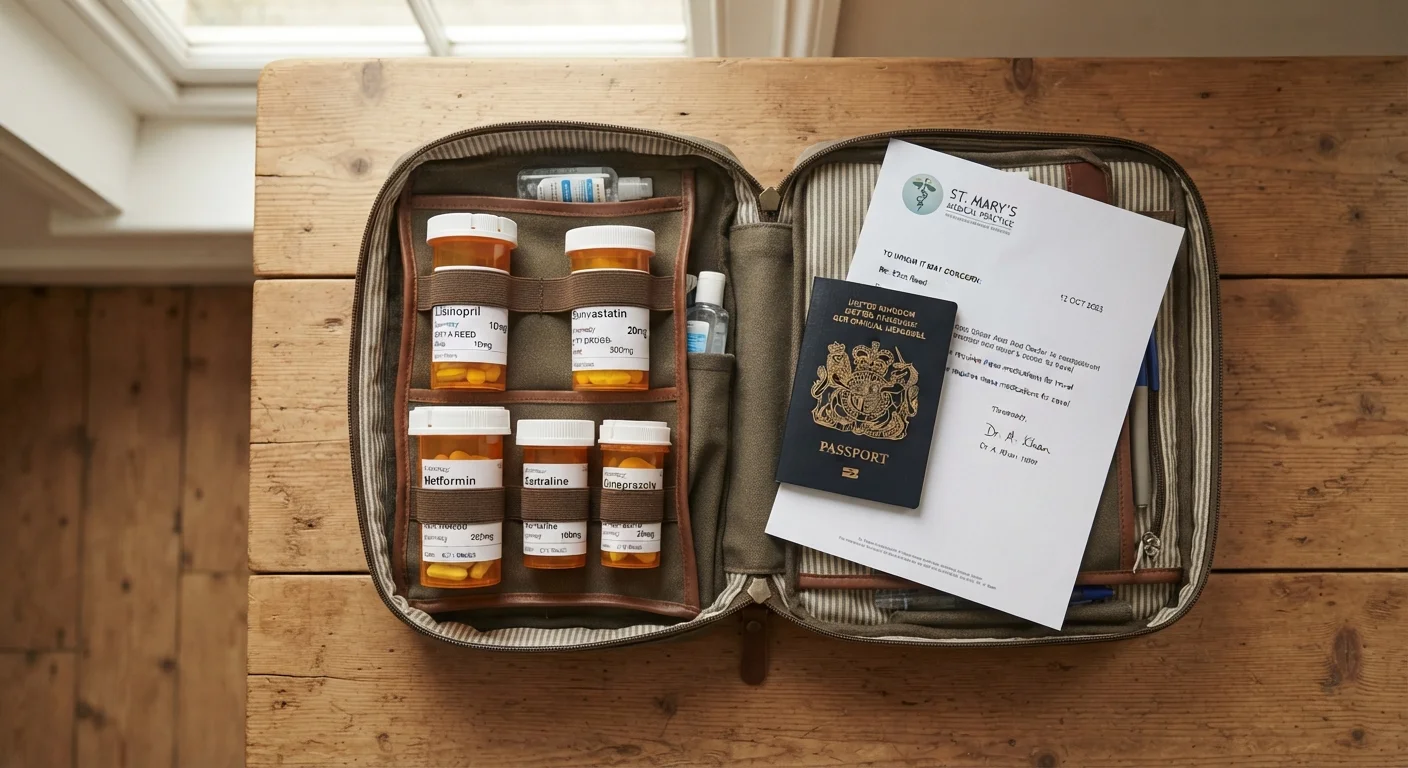
Doctor's Travel Letter
A signed letter on official letterhead listing your medications, dosages, diagnoses, and travel dates — the single most important document for carrying prescription drugs across borders.
Original Pharmacy-Labeled Containers
Keeping medications in their original dispensed containers with the pharmacy label intact helps customs officers quickly verify your prescription status.
Copies of Prescriptions
Printed or digital copies of your actual prescriptions serve as secondary verification and can help you obtain replacements if medication is lost or delayed.
Embassy or Consulate Contact Details
Having the destination country's embassy contact information allows you to confirm entry requirements or obtain an import permit for controlled medications before you travel.
Medication Import Permit
Some countries require a formal import permit for controlled substances; this must typically be obtained in advance through the destination country's health or narcotics authority.
List every medication you plan to carry
Start by writing down every prescription drug, over-the-counter remedy, supplement, and injectable you intend to bring — including vitamins, insulin, inhalers, and topical treatments. Include the generic name, brand name, and dosage for each item. This list becomes the foundation for all subsequent research and documentation.
Research restrictions for every country on your itinerary
Using the generic name of each medication, check the entry and import rules for every country you will visit or transit through. The most reliable sources are the destination country's official embassy website, its national health ministry, or the US Embassy country pages at travel.state.gov. Pay special attention to whether your medication appears on the country's list of controlled or prohibited substances.
Obtain a signed letter from your prescribing doctor
Ask your physician or specialist for a travel letter written on official letterhead. It should include your full name, the names (generic and brand) of all medications, the medical condition being treated, prescribed dosages, the duration of treatment, and the travel dates. Request the letter well in advance — at least two to three weeks before departure — as some practices have delays.
Secure an import permit if required
Certain countries — particularly in the Middle East, Asia, and parts of Europe — require travelers carrying controlled substances (such as opioid pain relievers, certain sedatives, or stimulants) to obtain a formal import permit before arrival. This is typically requested through the destination country's embassy or narcotics authority, and the process can take several weeks. Begin this step as early as possible.
Pack medications correctly for travel
Keep all medications in their original pharmacy-labeled containers. Do not consolidate pills into unmarked cases or weekly pill organizers for international travel — customs officers need to match the physical medication to your documentation. Pack a sufficient supply for your entire trip plus at least five to seven additional days' worth as a buffer for delays. For flights, carry essential medications in your hand luggage rather than checked baggage, which can be lost or delayed.
Declare medications at customs when required
Many countries require travelers to declare medications — particularly controlled substances — on arrival customs forms. When in doubt, declare. Proactively presenting your documentation (doctor's letter, prescriptions, import permit) to customs officers before they ask demonstrates good faith and typically speeds up the process. Concealing medication you are required to declare is treated as a much more serious issue than an honest declaration.
Transit Countries Count Too
Many travelers focus only on their final destination and overlook transit countries where they have a layover. If you change planes in a country that classifies your medication as a controlled substance, you may face issues even if you never leave the airport. Check the rules for every country on your itinerary, not just the last stop.
Use Generic Drug Names When Researching
Brand names for the same medication differ widely between countries. When researching whether a drug is permitted at your destination, look up its generic (chemical) name — for example, sertraline rather than Zoloft. Official government health portals typically list substances by generic name, making your research more reliable. This is also useful if you need to replace medication abroad — our guide on navigating a foreign pharmacy covers that scenario in detail.
Always Verify Rules With Official Sources
Medication regulations change frequently and vary dramatically between countries. The general guidance in this article is educational, not a substitute for checking with the official embassy, consulate, or health authority of every country you plan to visit or transit through. What is legal to carry in the US may be a controlled or banned substance elsewhere — and the consequences of getting it wrong can be serious.
Once you've completed your medication preparation, consider reviewing the full pre-departure travel checklist to make sure your documents, bookings, and health prep are all in order before you leave. For a more health-focused review, the pre-travel health and documents checklist covers vaccinations, prescriptions, and key paperwork in detail.
This article is for general informational purposes only and does not constitute medical or legal advice. Medication regulations vary by country and change over time. Always consult your healthcare provider about your specific medications and verify current entry requirements with the official embassy, consulate, or health authority of every country on your itinerary before you travel.