

Key Takeaways
Why Each Weather Condition Demands a Specific Response
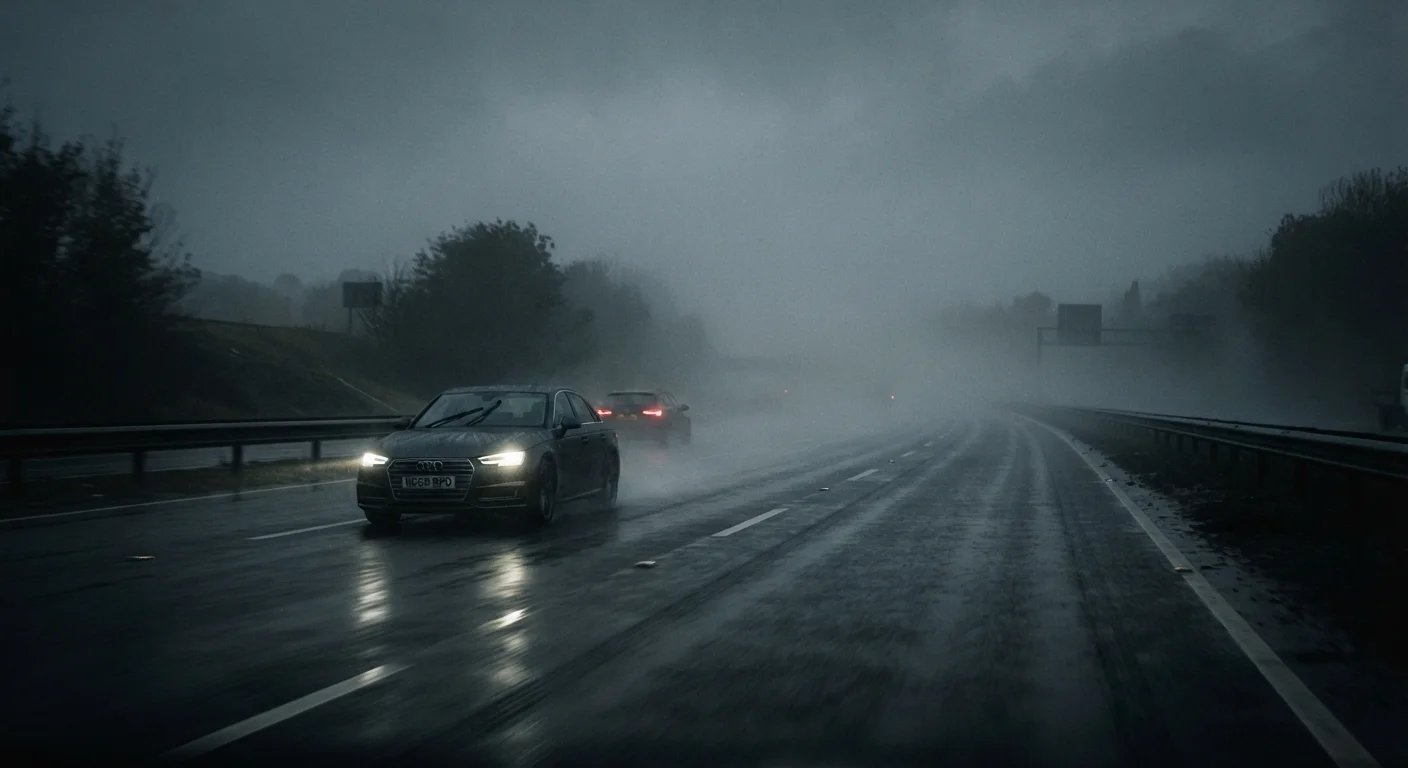
Rain, fog, and ice each create different physical hazards, and the adjustments that help in one condition can be wrong in another. Rain primarily reduces tyre grip and increases stopping distance — hydroplaning (when your tyre rides on a film of water rather than the road surface) is a real risk above roughly 35 mph on flooded roads. Fog is fundamentally a visibility problem: the road surface may be perfectly dry, but your ability to perceive hazards ahead is severely limited. Ice combines both problems — drastically reduced friction and, in freezing fog, near-zero visibility.
Understanding what each condition actually does to your driving environment is the foundation for responding correctly. For a broader framework on how environment shapes safe driving behaviour, see our complete safe driving overview.
Do Not Rely on AWD for Braking on Ice
All-wheel drive improves traction when accelerating but does not shorten stopping distances on ice. Braking physics are the same for all drivetrain types. Drivers of AWD vehicles must still reduce speed and increase following distance on icy roads.
Before You Drive: Setting Up for Poor Conditions
The best time to prepare for bad weather is before it arrives. Worn wiper blades, under-inflated tyres, and dim headlights are manageable inconveniences in sunshine; in a rainstorm or on an icy road, they become serious safety deficits. A thorough vehicle check at the start of each season covers the key systems most affected by changing conditions.
What you will need
Prepare Your Vehicle Before Weather Arrives
Wiper condition, tyre tread depth, and working headlights all matter significantly in poor conditions. Consult the seasonal car maintenance checklist to make sure your vehicle is ready before conditions deteriorate.
What You'll Need
Most adjustments for poor-weather driving are behavioural — they cost nothing and require no special equipment. That said, a few physical items make a material difference, particularly in winter conditions.
Properly Inflated Tyres
Correct tyre pressure maintains the contact patch that provides grip on wet or icy surfaces.
Winter or All-Season Tyres
Provide meaningfully better traction and braking performance in snow and ice compared to summer tyres.
Ice Scraper and Defrost Spray
Clears ice from windshields and mirrors so visibility is fully restored before driving.
Roadside Emergency Kit
Includes reflective triangles, a flashlight, and basic supplies in case you become stranded in poor weather.
Step-by-Step: Adjusting Your Driving
Work through these steps each time conditions deteriorate. They apply whether you are caught in a sudden downpour, driving into a fog bank on the highway, or setting off on a frosty morning.
Check your vehicle before you leave
Before driving in any poor-weather condition, take two minutes to verify that your headlights, taillights, and brake lights are working. Confirm your windshield wipers clear cleanly without streaking, and check that all windows and mirrors are completely cleared of ice, snow, or condensation. A quick look at your tyre pressure is worthwhile too — cold temperatures cause pressure to drop.
Reduce your speed below the posted limit
Speed limits are set for ideal road conditions. In rain, stopping distances increase significantly because wet pavement reduces tyre grip. In fog, your ability to see hazards ahead is cut sharply — by the time a stopped vehicle or pedestrian appears, you may have very little time to react. On ice, stopping distances can be ten times longer than on dry pavement. A meaningful speed reduction — not just a token one — is the single most effective adjustment you can make.
Increase your following distance
The standard two-second following rule applies to dry conditions only. In rain, aim for at least four seconds. In fog or ice, extend this to six seconds or more. Count by watching the vehicle ahead pass a fixed point, then counting until you reach the same point. This gap gives you the reaction and braking time that slick surfaces demand.
Set your lights correctly for the conditions
In rain and reduced visibility, switch on your headlights — even during daylight. In fog, use low-beam headlights and front fog lights if your vehicle has them. High beams scatter off water droplets and actually reduce your effective vision. Rear fog lights should be used only in dense fog (visibility under 328 feet / 100 meters), as they can mask your brake lights from drivers behind you.
Steer and brake smoothly on ice
Ice punishes abrupt inputs. Sudden steering, hard braking, and sharp acceleration all reduce tyre contact and can trigger a skid. Apply brakes steadily and early. If your vehicle has ABS (anti-lock braking system), press the brake pedal firmly and hold it — the system pulses automatically. If you do not have ABS, apply gentle, threshold pressure. In a rear-wheel skid, ease off the throttle and steer gently in the direction you want the front of the car to go.
Know when to pull over or delay your trip
Some conditions — whiteout snow, dense freezing fog, or glare ice — genuinely warrant waiting. If visibility is near zero or you feel your vehicle is consistently struggling for grip, find a safe, well-lit location off the road and wait for conditions to improve. Arriving late is always preferable to not arriving safely. If you do pull over on a highway, move as far from travel lanes as possible, keep hazard lights on, and stay in your vehicle with a seatbelt fastened.
Never Use Cruise Control on Wet or Icy Roads
Cruise control can accelerate the vehicle when it detects a wheel slip, which is the opposite of what you need in a skid. Disengage it entirely whenever road surfaces are compromised by rain, ice, or snow.
Staying Safe Beyond the Basics
Poor-weather driving shares important overlap with other challenging conditions. Reduced visibility from fog has parallels with driving after dark — see how night driving demands its own adjustments for a complementary set of techniques. Fatigue compounds every weather-related risk significantly, since tired drivers react more slowly and make worse judgement calls; understanding how fatigue impairs driving is essential reading before any long trip in bad conditions.
Finally, the habits that serve you well in poor weather — scanning further ahead, keeping larger gaps, staying smooth on the controls — also translate directly to safer driving in ordinary conditions. Every drive is an opportunity to reinforce them.