

| Interim service frequency | Every 6 months or 6,000 miles |
| Full service frequency | Every 12 months or 12,000 miles |
| Major service frequency | Every 2 years or 24,000–30,000 miles |
| Trigger rule | Whichever comes first — time or mileage |
| Most authoritative schedule source | Your vehicle's owner's manual |
| "I" in schedule tables | Inspect the component |
| "R" in schedule tables | Replace the component |
Why Service Schedules Look Confusing (And How to Cut Through It)
Open the maintenance section of most owner's manuals and you'll find a grid of mileage intervals, cryptic abbreviations, and tasks listed in no particular order of importance. It's enough to make many drivers hand the document straight to their mechanic and say, "just do whatever's needed." That's not a bad instinct — but understanding the basics yourself means you can ask better questions, avoid unnecessary upsells, and know whether a quoted job is actually due.
At its core, a manufacturer service schedule answers two questions: what needs to be checked or replaced, and when. The "when" is usually expressed in miles, months, or both — whichever comes first. A typical instruction might read "every 5,000 miles or 6 months." If you drive 3,000 miles in six months, time triggers the service. If you drive 7,000 miles in four months, mileage does.
For a broader overview of what routine upkeep involves, see our routine car maintenance schedule that breaks down oil changes, tyre rotations, and brake checks in plain terms.
| Interim service frequency | Every 6 months or 6,000 miles |
| Full service frequency | Every 12 months or 12,000 miles |
| Major service frequency | Every 2 years or 24,000–30,000 miles |
| Trigger rule | Whichever comes first — time or mileage |
| Most authoritative schedule source | Your vehicle's owner's manual |
| "I" in schedule tables | Inspect the component |
| "R" in schedule tables | Replace the component |
Interim, Full, and Major: What Each Service Level Actually Covers
Most service plans in the US — whether offered by dealerships or independent garages — organize work into tiers. Understanding these tiers helps you compare quotes and spot if something is missing.
Interim Service
Typically due every 6 months or 6,000 miles, this is the lighter of the scheduled visits. It usually includes an engine oil and filter change, a visual inspection of brakes and tires, fluid top-ups (washer fluid, coolant reservoir), and a check of lights and wipers. Think of it as a health check between the deeper visits.
Full Service
Due annually or every 12,000 miles, a full service includes everything in an interim plus a broader sweep: air filter inspection or replacement, cabin (pollen) filter check, spark plug inspection on older intervals, brake fluid condition check, battery voltage test, and a more thorough undercarriage inspection. This is the service most commonly advertised as a standalone package.
Major Service
Intervals vary — commonly every 2 years or 24,000–30,000 miles — but a major service adds the high-wear replacements: spark plugs (if not replaced at full service), timing belt or chain inspection, transmission fluid, coolant flush, and a full brake system service. These jobs cost more because the parts themselves are expensive and labor-intensive to reach.
Service interval
The recommended period between scheduled maintenance visits, expressed in miles, months, or both — whichever occurs first.
Interim service
A lighter scheduled maintenance visit, typically every 6 months or 6,000 miles, covering oil changes, fluid top-ups, and visual inspections.
Full service
An annual or 12,000-mile service that builds on the interim by adding air filter checks, brake fluid condition testing, and a battery assessment.
Major service
A less frequent but more intensive service — often every 2 years or 24,000–30,000 miles — that includes high-wear component replacements such as spark plugs, timing belt inspection, and coolant flush.
Severe driving conditions
A manufacturer classification for driving patterns that accelerate wear, including frequent short trips, towing, extreme temperatures, or dusty environments. Vehicles in these conditions typically require shorter service intervals.
Inspect (I) vs. Replace (R)
Abbreviations used in manufacturer schedules. Inspect means assess the component's condition; replace means swap it out regardless of visible condition because it has reached its service life.
If you're comparing where to get these services done, our breakdown of franchised garages versus independent mechanics covers the practical trade-offs.
Reading the Schedule in Your Owner's Manual
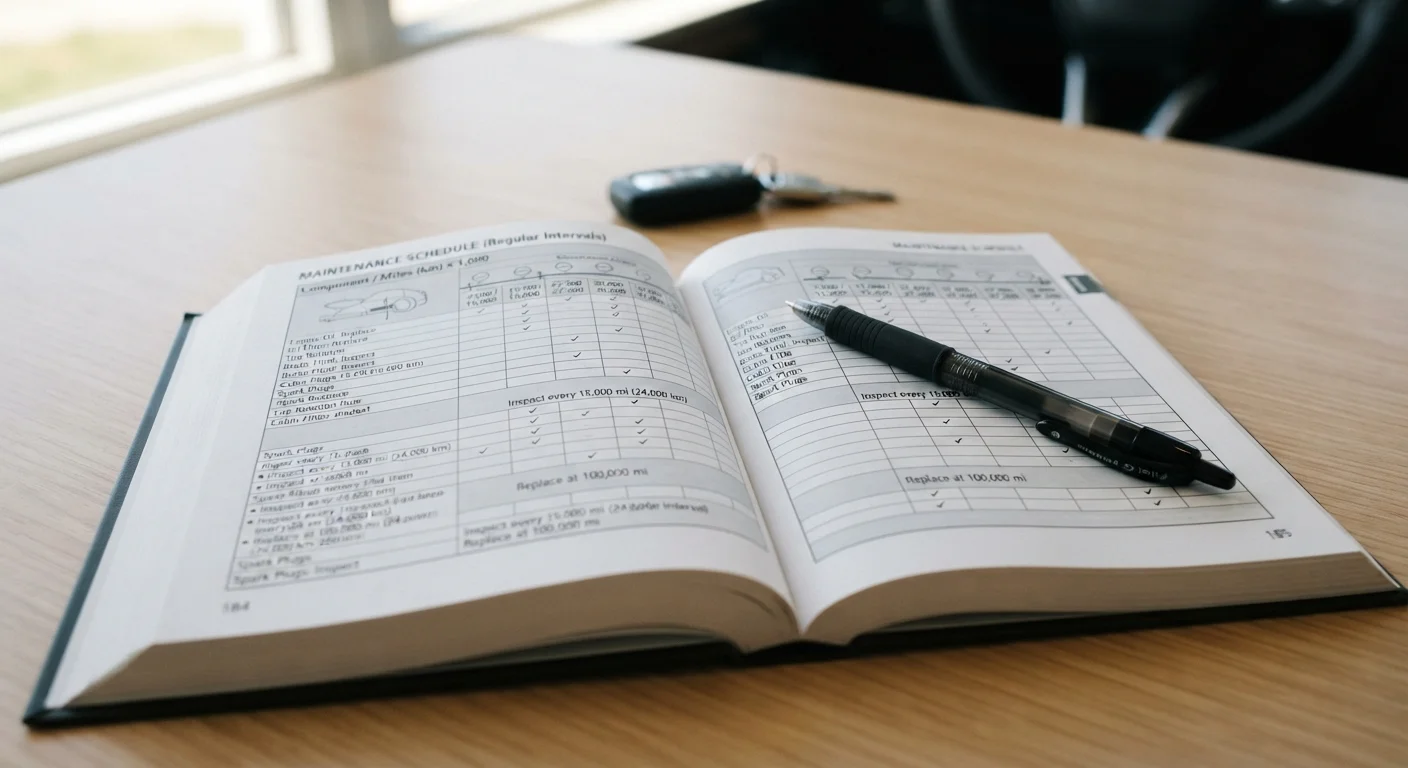
Manufacturer schedules are always more authoritative than any generic service plan. Here's how to read one efficiently:
- Find the maintenance section. It's usually titled "Maintenance Schedule" or "Scheduled Maintenance" and appears toward the rear of the manual.
- Identify your driving profile. Many manuals list two schedules — "Normal" and "Severe" driving conditions. Severe conditions include frequent short trips under 5 miles, towing, dusty environments, or extreme temperatures. City drivers may qualify as severe even if the label feels counterintuitive.
- Match the task to the interval. Tasks are listed in rows; intervals appear across the top or side. An "I" typically means inspect, an "R" means replace, and a "T" means tighten.
- Note which intervals have passed. Cross-reference the schedule with your current mileage and the date of your last service stamp to see what's actually due.
New to ownership and finding all of this overwhelming? Our guide on everything first-time car owners need to know walks through registration, insurance, and service intervals from scratch.
Dealer Schedules vs. Manufacturer Schedules
Some dealerships and service chains offer their own branded service packages that don't map exactly to your manufacturer's schedule. Always cross-reference any proposed service against your owner's manual before agreeing to work. A job listed as "due" by a service provider may be ahead of what the manufacturer actually recommends for your mileage and conditions.
Keeping service costs predictable over time is also about more than just following the schedule — our article on keeping car running costs under control offers practical habits that stretch your maintenance budget further.