

Key Takeaways
Option A
Engineered Wood Flooring
The dimensionally stable, moisture-tolerant modern option.
Best for: Homeowners installing flooring in basements, kitchens, or over radiant heat where moisture and temperature fluctuations are a concern.
Option B
Solid Hardwood Flooring
The timeless, long-lasting classic that can be refinished repeatedly.
Best for: Above-grade living rooms and bedrooms where maximum longevity and the ability to sand and refinish multiple times is the priority.
If you're installing in a basement or over a concrete slab
Engineered Wood Flooring
Engineered wood's layered plywood core resists the moisture vapor that concrete subfloors emit, making it far less likely to warp or cup over time.
If you want a floor that lasts 75–100 years and can be refinished multiple times
Solid Hardwood Flooring
A thick solid hardwood plank can be sanded and refinished numerous times, allowing you to refresh the surface and extend its life across generations.
If you have radiant in-floor heating
Engineered Wood Flooring
Engineered wood is more dimensionally stable under the heat cycling of radiant systems, reducing the risk of gapping or buckling that can affect solid hardwood.
If you're renovating a main-floor living room or bedroom with a wood subfloor
Solid Hardwood Flooring
Above-grade rooms with plywood subfloors are ideal for solid hardwood, where conditions are stable and its refinishing potential adds the most long-term value.
What's the Actual Difference in Construction?
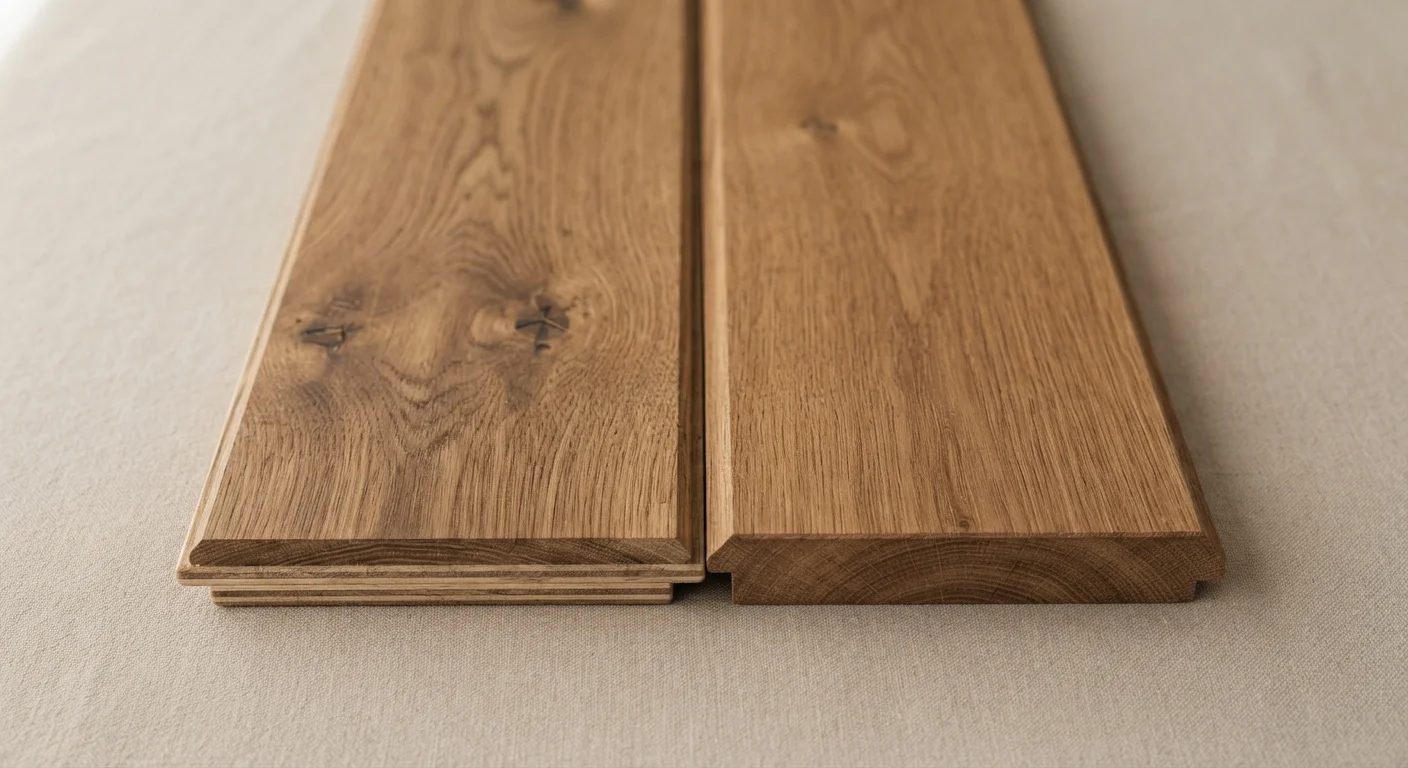
Despite looking almost identical once installed, engineered wood and solid hardwood are built very differently. Solid hardwood is exactly what it sounds like — a plank milled from a single piece of timber, typically three-quarters of an inch thick. Every layer of the board is the same species of wood, from top to bottom.
Engineered wood is constructed from a real hardwood veneer (often 2–6 mm thick) bonded over multiple layers of plywood or high-density fiberboard (HDF). Those cross-directional core layers are what give engineered flooring its defining strength: resistance to swelling, shrinking, and warping when humidity levels shift.
This matters practically. Wood is a hygroscopic material — it absorbs and releases moisture from the surrounding air. Solid hardwood, being uniform in grain direction, expands and contracts as a single unit. Engineered wood's cross-ply construction counteracts that movement, keeping the floor more stable across a wider range of conditions. For a broader look at how wood compares to other natural interior materials, see our guide to natural materials in the home.
Head-to-Head: Key Comparison Criteria
The table below captures the most important practical differences between the two flooring types. Keep in mind that performance can vary by product grade and installation quality — these are general characteristics rather than guarantees.
| Criterion | Engineered Wood | Solid Hardwood |
|---|---|---|
| Core construction | Hardwood veneer over plywood/HDF layers | Single piece of solid timber |
| Moisture resistance | Higher — stable in humid conditions | Lower — prone to swelling and cupping |
| Suitable installation grade | Above, on, or below grade | Above grade only (typically) |
| Radiant heat compatibility | Generally compatible | Limited — manufacturer dependent |
| Refinishing potential | 1–3 times (wear layer dependent) | 5–10 times over lifespan |
| Typical plank thickness | 3/8" to 3/4" | 3/4" standard |
| Installation methods | Float, glue, nail, or staple | Nail or staple (primarily) |
| Expected lifespan | 25–50 years (condition dependent) | 75–100+ years if maintained |
Moisture, Installation, and Where Each Works Best
Room location is one of the most decisive factors in this choice. Solid hardwood is generally not recommended for below-grade installation (basements) or directly over concrete slabs because moisture vapor from concrete can cause the planks to cup, buckle, or separate. Most solid hardwood manufacturers specify installation only on or above grade.
Engineered wood can be installed on, above, or below grade depending on the product's moisture specifications. It can be glued directly to a concrete slab, stapled or nailed to a plywood subfloor, or floated — giving it more installation flexibility overall.
3/4"
Standard solid hardwood plank thickness
This uniform thickness is what allows solid hardwood to be sanded down and refinished multiple times across its lifespan.
2–6 mm
Typical engineered wood veneer thickness
Thicker veneer layers allow for more refinishing cycles; always check the wear-layer spec when evaluating a product's longevity.
Both types can be installed as floating floors, but solid hardwood is more commonly nail-down or staple-down only. If you have radiant heating beneath your floor, engineered wood is the safer choice: the repeated heating and cooling cycles are less likely to cause it to gap or crack.
Refinishing, Longevity, and Practical Costs
One of solid hardwood's most cited advantages is its refinishing potential. Because the plank is solid all the way through, it can typically be sanded and refinished anywhere from 5 to 10 times over its lifespan — enough to restore the surface after decades of wear and to change stain colors entirely when redecorating.
Engineered wood can also be refinished, but its thinner wear layer (the real wood veneer on top) limits how many times this is practical. Thicker-veneer engineered products (4 mm or more) may allow two or three sandings; thinner products may allow only one, or none at all. Check the manufacturer's wear-layer specification before purchasing if refinishing is a priority.
Permits and Professional Installation
Most wood flooring installation does not require a building permit, but work that involves changes to the subfloor structure — such as leveling with self-leveling compound or installing a new subfloor layer — may be subject to local code requirements. If you are unsure, check with your local building department. For large installations or when working over radiant heat systems, consulting a professional flooring installer is advisable to avoid costly mistakes.
On initial cost, engineered wood products vary widely — entry-level engineered flooring can be less expensive per square foot than comparable solid hardwood, but premium engineered products can cost the same or more. Installation labor costs are generally similar for both. Factor in your subfloor type, room grade, and long-term refinishing plans rather than upfront price alone when evaluating overall value.