

Key Takeaways
Our Verdict
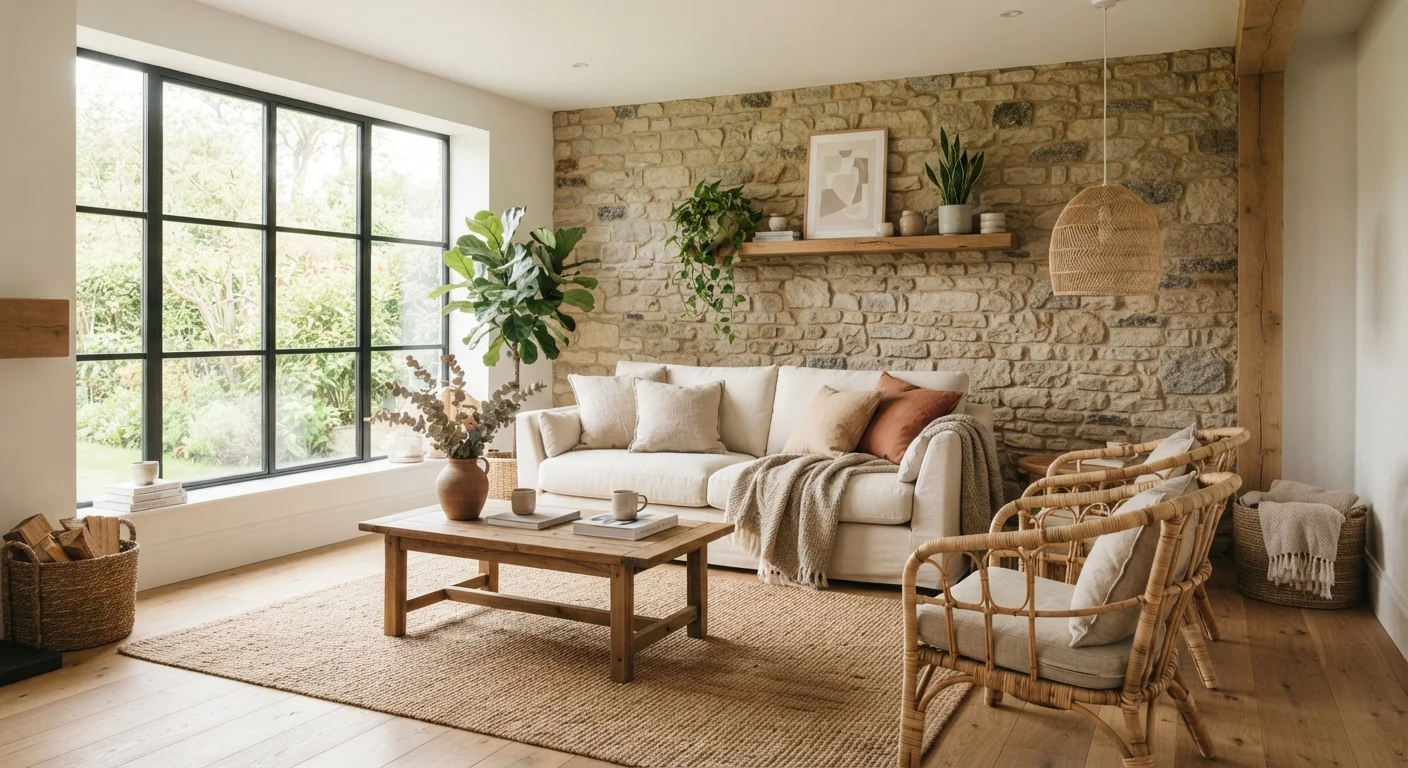
Each of these four natural materials brings something distinct to a home — stone anchors and endures, wood adapts and warms, linen softens and breathes, and rattan adds casual texture at a lower price point. The most livable interiors typically combine two or three of them rather than relying on one alone.
| Best for | Recommended |
|---|---|
| High-traffic areas needing long-term durability | Stone |
| Versatile, warm surfaces across living and sleeping spaces | Wood |
| Soft furnishings and textiles in bedrooms or living rooms | Linen |
| Budget-conscious decorating with a relaxed, organic aesthetic | Rattan |
Why Natural Materials Matter in Interior Design
Natural materials have shaped domestic interiors for centuries — and their popularity hasn't faded. Stone, wood, linen, and rattan each carry a tactile quality that manufactured alternatives struggle to replicate. They age in ways that often add character rather than diminish it, and they tend to integrate well with a wide range of color palettes and design styles.
Choosing between them isn't simply an aesthetic decision. Each material behaves differently under daily use, responds to humidity and temperature in its own way, and requires a distinct maintenance approach. Understanding those differences before you invest is the most practical starting point.
For a broader look at how texture shapes the feel of a room, see our guide on how texture works in interior design. And if you're furnishing a new space from scratch, decorating your first home room by room offers a useful foundation.
Side-by-Side Comparison: Stone, Wood, Linen, and Rattan
The table below compares all four materials across the criteria that matter most to everyday homeowners — from durability and maintenance to cost and versatility.
| Stone | Wood | Linen | Rattan | |
|---|---|---|---|---|
| Durability | Exceptional — decades or more | High with proper finishing | Moderate — softens over time | Moderate — vulnerable to moisture |
| Moisture resistance | High (when sealed) | Low to moderate — varies by type | Moderate — washable but prone to mildew | Low — avoid humid environments |
| Maintenance | Seal periodically; wipe spills promptly | Clean regularly; refinish when worn | Machine wash; iron or steam | Dust regularly; avoid saturation |
| Typical applications | Floors, countertops, feature walls | Floors, furniture, cabinetry, trim | Cushions, curtains, upholstery, bedding | Chairs, baskets, lampshades, shelving |
| Cost range | High — material and installation | Moderate to high | Low to moderate | Low to moderate |
| Design versatility | High in traditional and modern styles | Very high across all styles | High — neutral and adaptable | Moderate — suits relaxed aesthetics |
| Sustainability profile | Quarried; long lifespan offsets impact | Renewable if responsibly sourced | Low-input crop; biodegradable | Fast-growing; generally renewable |
Stone leads on longevity and is essentially immune to scratching and staining when properly sealed. Wood offers the widest range of applications. Linen and rattan serve as finishing layers — softening and warming a space without demanding significant structural commitment.
Stone: Weight, Permanence, and Presence
Stone — whether slate, marble, travertine, or limestone — is the most durable of the four materials. Used as flooring, countertops, or accent walls, it requires little beyond periodic sealing to maintain its appearance over decades. Its thermal mass also means it stays cool in summer, which can be a genuine comfort advantage in warmer climates.
The trade-offs are real: stone is heavy, often expensive to source and install, and difficult to modify once in place. Porous varieties like marble can stain if spills aren't addressed promptly. It's also cold underfoot in winter unless paired with radiant heating.
Sealing Stone Is Non-Negotiable
Most natural stone used in homes — including marble, limestone, and travertine — is porous and will absorb liquids if left unsealed. Apply a penetrating stone sealer at installation and re-seal every one to three years depending on traffic and use. Always test sealers on an inconspicuous area first, as some formulas can slightly alter the stone's appearance.
Stone works best as a considered investment in areas where permanence is a virtue — kitchen countertops, bathroom floors, or a single feature wall. Its pairing with warmer materials like wood or linen prevents a space from feeling clinical.
Wood: Warmth, Adaptability, and Longevity
Wood is arguably the most adaptable natural material in the home. It appears as flooring, furniture, cabinetry, ceiling beams, and decorative trim — and moves between traditional and contemporary styles with ease. Properly maintained hardwood flooring can last generations; solid hardwood can even be sanded and refinished multiple times to remove surface wear.
Moisture is wood's primary vulnerability. Bathrooms and basements require engineered wood rather than solid boards, since engineered products are dimensionally more stable under humidity fluctuations. Our comparison of engineered wood vs. solid hardwood flooring breaks down those differences in detail.
Direct sunlight causes gradual fading in most wood finishes, so south-facing rooms may benefit from UV-filtering window treatments — a topic explored in our article on curtains vs. blinds.
Linen and Rattan: Softness, Structure, and Practical Limits
Linen is a plant-derived textile made from flax fibers. It's breathable, gets softer with each wash, and has a naturally rumpled texture that reads as relaxed rather than sloppy when used intentionally. It's well suited to cushion covers, curtains, bed linens, and upholstery in lower-traffic areas. Linen wrinkles easily and may require more frequent laundering than synthetic alternatives, but it handles repeated washing well and is less prone to pilling than cotton-polyester blends.
Rattan refers to a climbing palm whose cane is woven or bent into furniture frames, baskets, lampshades, and decorative objects. It's lightweight, relatively affordable, and carries a casual, organic aesthetic that suits coastal, bohemian, and transitional interiors. Its primary limitation is moisture sensitivity — prolonged humidity can cause mold or structural weakening, making it a poor choice for bathrooms or uncovered outdoor settings.
Both materials layer well with stone and wood, adding softness without competing visually. For a room built around natural materials, linen and rattan typically function as the finishing layer rather than the structural foundation.
~60%
US homeowners preferring natural finishes
Houzz's annual renovation trend surveys have consistently found that a majority of homeowners cite natural or organic textures as a priority in renovation projects.
25–100 years
Lifespan of hardwood flooring with proper care
Industry guides from flooring associations note that solid hardwood, when refinished periodically, can remain structurally sound for a century in low-moisture environments.