

Key Takeaways
Option A
Curtains
The soft, expressive classic that shapes a room's personality.
Best for: Living rooms, bedrooms, and dining spaces where warmth, sound absorption, and decorative impact are priorities.
Option B
Blinds
The precise, low-maintenance option built for control and durability.
Best for: Kitchens, bathrooms, offices, and any space where moisture resistance, exact light control, or easy cleaning matters most.
If you want a cozy, design-forward bedroom
Curtains
Heavyweight or blackout curtains reduce light, muffle outside noise, and create a warm, layered look that promotes better sleep.
If your priority is a moisture-prone kitchen or bathroom
Blinds
Faux-wood or aluminum blinds resist humidity, wipe clean easily, and won't trap odors or grow mildew the way fabric can.
If you work from a home office and need glare control
Blinds
Adjustable slats let you direct light precisely — reducing screen glare without fully darkening the room throughout the day.
If you're decorating a formal dining or living room
Curtains
Floor-length curtains in linen, velvet, or patterned fabric anchor a room visually and add the softness that hard furnishings can't provide.
If you want maximum versatility from a single window
Curtains
Pairing sheer curtains with a blackout layer gives you the full range from diffused daylight to complete privacy with one simple system.
What Each Treatment Actually Does
Curtains are fabric panels hung from a rod, typically running floor to ceiling or window-frame to sill. They control light primarily through fabric weight and lining — a sheer panel filters glare while preserving views, while a thermal-lined or blackout curtain blocks nearly all incoming light. Beyond light management, curtains add acoustic softness: fabric absorbs sound rather than reflecting it, which meaningfully reduces echo in hard-surfaced rooms.
Blinds are rigid or semi-rigid coverings made from slats (horizontal or vertical) or a single rolled sheet. Materials include aluminum, faux wood, real wood, vinyl, and fabric. Their key advantage is adjustability — you can tilt slats to redirect light while maintaining privacy, something most curtains can't replicate. Blinds also sit closer to the glass, making them less intrusive in small spaces or on windows with shallow sills.
Understanding these functional differences is the foundation of any window-treatment decision. Consider pairing your window choice with a broader room refresh — our room-by-room décor audit can help identify where window treatments are holding a space back.
| Criterion | Curtains | Blinds |
|---|---|---|
| Light control | Depends on lining weight | Precise via adjustable slats |
| Moisture resistance | Low (fabric absorbs humidity) | High (especially faux wood, aluminum) |
| Sound absorption | Good — fabric dampens echo | Minimal |
| Ease of cleaning | Machine wash or dry-clean | Wipe down with damp cloth |
| Insulation value | Good with thermal lining | Moderate (cellular shades best) |
| Decorative impact | High — adds softness and texture | Low-profile, streamlined look |
| Space required | Needs rod clearance and wall space | Fits inside or outside frame |
| Privacy | Full when closed | Adjustable without full closure |
Room-by-Room Guidance
Living rooms benefit most from curtains. The space is typically dry, decoratively important, and used for relaxing — all conditions where fabric's warmth and sound absorption shine. Full-length panels in linen, cotton, or velvet create visual height and anchor the seating area. If privacy isn't a concern, sheer curtains let natural light pour in without sacrifice. For material inspiration, see how linen and rattan compare with other natural home materials.
Bedrooms are where blackout curtains deliver their clearest value. Lined curtains reduce early morning light, deaden street noise, and contribute to thermal comfort. If your bedroom doubles as a media space, consider layering sheer blinds under blackout curtains for daytime flexibility.
Kitchens demand moisture and grease resistance. Fabric curtains near a stovetop trap cooking odors and are genuinely difficult to clean. Faux-wood or aluminum blinds are the practical answer — they wipe down in seconds and tolerate steam without warping. Real wood blinds, while attractive, can warp over a sink or near a dishwasher.
Bathrooms follow the same logic. Humidity is the primary concern. Aluminum mini blinds or moisture-rated roller blinds are far more durable than fabric in a shower-adjacent setting. If aesthetics matter, waterproof Roman shades in moisture-resistant fabric offer a middle path.
Home offices call for adjustable light control. Cellular shades (a type of blind) provide insulation while diffusing harsh direct sun — a combination that reduces eye strain across long working hours.
~30%
Heat loss through uninsulated windows
The U.S. Department of Energy estimates that windows account for roughly 25–30% of residential heating and cooling energy use, making treatment choice a meaningful factor in comfort.
6–12 in
Recommended rod overhang per side
Interior design guidelines consistently recommend extending curtain rods 6 to 12 inches beyond the window frame on each side to maximize perceived window size and light when panels are open.
3x
Fabric fullness for a gathered look
A general rule in soft-furnishings guidance is to use fabric that is two to three times the width of the rod for curtains to appear full and structured rather than flat.
Layering Both for Maximum Flexibility
The most versatile window treatments layer curtains over blinds. In practice, this means installing blinds for precise daytime light management — tilting slats to reduce glare without closing the room — then drawing curtains for privacy, warmth, or a fully darkened sleep environment at night. This approach also helps with insulation: blinds reduce radiant heat gain from glass, while heavy curtains trap a still-air buffer between fabric and window.
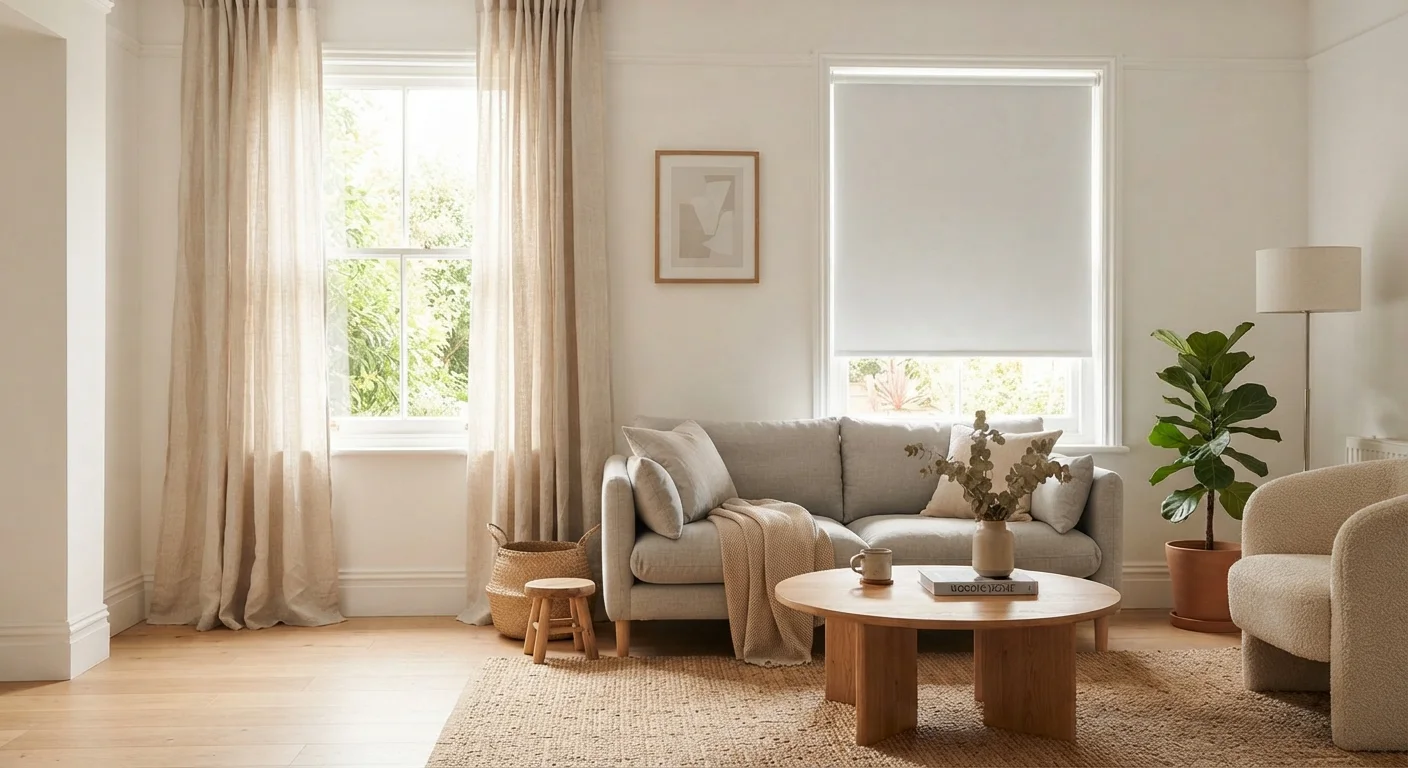
From a design standpoint, layering also creates visual depth. A neutral roller blind paired with patterned curtain panels adds dimension that a single treatment rarely achieves. Just be sure the curtain rod extends well beyond the window frame (typically 6–12 inches on each side) so the panels stack off the glass when open, keeping the view unobstructed.
If the broader decorating picture matters to you, paint finish choice interacts with window treatment decisions too — a matte wall behind a curtained window reads differently than a satin finish that reflects daylight.
This article is for informational purposes only. Costs, product availability, and installation requirements vary by region; always verify specifics with a qualified retailer or installer before making decisions.