

Key Takeaways
Option A
Fixed Expenses
The predictable, non-negotiable costs you can plan around.
Best for: Building a reliable spending baseline and simplifying monthly financial planning.
Option B
Variable Expenses
The flexible costs that shift with your habits and choices.
Best for: Identifying the portion of your budget where behavioral changes can free up money.
If you want to build a dependable monthly budget floor
Fixed Expenses
Fixed expenses give you a firm, unchanging baseline to anchor your budget. Knowing this number up front removes guesswork and makes planning far more reliable.
If you need to find room to save more money each month
Variable Expenses
Variable expenses are where behavioral changes have the most impact. Trimming discretionary spending here is often the fastest path to freeing up cash.
If your income changes month to month
Variable Expenses
On an irregular income, scaling variable costs up or down gives you the flexibility fixed obligations cannot. Understanding these expenses is especially critical for freelancers.
What Makes an Expense 'Fixed'?
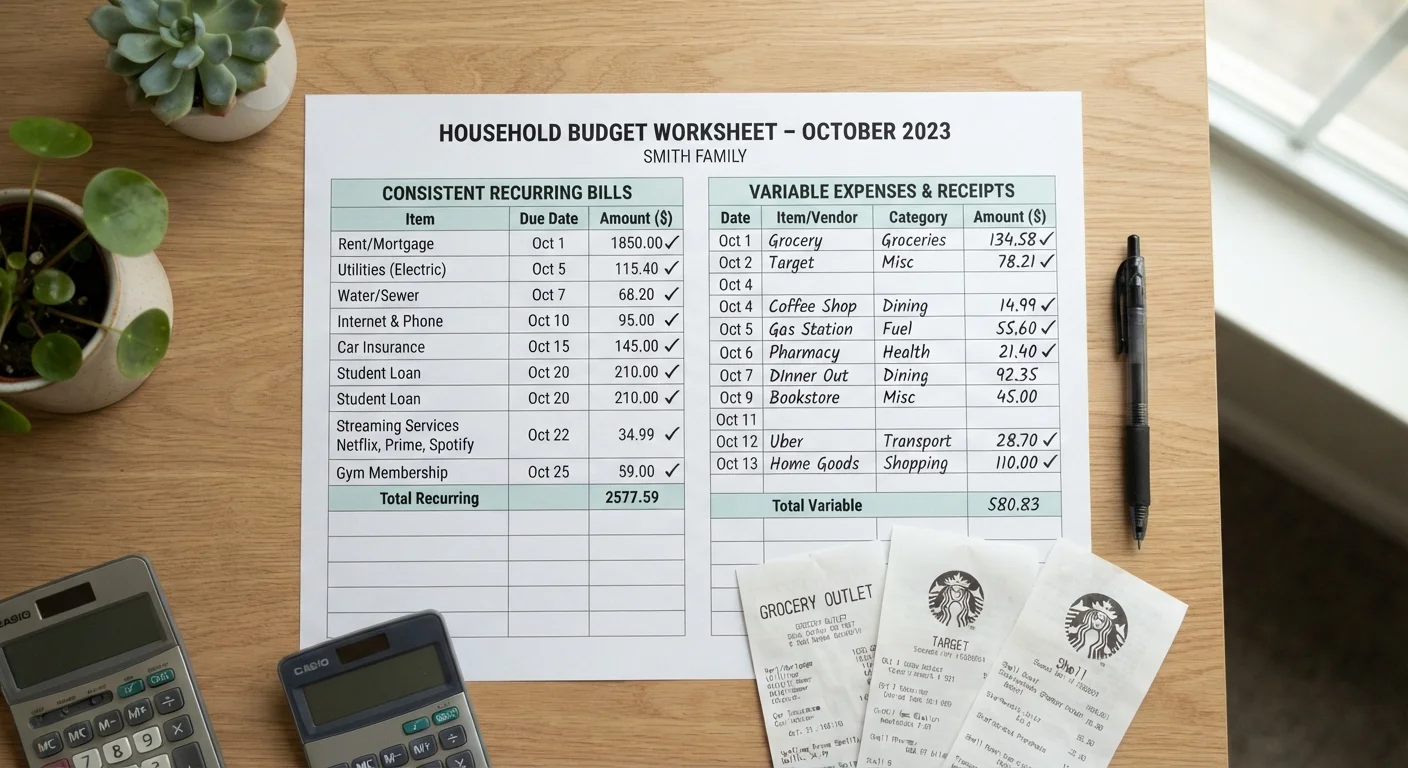
A fixed expense is any cost that stays the same amount every billing cycle, regardless of how much you use a service or how your life changes month to month. Classic examples include rent or mortgage payments, car loan installments, insurance premiums, and subscription services billed at a flat rate.
Because fixed expenses are predictable, they form the structural floor of your budget — the minimum you must spend before anything else. Financial educators often recommend listing all fixed expenses first when building a budget, precisely because this number doesn't change and gives you a reliable anchor.
One important nuance: fixed doesn't mean permanent. A lease ends, a car gets paid off, or you renegotiate an insurance policy. Over longer time horizons, these costs can and do change — but within a given month, you can treat them as set in stone.
This article is for general informational and educational purposes only. It is not personalized financial advice. Consult a qualified financial professional for guidance specific to your situation.
What Makes an Expense 'Variable'?
A variable expense is any cost that changes from month to month based on usage, decisions, or circumstances. Groceries, gasoline, dining out, entertainment, clothing, and household supplies all fall into this category. Even utility bills — electricity and water — are often considered variable because consumption drives the amount.
Variable expenses are where your behavior has the most direct financial influence. Choosing to cook at home more often, carpooling, or skipping a streaming upgrade are all decisions that show up immediately in this side of your spending. That's both a challenge and an opportunity: these costs require more monitoring, but they also offer genuine room to flex.
| Criterion | Fixed Expenses | Variable Expenses |
|---|---|---|
| Amount each month | Same every cycle | Changes with usage or choices |
| Examples | Rent, car payment, insurance | Groceries, gas, dining out |
| Predictability | High — easy to plan around | Low — requires ongoing tracking |
| Short-term flexibility | Very limited | High — behavior drives the cost |
| Role in budgeting | Sets the spending baseline | Reveals room to save or cut |
| Crisis response | Hard to reduce quickly | Can be scaled down immediately |
For readers managing an unpredictable paycheck, understanding variable costs is especially critical. Our guide on budgeting on an irregular income walks through how to plan when your income itself is the variable.
The Gray Zone: Semi-Fixed Expenses
Not every cost fits neatly into either bucket. Semi-fixed expenses — sometimes called semi-variable — have a predictable base component but can rise based on usage. A cell phone plan with data overage charges, a heating bill that spikes in winter, or a gym membership with optional add-on classes all share this hybrid nature.
When Utilities Straddle Both Categories
Electric, gas, and water bills are often listed as variable expenses because consumption determines the amount. However, many people find it helpful to budget a fixed estimate based on their 12-month average, then treat any excess as a variable overage. This hybrid approach smooths out seasonal swings and prevents budget surprises during peak usage months.
Treating semi-fixed costs as variable is generally the safer budgeting approach. Estimating slightly higher than the base rate builds in a buffer and prevents shortfalls when usage climbs. Over several months, you'll develop a realistic average that makes planning easier.
Why the Distinction Matters for Your Budget
Separating fixed from variable expenses isn't just an accounting exercise — it changes how you make financial decisions. When you know exactly which costs are locked in, you can immediately see how much discretionary income you actually have left over. That clarity is the starting point for any meaningful savings strategy.
~33%
Of take-home pay consumed by housing alone
The U.S. Bureau of Labor Statistics Consumer Expenditure Survey consistently shows housing as the single largest fixed expense category for American households.
15–20%
Typical share of budget that is discretionary variable spending
Common budgeting frameworks, including the widely cited 50/30/20 guideline, identify wants and flexible expenses as accounting for roughly this share of after-tax income.
It also sharpens your response to financial pressure. If your income drops unexpectedly, you can't quickly renegotiate your rent, but you can scale back dining out, pause non-essential subscriptions, or delay a clothing purchase. Knowing which costs are movable in a crisis is genuinely useful information.
Categorizing your spending also sets the stage for more advanced budgeting methods. Our comparison of zero-based vs. envelope budgeting shows how both approaches rely on this same underlying distinction to assign every dollar a purpose. And once you've categorized your spending, pairing that framework with a tracking tool helps close the loop — see the difference between a budget and a spending tracker for how both tools complement each other.
For a practical next step, categorizing your spending into needs, wants, and savings builds naturally on this fixed/variable foundation and helps you decide where each dollar truly belongs.