

Key Takeaways
Diversification
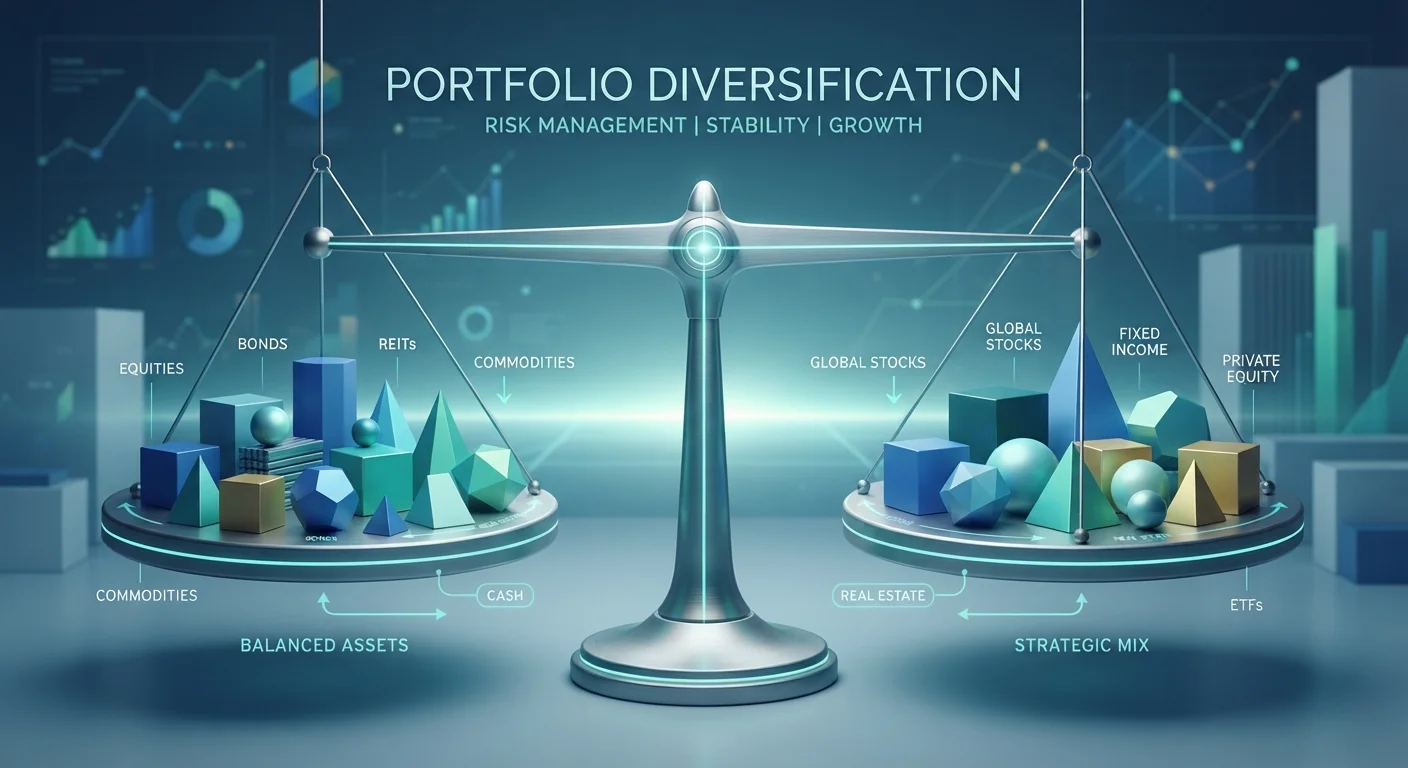
Diversification is the practice of spreading your investments across different types of assets, industries, or geographic regions so that a loss in one area doesn't wipe out your entire portfolio. The core idea is that different investments tend to respond differently to economic events. When some go down, others may hold steady or rise, softening the overall blow to your savings.
In portfolio theory, diversification works by combining assets with low or negative correlations — meaning they don't move in lockstep — which can reduce overall portfolio volatility without necessarily sacrificing expected returns.
The Core Idea: Don't Put All Your Eggs in One Basket
Most people have heard the old saying: don't put all your eggs in one basket. Diversification is simply the financial version of that wisdom, applied to investing.
If you put all your money into a single company's stock and that company struggles — due to poor management, a product recall, or an industry downturn — your entire investment suffers. But if your money is spread across dozens of companies in different industries, one failure becomes a much smaller setback rather than a financial crisis.
This isn't just folk wisdom. It's a well-established principle in investing, grounded in how markets behave. Different assets — stocks, bonds, real estate, commodities — tend to react differently to economic conditions. When one category is under pressure, another may be stable or growing. That natural variation is what makes diversification effective.
To understand why diversification matters so deeply, it helps to understand what it's protecting against. See our explainer on risk and return for the full picture on how these two forces are always in play.
~30
Stocks needed for meaningful diversification benefit
Classic portfolio theory research, including work associated with studies of random diversification, has suggested that a portfolio of around 20–30 uncorrelated stocks captures the bulk of diversification's risk-reduction benefit within a single market.
~50%
Portfolio volatility reduction from basic diversification
Academic research in portfolio theory has long demonstrated that moving from a single stock to a well-diversified portfolio can roughly halve the volatility attributable to individual company (unsystematic) risk.
What Can You Actually Diversify Across?
Diversification isn't just about owning lots of stocks. There are several distinct dimensions where spreading risk adds value:
- Asset classes: Stocks, bonds, cash equivalents, and real estate behave differently under various economic conditions. Combining them creates a more balanced portfolio.
- Sectors and industries: Technology, healthcare, energy, and consumer goods all respond to different market forces. Owning companies from multiple sectors reduces exposure to a single industry's downturn.
- Geographic regions: Domestic and international investments respond to different economic cycles, currencies, and political environments. Spreading globally adds another layer of protection.
- Company size: Large established companies (large-cap) and smaller growth-oriented firms (small-cap) behave differently. Including both can smooth out volatility.
The most practical way many investors achieve broad diversification is through index funds or exchange-traded funds (ETFs). These instruments hold hundreds or even thousands of individual securities in a single product, providing instant diversification without requiring you to hand-pick assets yourself.
What Diversification Can and Can't Do
It's important to have realistic expectations. Diversification is a powerful risk-management tool, but it has real limits.
What it can do: reduce the damage caused by any individual investment failing. It can smooth out the ups and downs of your portfolio over time, making the ride less volatile — which matters enormously for investors who might panic and sell at the wrong moment.
What it cannot do: protect you from a broad market collapse. When a financial crisis hits the entire system — as in 2008 or the early weeks of the COVID-19 pandemic — nearly all asset classes fall together. This is called systematic risk, and no amount of diversification fully eliminates it.
That's why thinking clearly about your personal risk tolerance matters just as much as diversification itself. Knowing how much volatility you can genuinely handle — emotionally and financially — should shape how you build your portfolio.
A Simple Starting Point for New Investors
If you're just getting started and the idea of building a diversified portfolio feels overwhelming, a broad market index fund can do the heavy lifting automatically. These funds spread your investment across hundreds of companies in a single, typically low-cost product. It's worth reading about common investing myths before you begin, so you start with accurate expectations rather than misconceptions.
This article is for general informational and educational purposes only and does not constitute personalised financial, investment, or tax advice. Consider consulting a qualified financial adviser before making decisions about your own investments.