

Key Takeaways
Risk-Return Trade-off
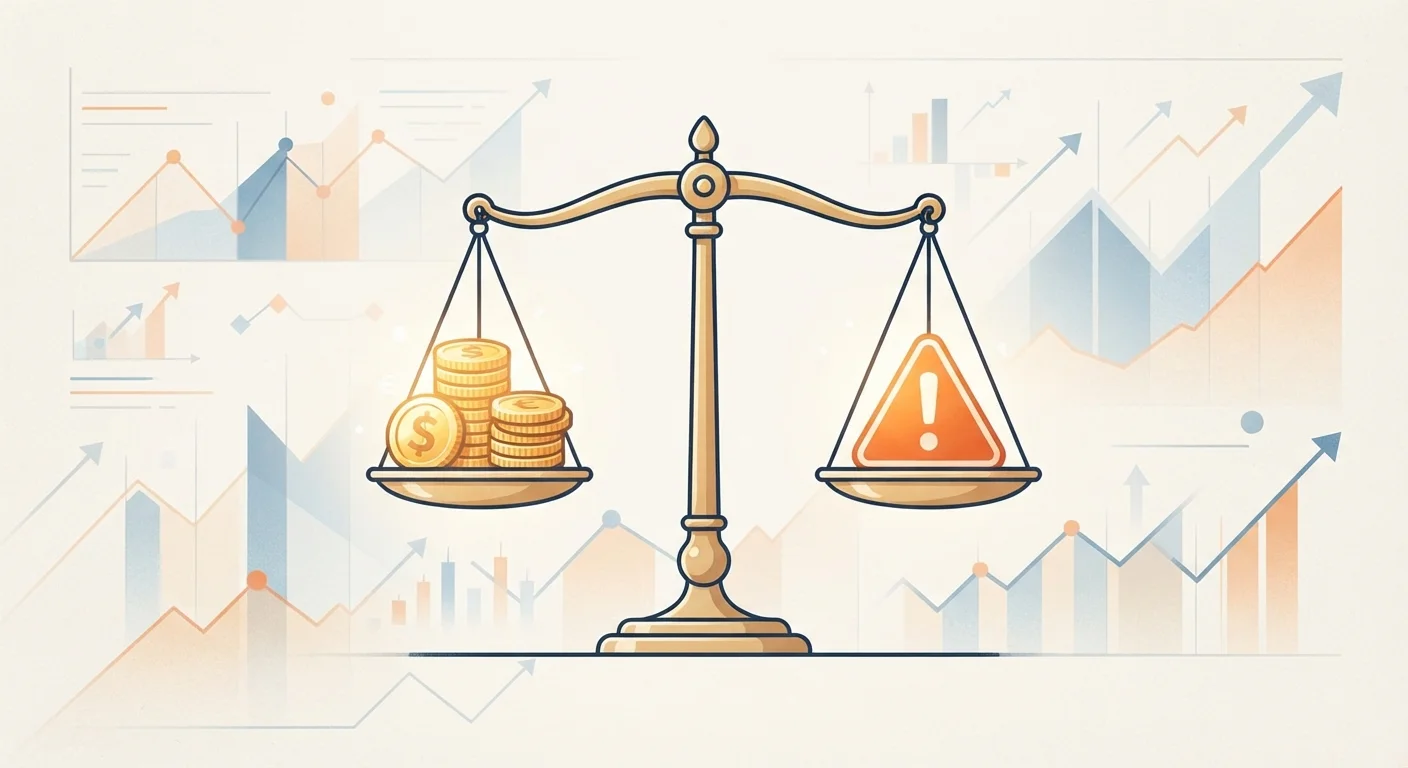
The risk-return trade-off is a fundamental investing principle stating that the potential for higher returns comes with a higher chance of losing money. In other words, safer investments tend to offer lower rewards, while higher-reward opportunities carry greater uncertainty. Understanding this relationship helps investors make choices that match their personal financial goals and comfort with uncertainty.
In portfolio theory, this relationship is often expressed through the concept of the 'efficient frontier' — the set of portfolios that offer the maximum expected return for a given level of risk, as developed by economist Harry Markowitz.
The Core Idea: Higher Reward Demands Higher Risk
When you put money into any investment, you're making a trade-off. You're exchanging the certainty of having that money today for the possibility of having more of it in the future — but that future is never guaranteed. This is the essence of the risk-return trade-off, and it underpins every financial market on earth.
Think of it on a spectrum. On one end sit low-risk options: federally insured savings accounts, U.S. Treasury bills, certificates of deposit. These preserve your money reliably but grow it slowly. On the other end sit higher-risk assets: individual stocks, emerging market funds, speculative assets. These can deliver strong gains — but they can also lose significant value, sometimes quickly.
The market essentially prices this uncertainty. Investors willing to accept more volatility demand a higher potential reward in exchange. If a risky asset offered the same expected return as a risk-free one, rational investors would simply choose the safer option every time. The higher potential return is the incentive for taking on uncertainty.
“The essence of investment management is the management of risks, not the management of returns.”
— Benjamin Graham, Author of 'The Intelligent Investor' and widely regarded as the father of value investing
Types of Risk Every Investor Should Recognize
Risk isn't one-dimensional. Understanding its different forms can help you make more informed choices rather than treating all risk as identical.
- Market risk: The possibility that the overall market declines, pulling your investments down with it. This affects nearly all assets to some degree.
- Inflation risk: The risk that your returns don't keep pace with rising prices, eroding your real purchasing power over time — a real concern even for "safe" cash holdings.
- Concentration risk: Putting too much into one asset, sector, or geography, so a single downturn causes outsized damage to your portfolio.
- Liquidity risk: The possibility that you can't sell an investment quickly without significantly affecting its price.
- Time horizon risk: Being forced to sell during a market downturn because you need the funds sooner than expected.
Understanding market volatility is especially useful here — what looks alarming in the short term often looks very different across a decade.
~10%
Average annual U.S. stock market return (historical)
The S&P 500 has historically averaged roughly 10% annual returns before inflation over the long term, though individual years vary dramatically and past performance does not predict future results.
~20%
Single-year S&P 500 decline in a bad year
In years of significant downturns, broad U.S. stock indexes have lost around 20% or more of their value, illustrating the real downside potential that accompanies long-term return expectations.
Risk Tolerance: Matching Investments to You
Knowing that risk and return are linked is only useful if you can apply it to your own situation. That's where risk tolerance comes in — a measure of how much uncertainty you can realistically accept, both financially and emotionally.
Two people with identical incomes might have very different risk tolerances. One may have dependents, a shorter timeline before retirement, or simply find market swings deeply stressful. The other may have decades ahead and feel comfortable watching values fluctuate. Neither approach is wrong — the goal is to build a portfolio you can stay committed to through difficult stretches.
A few questions worth reflecting on:
- How many years until you'll need this money?
- Could you absorb a significant short-term loss without derailing your financial life?
- Would a sharp market drop make you want to sell everything?
Your honest answers help define where on the risk spectrum your investments should sit. If you're still building the foundation, understanding the difference between saving and investing is a good place to start.
Reassess Your Risk Tolerance Over Time
Your risk tolerance isn't fixed for life. Major life changes — a new job, a growing family, approaching retirement — can all shift how much risk is appropriate for you. Periodically reviewing your investment mix ensures it stays aligned with where you are now, not where you were when you started investing.
Managing the Trade-off Without Eliminating It
You can't eliminate the risk-return trade-off — but you can manage how it affects your portfolio. The most widely recognized approach is diversification: spreading investments across different asset classes, sectors, and geographies so that a loss in one area doesn't devastate the whole. Diversification is a core investing principle precisely because it addresses concentration risk without requiring you to avoid markets altogether.
Time is another powerful tool. Investors with longer horizons have historically had more opportunity to recover from downturns — though this is not a guarantee, and past market behavior does not predict future results.
It also helps to be skeptical of anything that claims to offer high returns with minimal risk. Such promises are a hallmark of schemes that don't hold up. Common investing myths often center on exactly this misunderstanding — the idea that there's a secret path to big gains without meaningful risk.
Managing the trade-off well means making deliberate choices aligned with your goals and circumstances — not chasing the highest return, and not avoiding all risk out of fear. Consulting a licensed financial adviser can help you find the balance that fits your situation.
This article is for general informational and educational purposes only and does not constitute personalized financial, investment, tax, or legal advice. Investing involves risk, including the possible loss of principal. Always consult a qualified financial professional before making decisions based on your individual circumstances.