

Key Takeaways
Saving vs. Investing
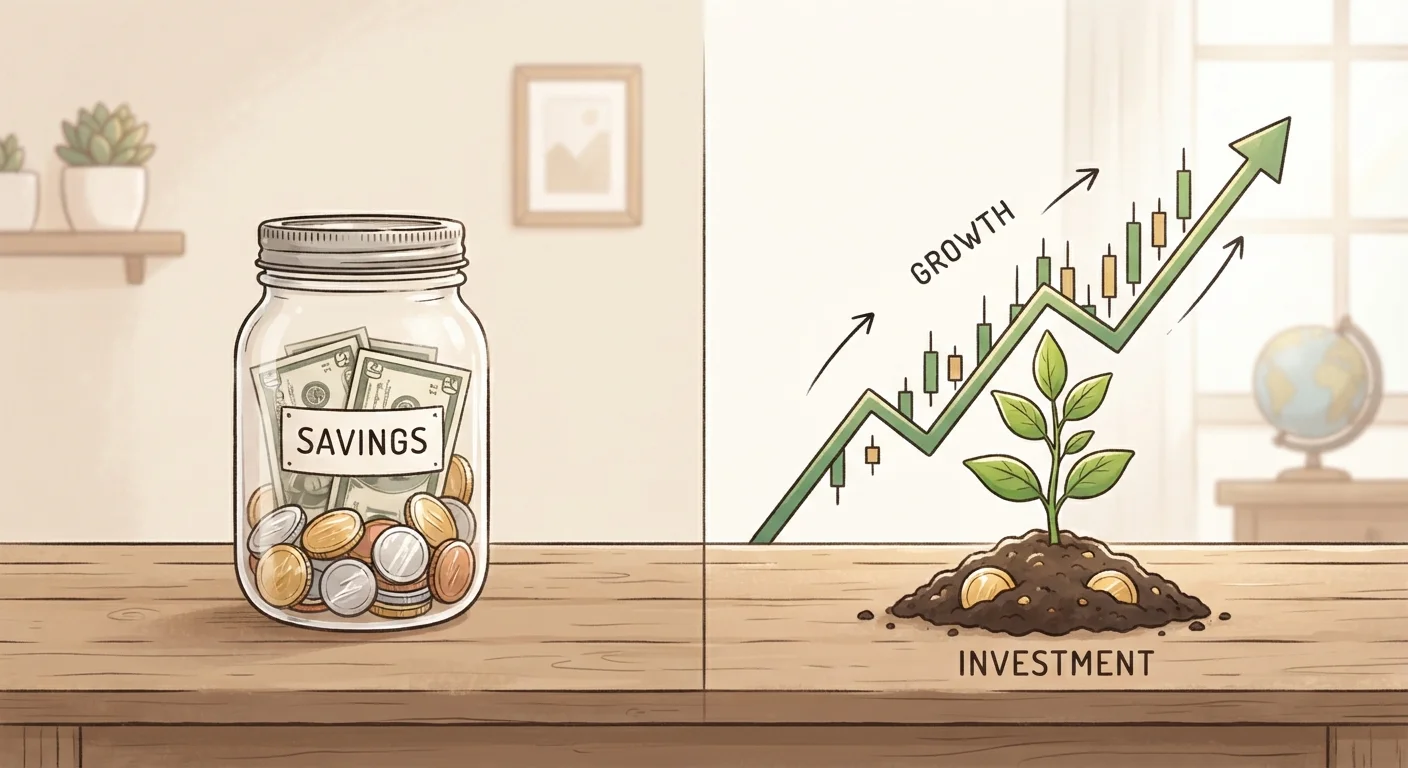
Saving means setting aside money in a secure, accessible place — like a bank account — where its value stays stable. Investing means putting money into assets such as stocks or bonds with the expectation of growth over time, but with the acceptance of some risk. Both build financial security, but they do it in different ways and for different purposes.
In finance, saving is associated with capital preservation and liquidity, while investing involves deploying capital into instruments that carry varying degrees of market risk in exchange for potential returns above inflation.
Two Tools, Two Purposes
Saving and investing are both ways to do something productive with your money — but they operate on entirely different principles. Treating them as interchangeable is one of the most common early financial mistakes, and it can cost you in ways that aren't immediately obvious.
Saving is about protection and access. When you save, you place money somewhere secure — a checking account, a savings account, or a similar low-risk vehicle. That money doesn't grow much, but it also doesn't shrink. You can reach it quickly when you need it.
Investing is about growth over time. When you invest, you put money into assets — such as stocks, bonds, or mutual funds — that have the potential to increase in value. That potential comes with a trade-off: your balance can go down as well as up, sometimes significantly. Investments are generally meant to stay untouched for years, or even decades.
Understanding this distinction early gives you a clearer framework for every financial decision ahead. See our budgeting basics hub for guidance on building the foundation that makes both saving and investing possible.
Why the Difference Matters in Practice
The stakes of confusing saving and investing become clear fast when life gets expensive. If your emergency fund is tied up in a brokerage account and the market drops 20% the week your car breaks down, you face a painful choice: withdraw at a loss or go without the repair.
On the flip side, keeping money you don't need for 20 years sitting in a savings account earning minimal interest means you're almost certainly losing ground to inflation — the slow, steady rise in the cost of goods and services that erodes purchasing power over time.
~0.5%
Average U.S. savings account interest rate
According to the FDIC, the national average deposit rate for savings accounts has historically hovered well below 1%, often failing to keep pace with inflation.
~10%
Historical average annual U.S. stock market return
The broad U.S. stock market has historically averaged roughly 10% annually before inflation, though past performance does not guarantee future results and individual years vary widely.
56%
Americans who own stocks in some form
Gallup polling has consistently found that roughly half to slightly more than half of U.S. adults participate in the stock market, including through retirement accounts like 401(k)s.
The practical takeaway: money you'll need within the next one to three years belongs in savings. Money you won't need for five or more years is generally a candidate for investing — with the understanding that markets fluctuate. This isn't a rigid rule, but it's a useful starting framework endorsed by most financial educators.
For a deeper look at how growth compounds over long periods, our plain-language explainer on compound interest breaks down exactly why time in the market matters so much.
How Saving and Investing Work Together
The goal isn't to choose one over the other — it's to use both strategically, in the right proportions, at the right time.
Use Separate Accounts for Clarity
Keeping your savings and investment accounts separate — and labeled by purpose — makes it easier to avoid accidentally tapping long-term funds. Many banks and brokerages allow you to nickname accounts (e.g., 'Emergency Fund' or 'Retirement 2045') to reinforce their intended use.
A common sequence that many financial educators recommend looks roughly like this:
- Cover immediate needs. Make sure monthly bills and essentials are handled before setting anything aside.
- Build a starter emergency fund. Even $500–$1,000 in a savings account creates a buffer against small financial shocks.
- Pay down high-interest debt. High-rate debt (like credit cards) often costs more than investments earn, making debt reduction a high-priority financial move.
- Grow your emergency fund. Aim for three to six months of essential expenses in a stable, accessible account.
- Begin investing for longer-term goals. Once savings are in place, direct additional funds toward retirement accounts or other investment vehicles suited to your timeline and risk tolerance.
This sequence isn't one-size-fits-all. Personal circumstances vary, and a licensed financial adviser can help you adapt this framework to your own situation. But the underlying logic — protect first, then grow — applies broadly.
If you're working on the saving side of this equation, our article on building a savings habit on a tight budget offers practical approaches when margins feel slim.
Early Action Has an Outsized Effect
One concept that makes starting early so valuable is compound growth — the process by which returns on an investment generate their own returns over time. The longer your money is invested, the more time it has to compound. A decade's head start can translate into a dramatically different outcome than beginning later, even if the monthly contribution amounts are identical.
This isn't meant to create pressure or urgency — just to frame why financial educators consistently emphasize starting as soon as your foundation is ready. You don't need a large sum to begin. What matters most is establishing the habit and allowing time to work in your favor.
For more on the building blocks you'll encounter once you move into investing, the overview of stocks, bonds, and cash is a useful next step.
This article is for general informational and educational purposes only and does not constitute personalized financial, investment, or tax advice. Consult a qualified financial professional before making decisions about your specific situation.