

| Primary purpose of stocks | Long-term growth through company ownership |
| Primary purpose of bonds | Income and stability through lending to issuers |
| Primary purpose of cash | Liquidity, safety, and short-term needs |
| Stock risk level | Higher — prices can fall significantly |
| Bond risk level | Moderate — subject to interest-rate and credit risk |
| Cash risk level | Low — but purchasing power can erode with inflation |
| Typical investor time horizon for stocks | 5+ years |
| Cash equivalents example | Money market accounts, Treasury bills, high-yield savings |
Why These Three Asset Classes Matter
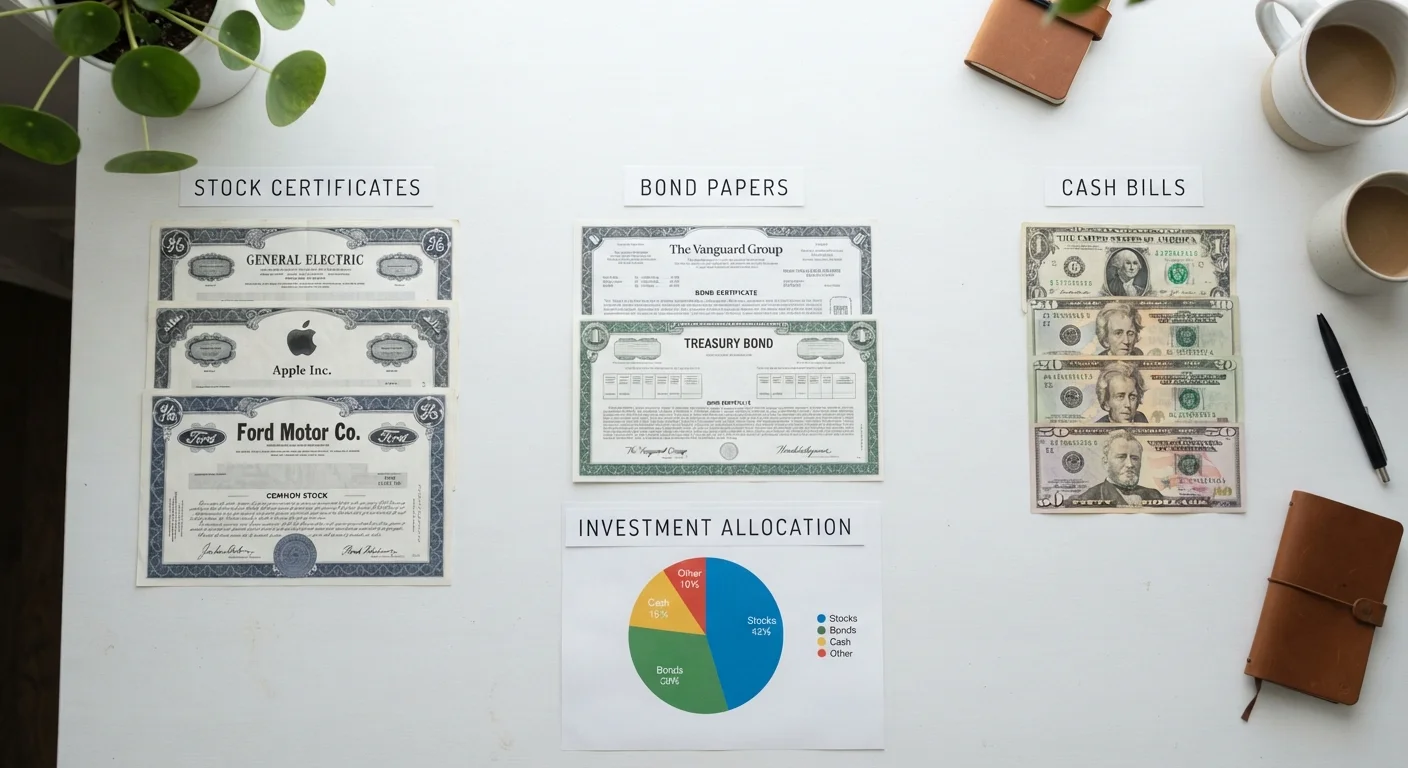
Walk into any conversation about investing and you'll quickly encounter three terms: stocks, bonds, and cash. These aren't just buzzwords — they're the three distinct asset classes that form the foundation of virtually every investment portfolio, from a simple retirement account to a complex institutional fund.
Each asset class serves a different purpose, carries a different level of risk, and behaves differently depending on economic conditions. Understanding what each one does — and why they're often used together — is one of the most useful things a new investor can learn. It's also the essential groundwork before exploring concepts like diversification, which relies on how these asset classes interact.
This Is General Education, Not Personalised Advice
This article explains how stocks, bonds, and cash work as asset classes. It is not a recommendation about how you personally should invest. Your ideal mix depends on your goals, time horizon, financial situation, and risk tolerance. Consider consulting a licensed financial adviser before making investment decisions.
Stocks: Ownership With Growth Potential
When you buy a stock, you're purchasing a small ownership stake in a company. If the company grows and becomes more valuable, your shares typically rise in value. If it struggles, your shares can fall — sometimes substantially.
Stocks are generally considered the highest-risk, highest-potential-return component of a portfolio. They're best suited for money you won't need for at least five years, because short-term price swings can be significant. Over longer periods, though, stock markets have historically trended upward — though this is not guaranteed and every investor's situation is different.
Stocks can also generate dividends — periodic payments some companies make to shareholders out of profits. Not all stocks pay dividends; growth-focused companies often reinvest profits instead.
3
Core asset classes in most portfolios
Stocks, bonds, and cash form the foundation that most financial education frameworks — including those from the U.S. Securities and Exchange Commission — use to explain portfolio construction.
~10%
Average annual return of U.S. stocks (historical)
The U.S. stock market has historically averaged roughly 10% annually before inflation, though individual years vary widely and past performance does not guarantee future results.
Negative real
Cash return when inflation exceeds yield
When inflation runs higher than the interest rate on cash savings, the purchasing power of that cash actually declines over time — a hidden cost of holding too much cash long-term.
Bonds: Lending for Steady Income
A bond works differently from a stock. When you buy a bond, you're essentially lending money to the issuer — a corporation, a municipality, or the federal government — in exchange for regular interest payments and the return of your principal when the bond matures.
Bonds are generally less volatile than stocks, which is why they're often used to add stability to a portfolio. However, they're not risk-free. Two key risks apply: interest-rate risk (when interest rates rise, existing bond prices fall) and credit risk (the possibility that the issuer can't repay). U.S. Treasury bonds carry very low credit risk; corporate bonds from weaker companies carry more.
The income bonds generate — called yield — is usually predictable, which makes them attractive to investors who need regular cash flow or want to reduce exposure to stock-market swings.
Asset class
A category of investment that shares similar characteristics and behaves similarly in the market. Stocks, bonds, and cash are the three foundational asset classes in most portfolios.
Equity
Another word for stock — it represents ownership in a company. When you hold equity, you share in both the company's gains and its losses.
Bond
A fixed-income debt instrument issued by a government or corporation. The issuer borrows money from you, agrees to pay periodic interest, and returns the principal at maturity.
Liquidity
How quickly and easily an asset can be converted to cash without significantly affecting its value. Cash itself is the most liquid asset; some investments take days or weeks to sell.
Yield
The income generated by an investment, typically expressed as a percentage of its price. Bond yields and savings account interest rates are common examples.
Volatility
The degree to which an investment's price fluctuates over time. Stocks are generally more volatile than bonds; cash holdings carry essentially no price volatility.
Cash: Safety and Liquidity at a Cost
"Cash" in a portfolio doesn't mean just dollar bills. It includes money market accounts, Treasury bills, certificates of deposit, and high-yield savings accounts — instruments that preserve your principal and can be accessed quickly.
The defining feature of cash is liquidity: it's available when you need it. This makes it valuable for short-term goals, emergency funds, or periods of economic uncertainty when you want to avoid forced selling of other assets at a loss. To understand more about where saving ends and investing begins, see the difference between saving and investing.
The trade-off: cash typically earns modest returns, and when inflation outpaces those returns, cash loses purchasing power over time. Holding too much cash for too long is itself a form of financial risk — just a quieter one.
| Primary purpose of stocks | Long-term growth through company ownership |
| Primary purpose of bonds | Income and stability through lending to issuers |
| Primary purpose of cash | Liquidity, safety, and short-term needs |
| Stock risk level | Higher — prices can fall significantly |
| Bond risk level | Moderate — subject to interest-rate and credit risk |
| Cash risk level | Low — but purchasing power can erode with inflation |
| Typical investor time horizon for stocks | 5+ years |
| Cash equivalents example | Money market accounts, Treasury bills, high-yield savings |
How the Three Work Together
No single asset class is universally superior — each has trade-offs. That's precisely why most portfolios hold a mix of all three. The proportion depends on an investor's goals, time horizon, and comfort with risk. A younger investor saving for retirement decades away might hold mostly stocks with a small bond allocation. Someone approaching retirement might shift toward more bonds and cash to preserve what they've built. For a structured way to think about your own risk profile, see our framework for thinking about investment risk.
How you decide to invest — all at once or gradually over time — also matters. That's a separate but related question explored in lump-sum investing vs. spreading contributions.
There's no universally correct ratio. The right mix is personal, and it typically shifts over a lifetime. What matters most at the beginning is simply understanding what you own and why — because informed investors tend to stay the course more steadily through market ups and downs. See habits that tend to serve long-term investors well for evidence-backed practices that support patient, consistent investing.
This article is for general informational and educational purposes only. It does not constitute personalised financial, investment, or tax advice. Please consult a qualified, licensed financial adviser for guidance tailored to your individual circumstances.