

Key Takeaways
Option A
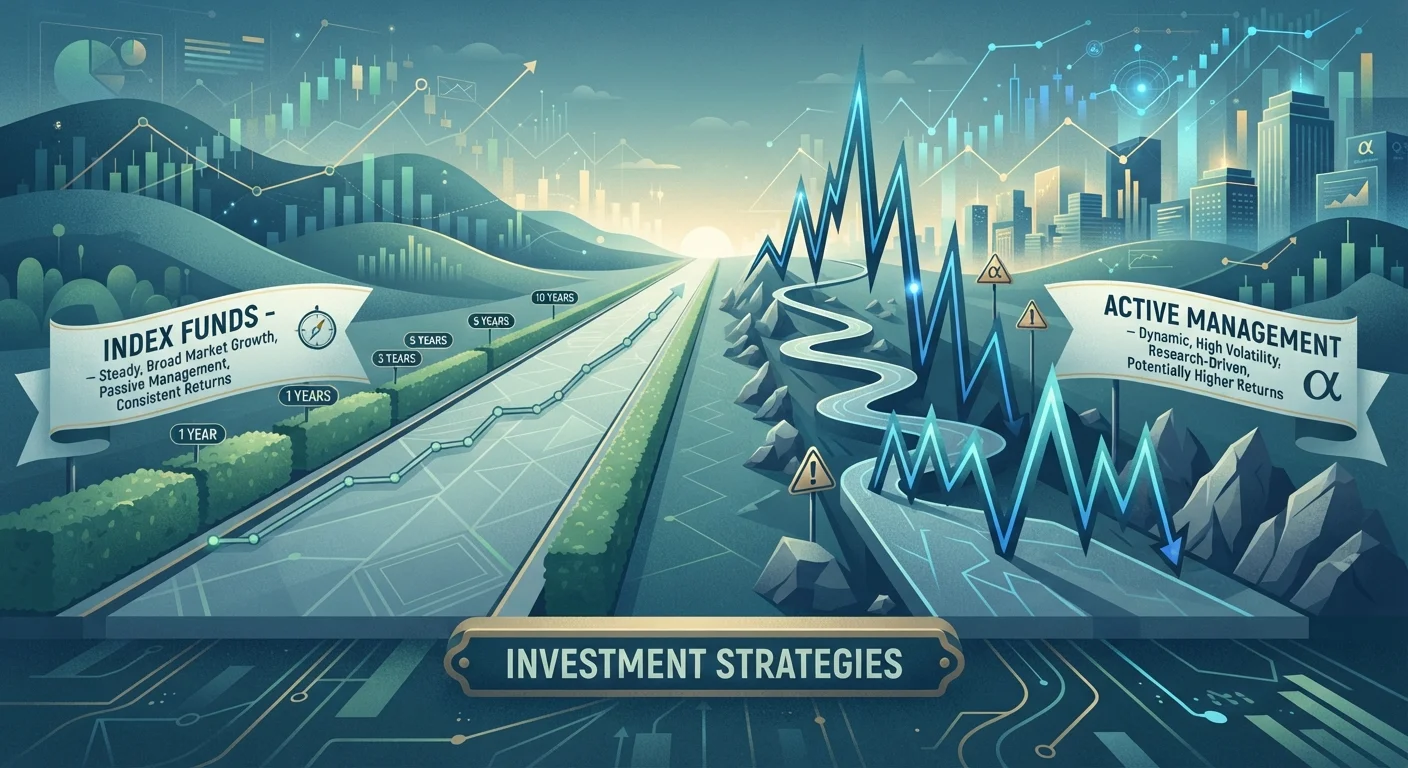
Index Funds
The low-cost, market-mirroring approach.
Best for: Investors who want broad market exposure, predictable costs, and a hands-off strategy over the long term.
Option B
Actively Managed Funds
The research-driven, beat-the-market approach.
Best for: Investors who believe skilled managers can outperform benchmarks and are willing to accept higher fees and variability for that chance.
If you're a beginner building your first portfolio
Index Funds
Low costs, built-in diversification, and no requirement to evaluate individual securities make index funds a straightforward starting point for new investors.
If you want exposure to a specific niche or strategy not easily indexed
Actively Managed Funds
Some asset classes — certain bond markets, private credit, or specialised sectors — may be less efficiently covered by index products, where active research can add real value.
If minimising investment fees is your top priority
Index Funds
Index funds routinely charge a fraction of what actively managed funds charge annually, and that difference compounds substantially over decades.
If you prioritise long-term, hands-off wealth building
Index Funds
Evidence over multi-decade periods favours passive strategies for most broad asset classes, with consistent costs and no manager-selection risk.
If you believe in the potential for skilled active management in specific markets
Actively Managed Funds
In less liquid or less researched markets, skilled managers have historically shown a greater chance of adding value relative to a passive benchmark.
How Each Fund Type Actually Works
Understanding these two fund types starts with a simple question: who — or what — decides which securities the fund holds?
An index fund is designed to replicate the performance of a specific market index, such as the S&P 500 or the Bloomberg U.S. Aggregate Bond Index. A computer-driven process buys every (or a representative sample of) security in that index in proportion to its weighting. No manager is calling which stocks look promising — the fund simply follows the rules of the index. This is called passive management.
An actively managed fund, by contrast, employs a team of analysts and a portfolio manager whose job is to research securities, identify mispricings, and build a portfolio they believe will outperform a relevant benchmark. Their decisions — what to buy, hold, or sell — reflect ongoing judgment calls based on company analysis, economic forecasts, and market conditions.
Both fund structures give investors access to a diversified pool of assets, which is a meaningful advantage over picking individual securities. To understand where funds fit within a broader portfolio, see our guide to stocks, bonds, and cash — the core building blocks that funds hold.
| Criterion | Index Funds | Actively Managed Funds |
|---|---|---|
| Management style | Passive — tracks an index | Active — manager-led decisions |
| Typical expense ratio | 0.03%–0.20% per year | 0.50%–1.00%+ per year |
| Goal | Match benchmark returns | Outperform benchmark returns |
| Trading frequency | Low — follows index changes | Higher — reflects manager decisions |
| Long-term performance record | Outperforms most active peers after fees | Majority underperform index over 10+ years |
| Transparency | Holdings mirror the index — highly predictable | Holdings reflect manager judgment — varies |
| Best suited for | Broad, liquid, efficient markets | Niche, less-efficient, specialised markets |
The Fee Gap — and Why It Compounds
The most concrete, quantifiable difference between index and active funds is cost. Index funds are administered largely by algorithm, keeping operational expenses low. Actively managed funds pay research teams, trading desks, and managers — costs passed to investors through the expense ratio (the annual percentage of your investment deducted as fees).
Index fund expense ratios commonly fall between 0.03% and 0.20% per year. Many actively managed funds charge between 0.50% and 1.00% or more annually. That gap may sound trivial, but over 20 or 30 years, the compounding effect on a sizeable portfolio can be substantial. Our article on why investing fees matter more than most beginners realise explains the mechanics in detail.
~85%
Active large-cap U.S. funds underperforming their index
According to S&P Dow Jones Indices SPIVA data, approximately 85% of actively managed large-cap U.S. equity funds underperformed the S&P 500 over a 15-year period.
0.03%
Lowest common index fund expense ratio
Some broad-market index funds charge as little as 0.03% annually, a fraction of the average actively managed fund fee.
~1% per year
Typical active fund fee premium over index funds
The fee gap between active and passive funds averages roughly 0.70–1.00 percentage points annually, a difference that compounds significantly over decades.
Beyond the stated expense ratio, actively managed funds can also generate higher trading costs and, in taxable accounts, more frequent capital gains distributions — adding another layer of drag that index funds tend to avoid.
This article provides general financial education and is not personalised investment advice. Consult a qualified financial adviser before making decisions about your own circumstances.
What the Evidence Says About Performance
The question investors most want answered is: do active managers actually beat the market? Over short periods, some do. Over longer time horizons, the picture is considerably less flattering.
The S&P Indices Versus Active (SPIVA) scorecards, published by S&P Dow Jones Indices, have tracked this question systematically for years. Their findings consistently show that across most major asset categories, the large majority of actively managed funds underperform their respective benchmark index over 10- and 15-year periods, once fees are accounted for.
This does not mean active management is without merit in every situation. In less efficient markets — certain emerging market segments, small-cap niches, or specialised bond markets where information is harder to come by — active managers have a more plausible edge. But for broad, liquid markets like large-cap U.S. equities, the evidence for consistent active outperformance is limited.
Past Performance Is Not a Guarantee
Even active funds that outperform in one period frequently revert toward average in subsequent periods. Research on manager persistence — whether a top-performing manager continues to outperform — suggests genuine persistence is rare. This makes selecting a consistently winning active fund extremely difficult in advance, even for sophisticated investors.
Developing consistent investing habits matters regardless of which fund type you choose. Our piece on habits that tend to serve long-term investors well offers practical perspective on behaviour over time. You might also consider how fund selection interacts with your contribution strategy — whether you invest all at once or gradually — covered in our guide to lump-sum investing versus pound-cost averaging.