

Key Takeaways
Separation Anxiety in Dogs
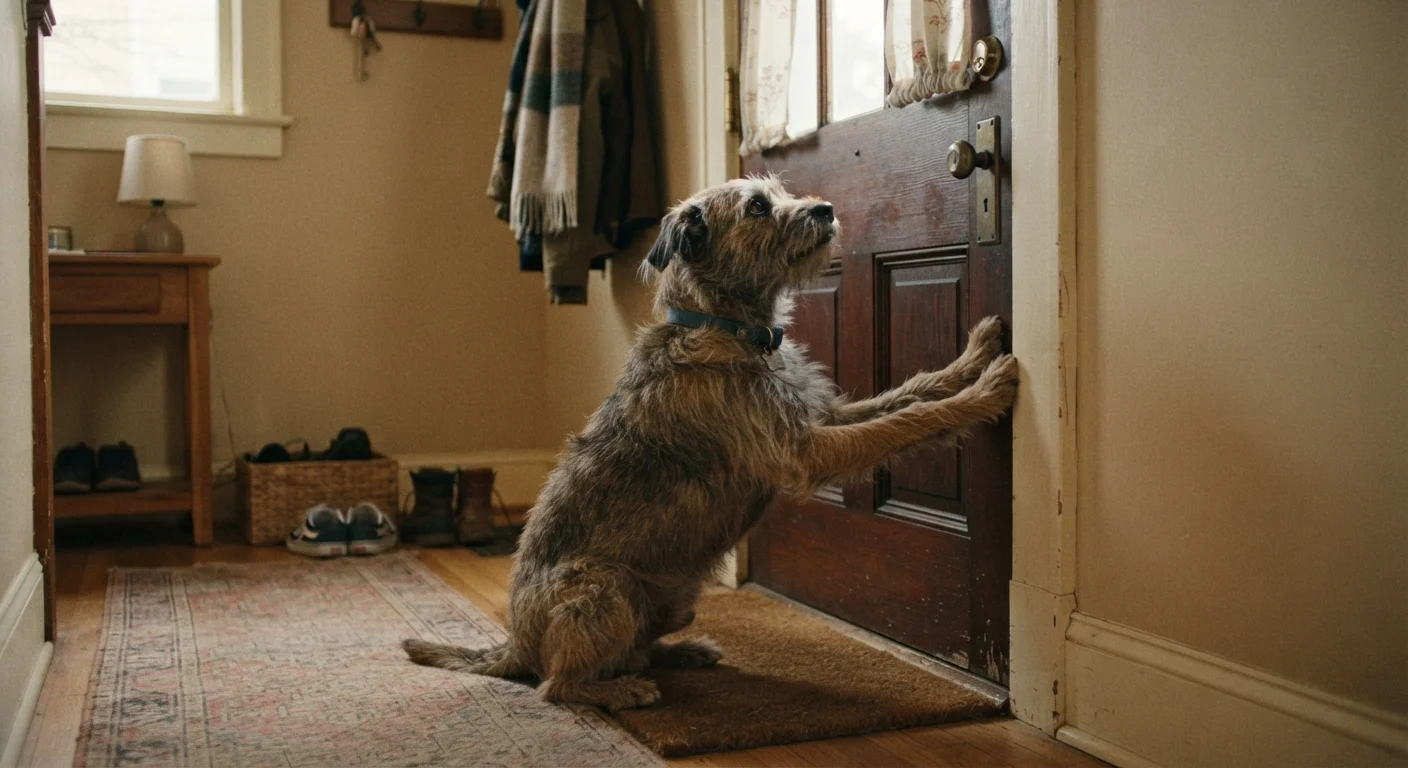
Separation anxiety is a behavioral condition in which a dog experiences significant distress when left alone or separated from the people they are attached to. It goes beyond ordinary restlessness — it's a genuine fear response driven by the dog's inability to self-regulate when their attachment figure is absent. Common signs include destructive chewing, excessive barking or howling, pacing, drooling, and house-soiling that occurs only when the dog is alone.
Veterinary behaviorists distinguish between true separation anxiety — triggered specifically by owner absence — and isolation distress, which occurs whenever the dog is left alone regardless of who is present. The distinction matters for treatment planning.
It's Not Spite — It's Panic
Coming home to shredded cushions, a howling neighbor complaint, or an accident on the floor is frustrating. It's tempting to assume your dog is acting out in retaliation for being left behind. But that interpretation misreads what's actually happening in your dog's brain.
Dogs don't experience emotions like revenge or calculated defiance. What they do experience — sometimes intensely — is fear. For a dog with separation anxiety, your departure triggers a genuine panic response similar to what a person might feel in a crisis. The destructive or disruptive behavior is not a message directed at you. It's the overflow of an animal in distress, trying to cope with a situation that feels unmanageable.
Understanding this distinction is the starting point for responding effectively. Punishment after the fact does nothing to reduce anxiety — the dog can't connect the scolding to a behavior that occurred hours earlier — and it can actually deepen their fear around your comings and goings.
Separation Anxiety vs. Isolation Distress
These two conditions look similar but have different triggers. Separation anxiety is specific to the absence of a particular person — the dog's primary attachment figure. Isolation distress occurs whenever the dog is left alone, regardless of who is or isn't present. A dog with isolation distress may settle down if a houseguest stays behind, while a dog with true separation anxiety may not. This distinction shapes which intervention strategies are most likely to help.
What's Happening in the Dog's Brain
Separation anxiety is rooted in the attachment system. Dogs are social animals that evolved alongside humans, and that bond has neurological weight. When a dog's primary attachment figure leaves, the brain can register it as a threat, triggering a stress response that floods the body with cortisol and adrenaline.
This is why the most intense anxiety-driven behaviors — pacing, vocalizing, scratching at doors, self-injury — tend to happen in the first 20 to 30 minutes after departure. The dog isn't simply bored; they're in a physiological state of alarm. Over time, some dogs begin anticipating departure through pre-leaving cues like picking up keys or putting on shoes, and the stress response starts even before you've walked out the door.
For a broader look at how stress manifests across pets, see our article on how cats and dogs experience stress day to day.
~14%
Dogs estimated to have separation anxiety
Research published in veterinary behavioral journals estimates that separation anxiety affects roughly 14–20% of the pet dog population in the United States.
20–30 min
Window when anxiety behaviors peak
Behavioral studies indicate that the most intense distress behaviors typically occur within the first 20 to 30 minutes after the owner's departure.
Which Dogs Are Most at Risk
Any dog can develop separation anxiety, but certain factors increase the likelihood. Rescue dogs with unknown or difficult histories, dogs that have experienced multiple rehomings, and those that went through major life disruptions — a move, a death in the household, a sudden change in schedule — are more vulnerable. Puppies that didn't develop early independence can also struggle when left alone as adults.
Some breeds with high human-bonding tendencies, such as Vizslas, Border Collies, and Labrador Retrievers, may be predisposed, though anxiety can emerge in any dog regardless of breed.
“Separation anxiety is not a training failure or a sign that a dog is badly behaved. It's a welfare issue — a dog communicating the limits of its emotional coping capacity in the only way it knows how.”
— Dr. Karen Overall, Veterinary behaviorist and author of works on clinical behavioral medicine in animals
How to Tell Separation Anxiety Apart From Other Issues
Not every problematic behavior is driven by separation anxiety. House-soiling, for instance, can stem from incomplete housetraining, a medical condition, or territorial marking rather than distress. The key differentiator is context: Does the behavior happen only when the dog is alone? Does it start quickly after departure? Is the dog otherwise calm and well-adjusted when you're home?
Video footage taken shortly after you leave is one of the most useful diagnostic tools available. It can reveal whether your dog settles after a few minutes or remains distressed for an extended period. It also helps rule out boredom-based destruction, which tends to be more generalized and less time-dependent. For context on how territorial marking differs from anxiety-related accidents, see our piece on territorial marking in cats and dogs.
Responding Effectively: What Helps and What Doesn't
The most evidence-supported approach to separation anxiety is graduated desensitization — systematically teaching your dog that departures are predictable, manageable, and temporary. This involves starting with very short absences (even seconds), then very gradually increasing duration, always keeping your dog below the threshold of panic. Progress can be slow, and consistency matters enormously.
Building a stable daily routine can also reduce baseline anxiety by making your dog's world more predictable. Our guide on building routine and structure for a better-behaved pet explains what a structured schedule can look like in practice.
For moderate to severe cases, a veterinarian or certified veterinary behaviorist may recommend combining behavioral training with medication to lower the dog's baseline anxiety enough for training to take hold. This is a legitimate, well-supported clinical approach — not a shortcut or a substitute for training.
Use Video to Understand Your Dog's Alone Time
Set up a phone or camera to record your dog for 30–45 minutes after you leave. Watch for panting, pacing, vocalizing, or attempts to escape — these are indicators of genuine distress. Sharing footage with your veterinarian or a behaviorist gives them concrete information to work with rather than relying solely on secondhand descriptions.
This article is for general informational purposes only and is not a substitute for professional veterinary or behavioral advice. If your dog's anxiety is severe or worsening, consult a licensed veterinarian or certified veterinary behaviorist.