

Key Takeaways
What Territorial Marking Actually Is
Territorial marking is a deliberate, instinct-driven behavior through which animals deposit scent signals to communicate information to others — including themselves. It is not a lapse in training, a hygiene failure, or an act of defiance. It is, in essence, a form of language.
Scent plays a central role in how both cats and dogs experience and interpret their environment. When a pet marks, they are typically conveying one or more messages: I was here, this is familiar to me, or another animal has entered my space. Understanding this reframes the behavior entirely. See our guide to reading pet body language for broader context on how animals communicate beyond vocalizations.
90%+
Reduction in urine marking after neutering male cats
According to the American Association of Feline Practitioners, neutering eliminates or significantly reduces spraying in the majority of male cats.
3x
More likely to mark: intact vs. neutered male dogs
Research in veterinary behavioral literature consistently shows intact males mark at substantially higher rates than neutered males in comparable settings.
~30%
Neutered cats that continue to spray
The Cornell Feline Health Center notes that roughly 10–30% of neutered cats may continue spraying, often due to stress or learned habit rather than hormonal drive.
How Cats Mark Their Territory
Cats have a more varied marking toolkit than most owners realize. Urine spraying — where a cat backs up to a vertical surface and releases a small amount of urine — is the most recognized method, but it is far from the only one.
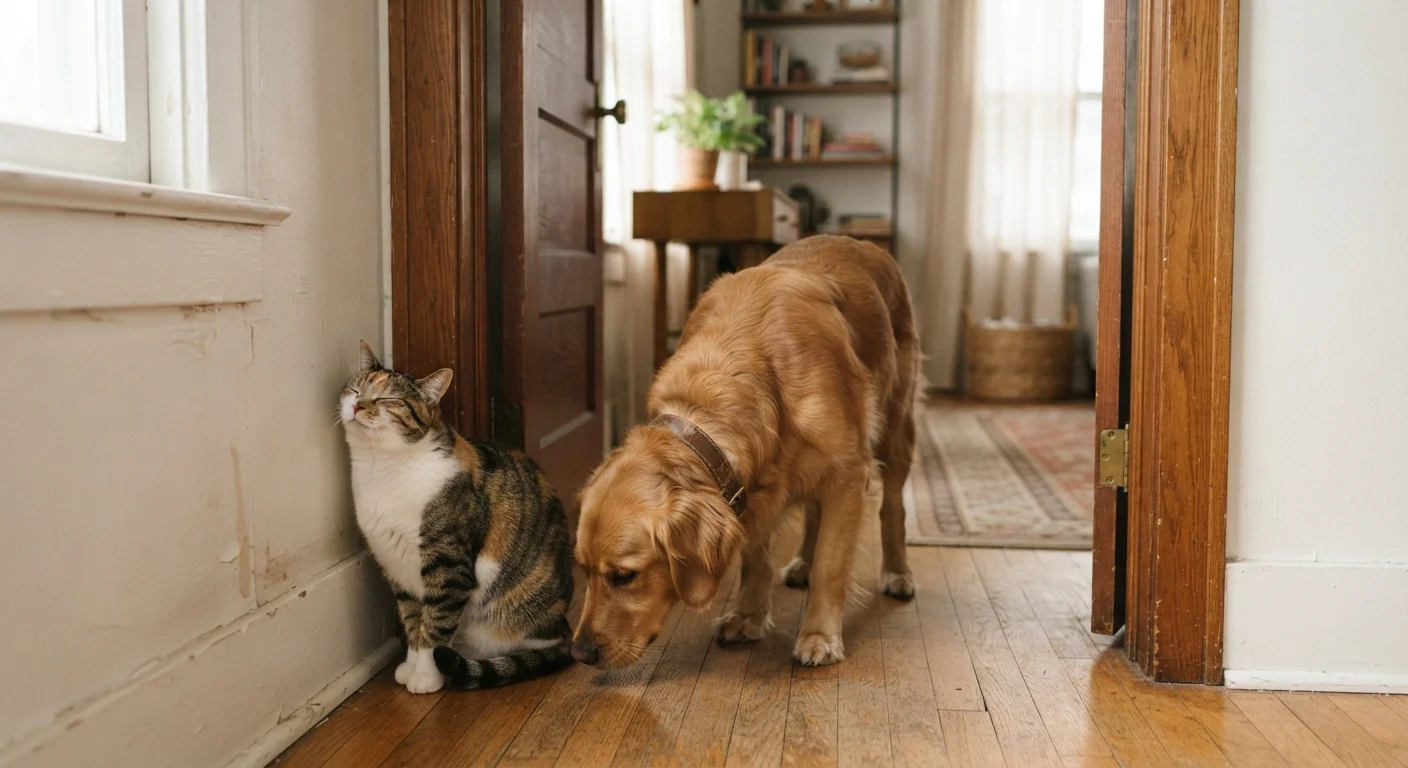
- Scent glands in the cheeks and forehead: When a cat rubs its face on furniture, doorframes, or your legs, it is depositing pheromones from facial glands. This is generally a positive, comfort-seeking behavior.
- Scratching: Cats have scent glands between their paw pads. Scratching visible surfaces leaves both a visual mark and a chemical signal.
- Urine spraying: More common in intact (unneutered) males but seen in females and neutered cats under stress. Targets are usually vertical: walls, doors, furniture edges.
It helps to distinguish spraying from toileting outside the litter box, which may indicate a litter-box aversion or a medical problem rather than marking. Sprayed urine typically appears in small amounts on vertical surfaces; inappropriate elimination usually involves larger volumes on horizontal surfaces. If you find the facial-rubbing behavior puzzling, our piece on commonly misread animal signals offers useful clarification.
If your cat rubs against you after returning from the vet, encourage it — they are reclaiming familiar scent after a stressful outing, and letting them do so helps restore their sense of security.
Facial pheromone deposition is a comfort behavior; allowing it reinforces positive associations with the owner's presence and helps the cat self-regulate after stress.
When introducing a new pet, swap bedding between animals before any face-to-face meeting so each animal's scent becomes familiar and less threatening — this can noticeably reduce reactive marking.
Scent introduction before visual contact is a well-established technique in veterinary behavioral guidance for reducing territorial conflict during multi-pet introductions.
How Dogs Mark Their Territory
Dogs rely heavily on urine marking, and the behavior is closely tied to hormones — particularly testosterone. Intact male dogs mark most frequently and most persistently, but spayed females and neutered males also mark, especially in response to social or environmental pressure.
- Leg-lifting: The classic posture allows dogs to deposit urine at nose height for other dogs, maximizing scent exposure. Some dogs mark dozens of times during a single walk.
- Ground scratching: After eliminating, many dogs scratch the ground with their hind legs. This spreads scent from paw-pad glands and creates a visual signal.
- Overmarking: Dogs frequently urinate on spots where another dog has already marked — a form of social commentary, not simple coincidence.
Indoors, marking is often triggered by novelty or anxiety rather than routine communication. A dog that suddenly begins marking furniture or doorways inside the home is often responding to a perceived threat to its social status or territory.
Common Triggers for Marking Episodes
Understanding what sets off marking helps owners anticipate and reduce it. The most frequently documented triggers include:
- Introduction of a new pet
- Both cats and dogs may intensify marking when a new animal joins the household. The existing pet is re-establishing boundaries in response to a perceived intrusion.
- Unfamiliar scents indoors
- Bringing home items that carry the scent of other animals — clothes, bags, shoes — can prompt marking even without a new animal present.
- Household changes and stress
- Moving furniture, new people in the home, or schedule disruptions can elevate anxiety enough to trigger marking. This overlaps with stress-driven behavior explored in our article on separation anxiety in dogs.
- Hormonal status
- Intact animals — particularly males — mark significantly more than those that have been spayed or neutered. Females in heat can also prompt nearby males to mark more intensely.
- Outdoor visitors
- Cats or wildlife passing near windows or doors is a common trigger, especially for indoor cats who cannot investigate or respond directly.
Punishment Makes Marking Worse
Scolding or punishing a pet for marking rarely reduces the behavior and can increase anxiety — which is often a root cause. Pets do not connect after-the-fact corrections to the act of marking. Instead, focus on identifying the trigger and addressing the environment, not the animal's character.
Practical Responses and Management Strategies
There is no single fix for marking, but a combination of approaches consistently reduces its frequency and intensity.
Spay or Neuter
This remains the single most effective intervention for hormonally driven marking. It does not guarantee the behavior will stop entirely — especially if the pet has been marking for a long time — but it substantially reduces motivation. Veterinary guidance on timing and approach is essential.
Clean Thoroughly with Enzymatic Products
Standard household cleaners mask odor to human noses but often leave enough residual scent to signal mark here again to a pet. Enzymatic cleaners break down the proteins in urine that carry that signal. Treating the spot completely — including padding under carpet, if relevant — removes the chemical invitation to repeat.
Reduce Stress and Increase Predictability
Consistent routines, adequate enrichment, and managed introductions to new animals all lower the baseline anxiety that fuels stress-driven marking. For multi-pet households, ensure each animal has its own resources — food stations, litter boxes, resting spots — to reduce competition.
Use of Synthetic Pheromone Products
Commercially available diffusers and sprays mimic naturally calming pheromones for cats and dogs. Evidence for their effectiveness is mixed and context-dependent, but some pets respond well, particularly in conjunction with other management strategies. A veterinarian or veterinary behaviorist can help assess whether these are appropriate for a specific situation.
Limit Visual Access to Outdoor Triggers
For cats that spray in response to outdoor cats seen through windows, blocking the sightline — with frosted film, furniture repositioning, or supervised-only window time — can reduce episodes significantly.
Make Cleaning Count
When treating a marked spot, apply enzymatic cleaner generously and allow it to soak for the time indicated on the label — the enzymes need contact time to break down scent proteins. Blotting the area dry afterward rather than rinsing preserves the enzymatic action. Reapply if the odor persists after drying.
When to Consult a Veterinarian
A sudden onset of marking — or a sharp increase in frequency — in a pet that has not previously shown the behavior warrants a veterinary evaluation before assuming it is purely behavioral. Urinary tract infections, bladder stones, cognitive decline in older animals, and hormonal disorders can all produce marking-like symptoms.
Similarly, if marking is accompanied by other behavioral shifts — changes in appetite, energy, social interaction, or aggression — that combination is worth investigating medically. Our article on recognizing when a behavior change warrants a vet visit outlines the kinds of signals that should prompt a call to your clinic.
For persistent or severe cases, a veterinary behaviorist — a specialist in animal behavior with clinical training — may offer structured assessment and a tailored management plan that goes beyond general strategies.
Rule Out Medical Causes First
Never assume marking is purely behavioral if it appears suddenly or intensifies without an obvious trigger. Urinary tract infections, kidney disease, and neurological changes can all produce marking-like behavior. A veterinary examination should be the first step, especially for older pets or those with no prior history of the behavior.
This article provides general educational information about pet behavior and is not a substitute for professional veterinary advice. Always consult a licensed veterinarian for guidance specific to your pet's health and situation.