

Key Takeaways
Africa's Safari Map Is Much Larger Than Most People Realize
When most Americans picture an African safari, they picture the Serengeti — wildebeest thundering across open savanna, lions sprawled under acacia trees, the Great Migration dominating wildlife documentaries. It's a genuinely extraordinary place. But Africa is a vast continent, and its wildlife destinations extend far beyond the plains of Tanzania. Some of the continent's most compelling parks see only a fraction of the visitors, yet deliver encounters just as breathtaking — sometimes more so.
If you're planning a safari and willing to look beyond the familiar names, you'll find ecosystems ranging from inland waterway deltas to arid salt pans to remote river valleys, each shaped by different forces and home to different constellations of animals. The destinations below aren't secrets exactly, but they're consistently underestimated by travelers who assume East Africa holds all the answers. For more context on the broader safari landscape, see our guide to safari destinations beyond Kenya.
Botswana's Okavango Delta
The Okavango is one of the world's most unusual ecosystems — a massive inland river delta that fans out across the Kalahari Desert, creating a patchwork of lagoons, channels, and floodplains that sustain extraordinary concentrations of wildlife. Unlike conventional safari parks driven by road networks, much of the Okavango is explored by mokoro (a traditional dugout canoe), on foot, or by small motorboat, giving it a quality of stillness and intimacy that jeep-centric parks can't replicate.
The delta supports large populations of elephants, cape buffalo, hippos, lions, leopards, and wild dogs — the latter being one of Africa's most endangered and captivating predators. Botswana's deliberate policy of low-volume, high-cost tourism means the camps are small and the wilderness genuinely feels uncrowded. The trade-off is a higher price point than some other destinations, something to factor carefully into trip planning.
Exploring by mokoro canoe gives the Okavango an intimacy that road-based safaris simply can't match.
Zambia's South Luangwa National Park
South Luangwa is widely regarded among experienced safari travelers as one of Africa's finest parks — yet it remains relatively unknown to casual American planners. The Luangwa River acts as a magnet for wildlife during the dry season, concentrating hippos, crocodiles, and a stunning diversity of antelope, giraffe, zebra, and predators along its banks.
What sets South Luangwa apart culturally and experientially is that it's credited as the birthplace of the walking safari. Guided walks here offer something that few safari formats can — the chance to slow down and understand the smaller details of an ecosystem: tracks, insects, plants, and bird calls alongside the drama of large mammals. Night drives are also widely available, opening a window onto nocturnal behavior rarely observed in more regulated parks.
South Luangwa is credited as the birthplace of the walking safari, offering an unmatched on-foot wilderness experience.
Namibia's Etosha National Park
Etosha's defining feature is its enormous salt pan — a vast, shimmering expanse that was once a lake and now anchors a semi-arid ecosystem unlike anything else on the continent. During the dry season, waterholes around the pan's edge become focal points for animal movement, drawing elephants, black rhinos, lions, cheetahs, and a remarkable variety of plains game in concentrations that reward patient observation.
One particularly appealing aspect of Etosha for independent travelers is that self-drive safaris are genuinely viable here. The park is well-managed and accessible without requiring a dedicated guide, making it one of the more budget-flexible safari options in southern Africa. Floodlit waterholes at some camps even allow for safe nighttime wildlife watching from stationary platforms.
Etosha's self-drive accessibility makes it one of the more flexible safari options in southern Africa.
Zimbabwe's Hwange National Park
Hwange is Zimbabwe's largest national park and one of Africa's premier elephant sanctuaries, home to one of the continent's largest free-ranging elephant populations — estimates have ranged into the tens of thousands, though numbers fluctuate seasonally. That sheer density of elephants, combined with lions, wild dogs, sable antelope, and rare brown hyenas, gives Hwange a character all its own.
The park also benefits from a strong tradition of walking safaris and small, intimate camps run by experienced guides. Tourism infrastructure has grown steadily in recent years, but Hwange still sees significantly fewer international visitors than comparable East African destinations. Travelers should research current conditions and logistics carefully, as infrastructure and services can vary considerably across the park's different zones.
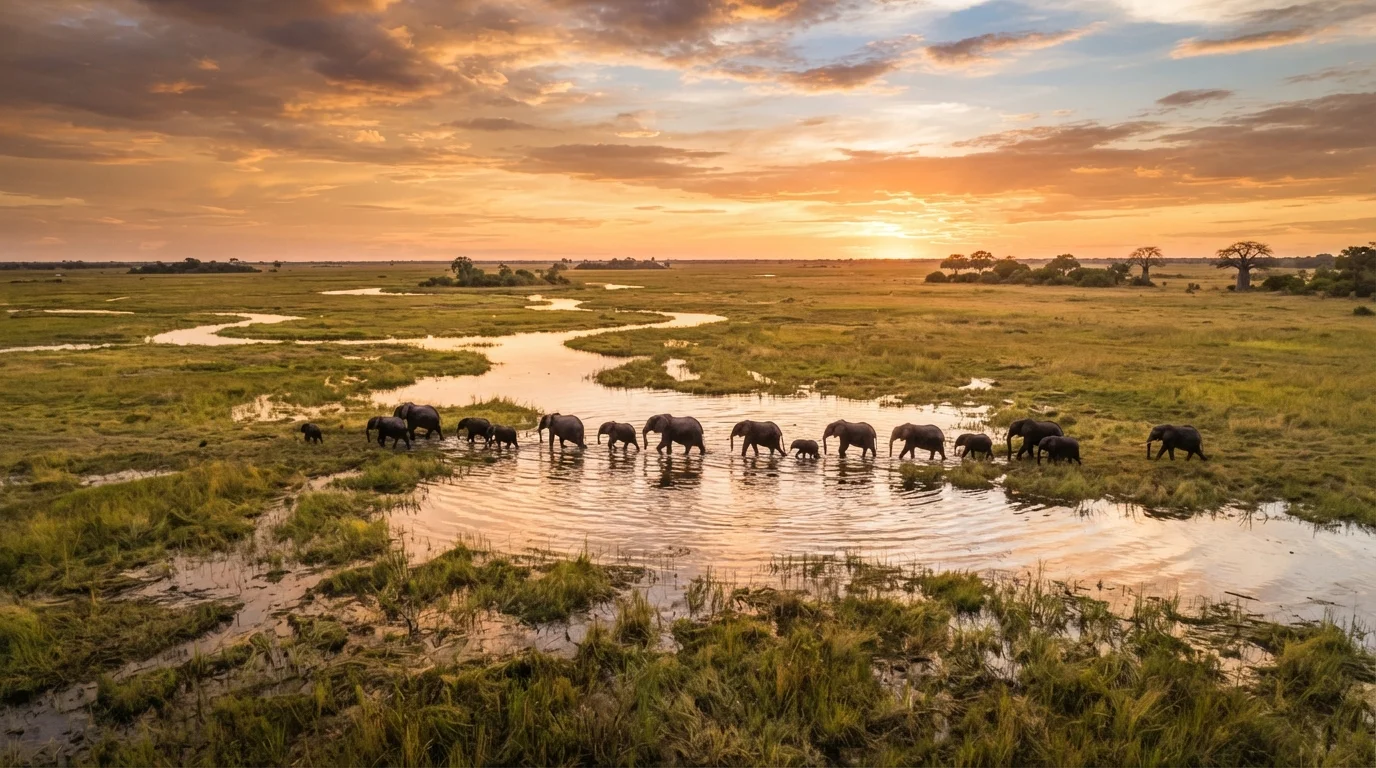
Hwange supports one of Africa's largest free-ranging elephant populations, a spectacle difficult to replicate elsewhere.
Rwanda's Volcanoes National Park
Rwanda offers something categorically different from savanna-based safari experiences: the chance to trek through montane rainforest to observe endangered mountain gorillas in their natural habitat. Volcanoes National Park sits in the Virunga mountain range and is home to several habituated gorilla families that can be visited on guided treks led by trained rangers.
Gorilla trekking is a physically demanding experience — treks can last anywhere from thirty minutes to several hours depending on where the family is that day — but the encounter itself is described by most visitors as profoundly moving. Rwanda's tourism model prioritizes conservation funding and community benefit, with permit revenue supporting both park management and local livelihoods. Permits are limited, allocated officially, and should be arranged well in advance through proper channels.
Trekking to encounter mountain gorillas in Rwanda's rainforest is an experience unlike any conventional safari.
Planning Your Trip: What to Keep in Mind
Each of these destinations has its own logistics, and the details matter. Seasonal variation is significant — water levels, vegetation density, and animal movement shift considerably between wet and dry seasons, affecting both accessibility and what you're likely to see. Consult tour operators or official park authorities to understand which months align with your priorities.
Choosing the Right Season Matters Enormously
Dry season is generally the prime wildlife-viewing window across southern and eastern Africa — lower vegetation and concentrated water sources make animals easier to spot. However, the wet season brings lush landscapes, newborn animals, and far fewer tourists. Research each destination's specific seasonal patterns before committing to dates, as the ideal window varies significantly between Botswana, Zambia, Namibia, and Zimbabwe.
Entry requirements, visa processes, and health recommendations — including vaccinations for yellow fever, malaria prophylaxis, and other conditions — vary by country and can change. Always verify current requirements through the U.S. Department of State's travel pages and the CDC's destination-specific health guidance well in advance of your trip. This article provides general educational information only and is not a substitute for up-to-date official guidance.
This article is for general informational and educational purposes only. Travel conditions, entry requirements, health recommendations, and wildlife regulations can change. Always verify current requirements with official government sources and consult a qualified travel health professional before your trip.