

Key Takeaways
Patagonia
Patagonia is a vast, sparsely populated region occupying the southern tip of South America, shared between Argentina and Chile. It encompasses everything from wind-scoured steppes and ancient glaciers to jagged peaks and fjord-laced coastlines. The region has no single official boundary — it's defined more by geography and character than by any political line drawn on a map.
Geographically, Patagonia is generally understood to encompass all land south of the Río Colorado in Argentina and the Biobío River in Chile, extending to the Strait of Magellan and beyond to Tierra del Fuego.
A Place That Defies Easy Description
There's a moment on the drive south through Argentine Patagonia when the land simply opens up — a vast, wind-torn steppe stretching to every horizon, interrupted only by distant peaks draped in permanent snow. No towns. No traffic. Just geography on a scale that recalibrates your sense of distance and solitude. That feeling, more than any single landmark, is what travellers mean when they talk about Patagonia.
The region occupies the southern cone of South America in a way that resists clean definition. It is not a country, not a province, not a park — it's a geographic and cultural concept, one that encompasses ice fields, fjords, grasslands, and rainforests across hundreds of thousands of square miles shared between Argentina and Chile. Its borders have been debated by geographers for generations, but its spirit is unmistakable.
“Patagonia is one of those rare places where the landscape actively resists being made comfortable. That resistance is precisely its value — it reminds you what wilderness actually means.”
— Bruce Chatwin, Author of 'In Patagonia', widely credited with shaping the modern literary image of the region
What Makes the Landscape So Distinctive
Patagonia's drama comes from geology in motion. The Andes, still actively rising, create a sharp climatic divide: Chilean Patagonia catches the full force of moisture-laden Pacific winds, producing dense temperate rainforests and some of the world's largest non-polar ice fields. Cross the mountains into Argentina and the landscape transforms almost instantly into dry, wind-blasted steppe — where guanacos graze and condors ride thermals over emptiness.
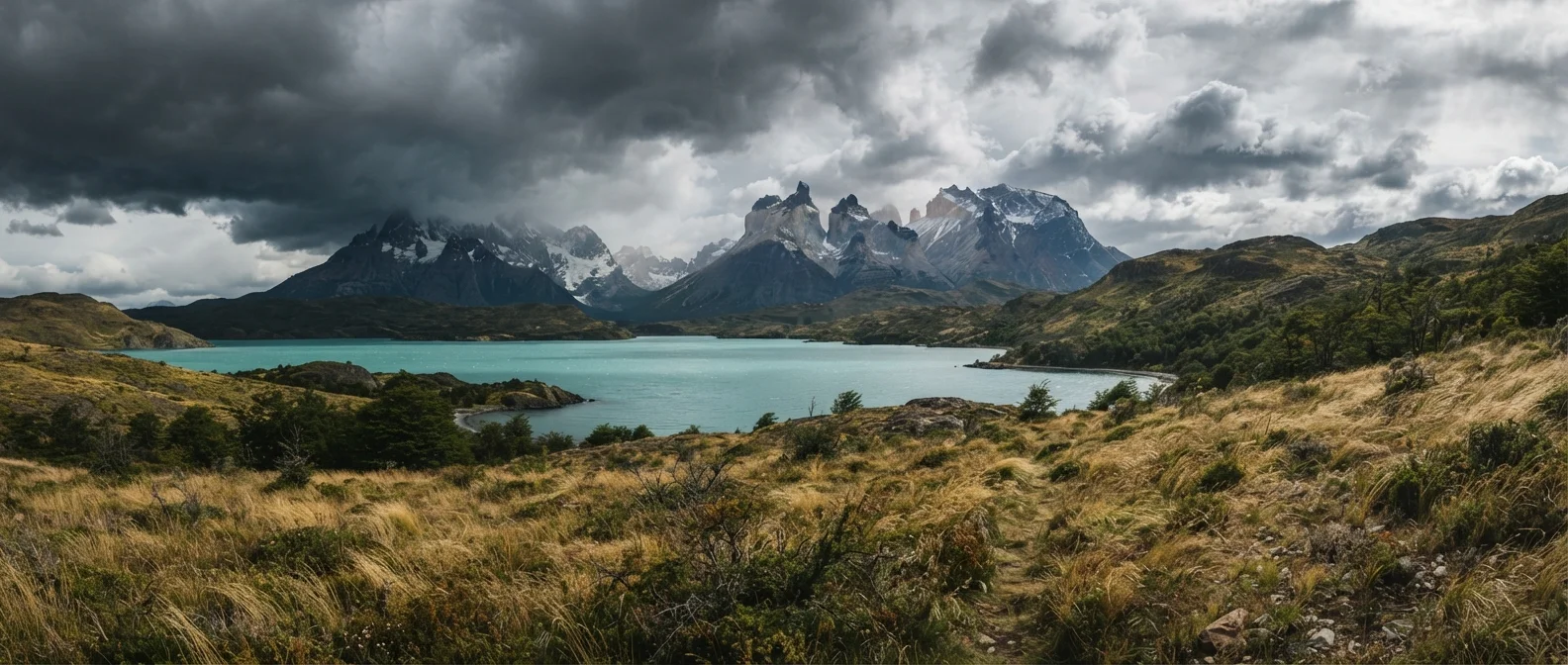
The Southern Patagonian Ice Field — shared across the border — feeds glaciers that calve directly into lakes and fjords of extraordinary color. Perito Moreno, arguably the world's most visited glacier, advances and ruptures in a slow-motion spectacle that draws visitors from across the globe. In Chile, the granite towers of Torres del Paine have become one of the defining images of wild travel anywhere on Earth.
~1,000 mi
North-to-south extent of Patagonia
Patagonia stretches roughly 1,000 miles from its northern limits to the tip of Tierra del Fuego, making internal distances a central planning challenge.
~5,000 ft
Height of Torres del Paine's granite towers
The Paine Massif's central towers rise approximately 8,200 feet above sea level, with exposed vertical faces that have made them a global symbol of wild Patagonia.
3.5 million acres
Area of Los Glaciares National Park, Argentina
Designated a UNESCO World Heritage Site, Los Glaciares protects one of the largest expanses of ice outside the polar regions and anchors Argentine Patagonia's tourism.
Understanding how these two sides differ in character and access is its own journey. Patagonia's Argentine and Chilean landscapes each offer a distinct experience worth exploring separately before you plan your route.
How to Approach Planning a Patagonia Trip
The single most common mistake first-time Patagonia travellers make is underestimating scale. The region is enormous — flying from Buenos Aires to Ushuaia alone takes more than three hours, and driving between key destinations within Patagonia can consume full days. A realistic itinerary needs to account for travel time, not just destinations.
Book Trekking Permits and Campsites Early
Torres del Paine's most popular circuits require advance reservations for campsites and refugios — sometimes six months or more ahead for peak-season dates. Check the official park concessionaire websites directly and confirm booking policies, as these can change between seasons.
Seasonality matters enormously. The austral summer (roughly November through March) brings the most daylight and the most reliable trekking conditions, but also the strongest winds and the heaviest visitor numbers at iconic sites. Shoulder season — particularly October and late March — can offer a more contemplative experience, though some services operate on reduced schedules.
Accommodation in gateway towns like Puerto Natales (Chile) and El Calafate (Argentina) ranges widely in character and price. Deep in the backcountry, options narrow significantly — refugios and designated campsites fill fast during peak season, and reservations months in advance are the norm for popular circuits.
Why Travellers Keep Coming Back
Patagonia rewards patience in ways few destinations can match. A morning of low cloud can part in minutes to reveal a skyline so surreal it seems computer-generated. A day of brutal headwinds along a trail can end with a campfire view of a glacier glowing pink in the low-angle light. The region's unpredictability is, paradoxically, one of its greatest assets — it demands presence in a way that more comfortable destinations do not.
There is also something quietly rare about a place that remains genuinely wild at this scale. Most of Patagonia's iconic areas are protected within national parks and reserves, and both governments have expanded protections significantly in recent decades. Travelling here with low impact — following Leave No Trace principles, staying on marked trails, respecting wildlife corridors — helps preserve the qualities that make the journey worthwhile in the first place.
For the curious traveller willing to plan carefully, tolerate weather, and embrace the inconveniences of remoteness, Patagonia delivers an experience that is difficult to replicate anywhere else on Earth.