

Key Takeaways
Option A
Argentine Patagonia
The vast, open, and surprisingly accessible side.
Best for: Travelers who want sweeping steppe scenery, accessible infrastructure, and iconic glacier experiences with fewer logistical hurdles.
Option B
Chilean Patagonia
The wild, dramatic, and reward-the-effort side.
Best for: Adventurous travelers seeking intense wilderness, world-class trekking, and some of the most spectacular fjord and tower scenery on Earth.
If you want iconic glacier access with straightforward logistics
Argentine Patagonia
Perito Moreno Glacier near El Calafate is one of the most accessible glaciers in the world, with well-maintained walkways and reliable transport from town.
If world-class multi-day trekking is your primary goal
Chilean Patagonia
The W Trek and O Circuit in Torres del Paine are widely regarded among the finest long-distance trails in South America, with unforgettable tower scenery.
If you prefer a self-drive road trip through remote landscapes
Chilean Patagonia
The Carretera Austral stretches over 700 miles through fjords, rainforest, and volcanic terrain — an unmatched driving adventure for those willing to navigate gravel roads.
If budget and ease of travel are top priorities
Argentine Patagonia
Argentina's Patagonian towns like Bariloche and El Calafate have stronger tourism infrastructure, more accommodation options, and generally smoother domestic connections.
If you want to experience both sides in one trip
Argentine Patagonia
Most combined itineraries use Argentina as the base, crossing into Chile for Torres del Paine before returning — a logical and well-trodden circuit.
Two Countries, One Region — and a World of Difference
Patagonia doesn't belong to one country — it straddles the southern tip of South America, divided roughly along the Andes between Argentina to the east and Chile to the west. But while both nations share the same raw, windswept spirit, the traveler experience on each side diverges in terrain, infrastructure, pace, and feel.
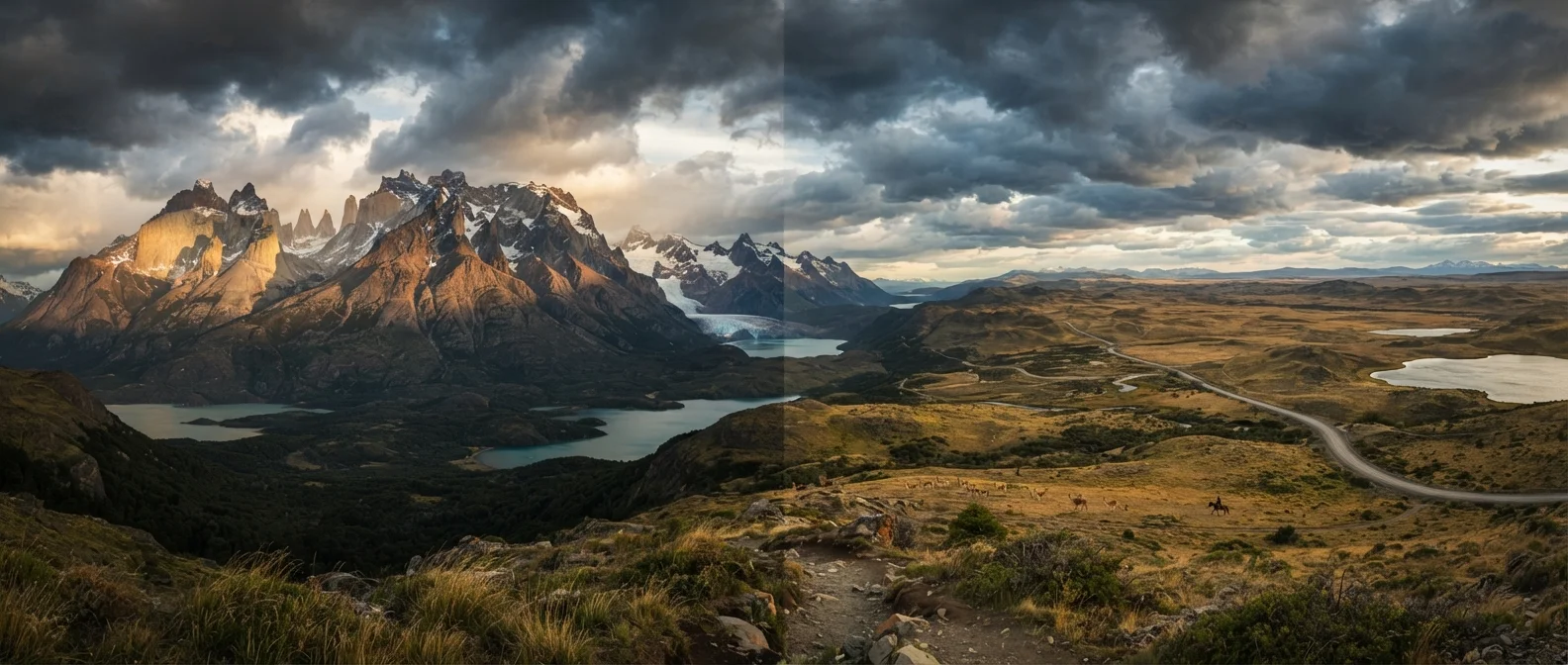
Argentine Patagonia unfolds across a massive plateau of steppe — flat, spare, and enormous in scale. The Andes rise to the west, but much of what visitors encounter first is open sky, grazing guanacos, and the kind of emptiness that puts your own smallness into focus. Chilean Patagonia, by contrast, is shaped by water: fjords carving the coastline, glacial lakes catching the light, and near-vertical granite towers erupting from the horizon. It is compressed and intense in a way Argentina rarely is.
Understanding this distinction early helps you plan with intention rather than assumption. Just as travelers choosing between New Zealand's two islands discover they're weighing entirely different experiences — see our guide to New Zealand's North vs. South Island — Patagonia demands the same honest self-assessment before booking flights.
| Criterion | Argentine Patagonia | Chilean Patagonia |
|---|---|---|
| Primary draw | Glaciers, steppe, Fitz Roy trekking | Torres del Paine, fjords, Carretera Austral |
| Terrain character | Open, vast, plateau-like | Dramatic, compressed, water-shaped |
| Infrastructure | Well-developed in key towns | More limited; remote in many areas |
| Ease of access | Regular domestic flights, paved roads | Requires more planning; some gravel and ferry routes |
| Trekking intensity | Day hikes to multi-day options | Multi-day circuits; permit system required |
| Crowd levels | Busy at key sites; manageable elsewhere | Torres del Paine fills early; permits sell out |
| Weather | Windy and variable; relatively drier steppe | Notoriously unpredictable; high wind and rain |
Terrain, Access, and the On-the-Ground Reality
Argentine Patagonia's logistical spine runs through a handful of well-connected towns. El Calafate serves as the gateway to Los Glaciares National Park and the thundering face of Perito Moreno Glacier. El Chaltén, a few hours north, is a base for trekking to Mount Fitz Roy — a challenging but deeply rewarding day or multi-day experience. Bariloche, further north in the Lake District, blends mountain scenery with a well-developed tourism scene. Domestic flights connect Buenos Aires to these hubs with reasonable frequency, and while distances are vast, the infrastructure exists to manage them.
Chilean Patagonia demands more effort. Punta Arenas is the main southern hub, with Puerto Natales acting as the staging town for Torres del Paine National Park — home to the famous W Trek and the longer O Circuit. The park's trails are globally recognized, but permits for camping fill months in advance, and the weather is famously unforgiving. Wind is not occasional here; it is a constant presence, and rain is always possible regardless of season.
The Carretera Austral — Chile's Route 7 — runs more than 700 miles through remote northern Chilean Patagonia, passing through temperate rainforest, volcanic landscapes, and isolated communities. Much of it is unpaved. Ferry crossings are required in sections. It is spectacular and genuinely wild, but it asks for patience, preparation, and flexibility. Much like the dramatic interior of New Zealand's South Island — which, as our South Island travel guide notes, surprises visitors with logistical realities as much as scenery — Chilean Patagonia's beauty comes packaged with real-world complexity.
700+ miles
Length of Chile's Carretera Austral
Route 7 in Chile stretches over 700 miles through remote Patagonian terrain, much of it unpaved and accessible only by ferry in some sections.
~2,400 sq mi
Area of Torres del Paine National Park
Torres del Paine covers roughly 2,400 square miles in southern Chile and receives hundreds of thousands of visitors annually, making advance permits essential.
3 miles wide
Face width of Perito Moreno Glacier
The Perito Moreno Glacier in Argentina's Los Glaciares National Park spans approximately 3 miles at its face, making it one of the world's most visually dramatic glaciers.
Atmosphere, Crowds, and Choosing Your Patagonia
Argentine Patagonia tends to attract a broader demographic of travelers — families, first-timers, and those who want genuine wilderness without sacrificing comfort. The towns have restaurants, hostels, hotels, and organized excursions. The Perito Moreno viewing platforms are a genuine marvel accessible to nearly anyone. That accessibility doesn't diminish the experience; it simply frames it differently.
Chilean Patagonia, especially Torres del Paine, has seen significant visitor growth over the past decade. It is no longer a secret — but its scale and its demands still self-select for travelers who are comfortable with physical exertion, weather exposure, and advance planning. The reward is a landscape that stops you cold: the Cuernos del Paine reflected in turquoise lakes, condors wheeling overhead, and a silence that feels earned.
For those with the time and appetite, combining both sides is genuinely worthwhile. A common route moves through El Calafate and El Chaltén in Argentina before crossing into Chile for Torres del Paine, then looping back. The border crossing is manageable, and the contrast between the two countries sharpens your appreciation of each.
Whichever side you choose — or whether you choose both — go with flexibility built into your plans. Weather will force adjustments. Permits and transport require lead time. And the landscape, on either side of the Andes, will almost certainly exceed what you imagined.
Verify Entry Requirements Before You Travel
Entry rules, visa requirements, and border crossing procedures between Argentina and Chile can change. Always verify current requirements with official government sources — both your home country's foreign affairs department and the destination countries' immigration authorities — well before your departure date. This is especially important if you plan to cross the border multiple times during a combined itinerary.