

Key Takeaways
Our Verdict
New Zealand's North and South Islands are genuinely different travel experiences rather than two halves of one story. The North suits travelers drawn to cultural depth, geothermal drama, and a more relaxed pace; the South rewards those chasing jaw-dropping alpine and coastal scenery who are prepared for longer drives and variable weather. Either island alone makes a fulfilling trip — attempting both in under two weeks risks doing justice to neither.
| Best for | Recommended |
|---|---|
| Travelers prioritizing Māori culture, geothermal landscapes, and warm coastal beaches | North Island |
| Outdoor adventurers seeking fjords, glaciers, and alpine wilderness | South Island |
| Those with two or more weeks and a taste for variety | Both Islands |
| First-time visitors with 10 days or fewer | South Island |
Two Islands, Two Entirely Different Stories
Most travelers arrive in New Zealand imagining a single cohesive destination. They quickly discover something more interesting: two islands with distinct personalities, separated by the Cook Strait, that feel as though they belong to neighboring countries rather than one nation. Choosing between them — or deciding how to divide your time — is genuinely one of the most consequential decisions in planning a New Zealand trip.
The North Island is warmer, greener, and shaped by volcanic fire and deep Māori cultural roots. The South Island is wilder, cooler, and dominated by the kind of glacial mountain scenery that ends up on travel posters. Neither is a consolation prize for not seeing the other. Both are worth your full attention, which is precisely why the choice matters so much.
For travelers wrestling with similar decisions in other destinations, our guide to planning a first Iceland visit explores how early decisions shape an entire trip — a dynamic that applies just as powerfully here.
What the North Island Offers
The North Island's identity is built on contrasts that feel impossible in such a compact space. Auckland, the country's largest city, sits on an isthmus between two harbors and within easy reach of island day trips and wine country. A few hours south, Rotorua steams and bubbles with geothermal energy — geysers, mud pools, and hot springs are woven into an area with some of New Zealand's richest concentrations of Māori cultural experience. Rotorua's iwi (tribal groups) offer performances, hāngi feasts, and guided experiences that give cultural engagement real substance rather than superficial spectacle.
Further south, Tongariro National Park contains one of the world's most celebrated single-day hikes — the Tongariro Alpine Crossing — threading between active volcanic craters and vivid emerald lakes. Wellington, the compact and walkable capital at the island's southern tip, punches well above its weight for food, coffee, and arts culture.
The North Island's pace is generally more forgiving. Distances between highlights are manageable, the climate is milder, and the landscape transitions gradually rather than demanding long mountain drives. It's a strong choice for travelers who want cultural depth alongside natural drama without committing to challenging terrain.
Consider Shoulder Season for the North Island
March through May and September through November offer genuinely pleasant conditions on the North Island — warm enough for beaches and outdoor activities, with fewer visitors than the December–February peak. Rotorua and Tongariro are accessible year-round, making the North Island a more weather-reliable option if your dates are fixed.
What the South Island Offers
The South Island is where New Zealand's scenery becomes almost unreasonably cinematic. The Southern Alps run nearly the full length of the island, with Aoraki/Mount Cook — the country's highest peak — anchoring a landscape of glaciers, braided rivers, and turquoise glacier-fed lakes. Queenstown has established itself as the adventure capital of the Southern Hemisphere, while the quieter Wanaka nearby offers similar mountain access with considerably less crowds.
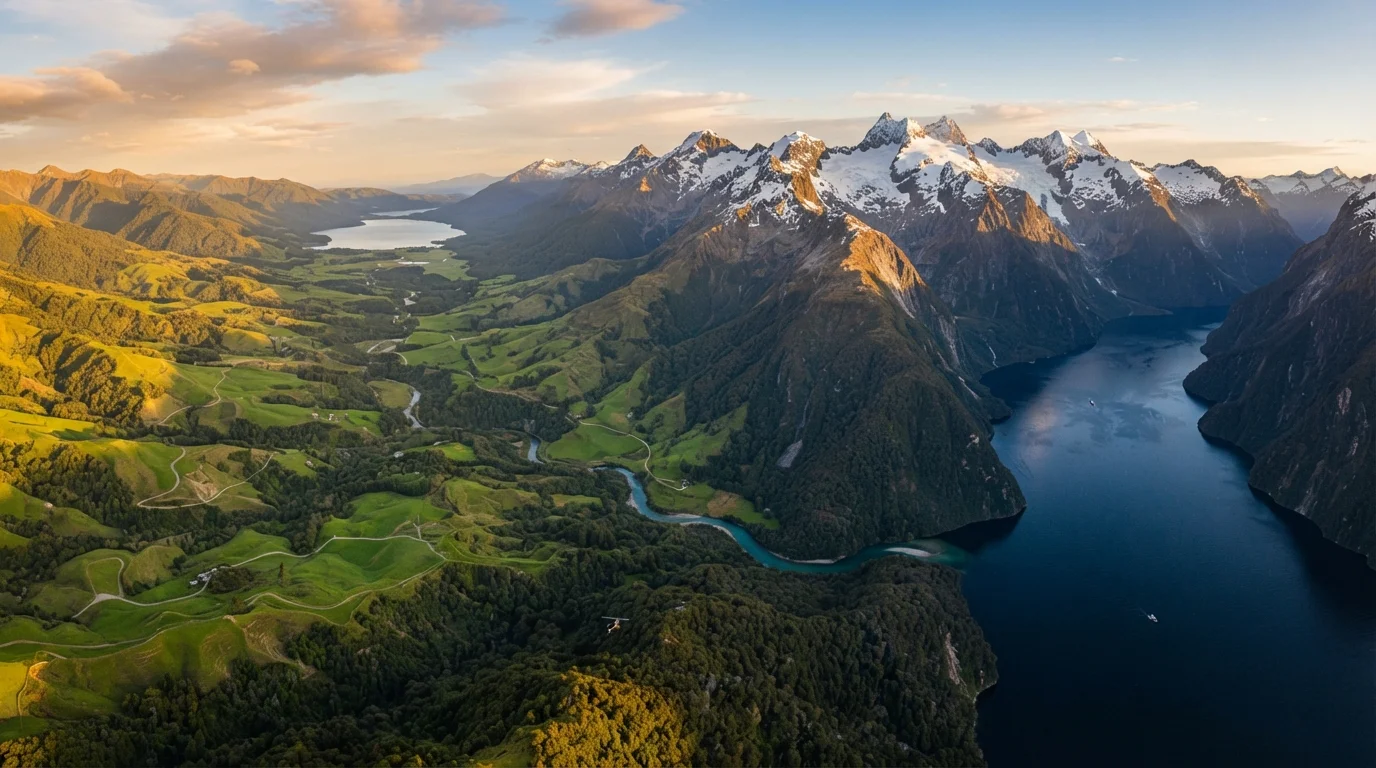
Fiordland National Park, in the far southwest, contains Milford Sound and Doubtful Sound — dramatic fjords carved by glaciers that descend steeply into dark, mirror-still water. The Marlborough Sounds in the north, the limestone landscapes of the Abel Tasman coast, and the wild beaches of the Catlins in the south all offer textures the North Island simply doesn't replicate.
What the scenery doesn't immediately advertise is the logistical reality: distances are long, some roads are genuinely challenging, and weather — particularly in Fiordland — can close or obscure major attractions for days at a time. Our deeper look at South Island planning covers what logistics and weather actually mean for your itinerary.
| North Island | South Island | |
|---|---|---|
| Signature landscape | Volcanic plateaus, geothermal fields, rolling coastlines | Alpine peaks, glaciers, fjords, turquoise lakes |
| Cultural depth | Extensive Māori cultural experience, major urban centers | Smaller population centers, Māori heritage present but less central |
| Climate | Warmer, more stable, subtropical in far north | Cooler, more variable; Fiordland among world's rainiest regions |
| Driving distances | Manageable; highlights within 4–5 hours of each other | Long; some key sites 6–8+ hours apart by road |
| Adventure activity range | Moderate; hiking, surfing, white-water rafting | Extensive; skiing, bungee, heli-hiking, kayaking in fjords |
| Best fit for | Culture-seekers, first-timers, shorter trips | Nature-chasers, outdoor adventurers, longer itineraries |
Making the Call: Time, Temperament, and Priorities
The clearest deciding factor is time. Travelers with fewer than ten days generally find the South Island more rewarding if maximum visual drama is the goal — though rushing it defeats the purpose. The North Island fits a slightly shorter window more comfortably because its highlights are more closely spaced.
Temperament matters just as much. If you travel to connect with history, living culture, and the stories behind a landscape, the North Island will feed you in ways the South cannot quite match. If you travel primarily to be physically inside spectacular nature — hiking, kayaking, watching waterfalls — the South Island is difficult to rival anywhere in the world.
Budget is also a quiet factor. Both islands share New Zealand's reputation for being an expensive destination, but the South Island's adventure activities and more remote lodgings can accumulate costs quickly. Travelers who have grappled with similar cost-versus-experience trade-offs in other dramatic destinations may find our comparison of Patagonia's Argentine and Chilean sides a useful parallel.
268,021 km²
Total land area of New Zealand
New Zealand's combined landmass is roughly the size of the United Kingdom, yet it contains extraordinary geographic diversity across two main islands.
~75%
Share of NZ population on North Island
The North Island holds the majority of New Zealand's population, anchored by Auckland and Wellington, shaping its more urban and connected character.
182 km
Length of Fiordland's Milford Road
The drive to Milford Sound from Te Anau traverses one of New Zealand's most dramatic — and sometimes closed — mountain roads, illustrating South Island logistics.