

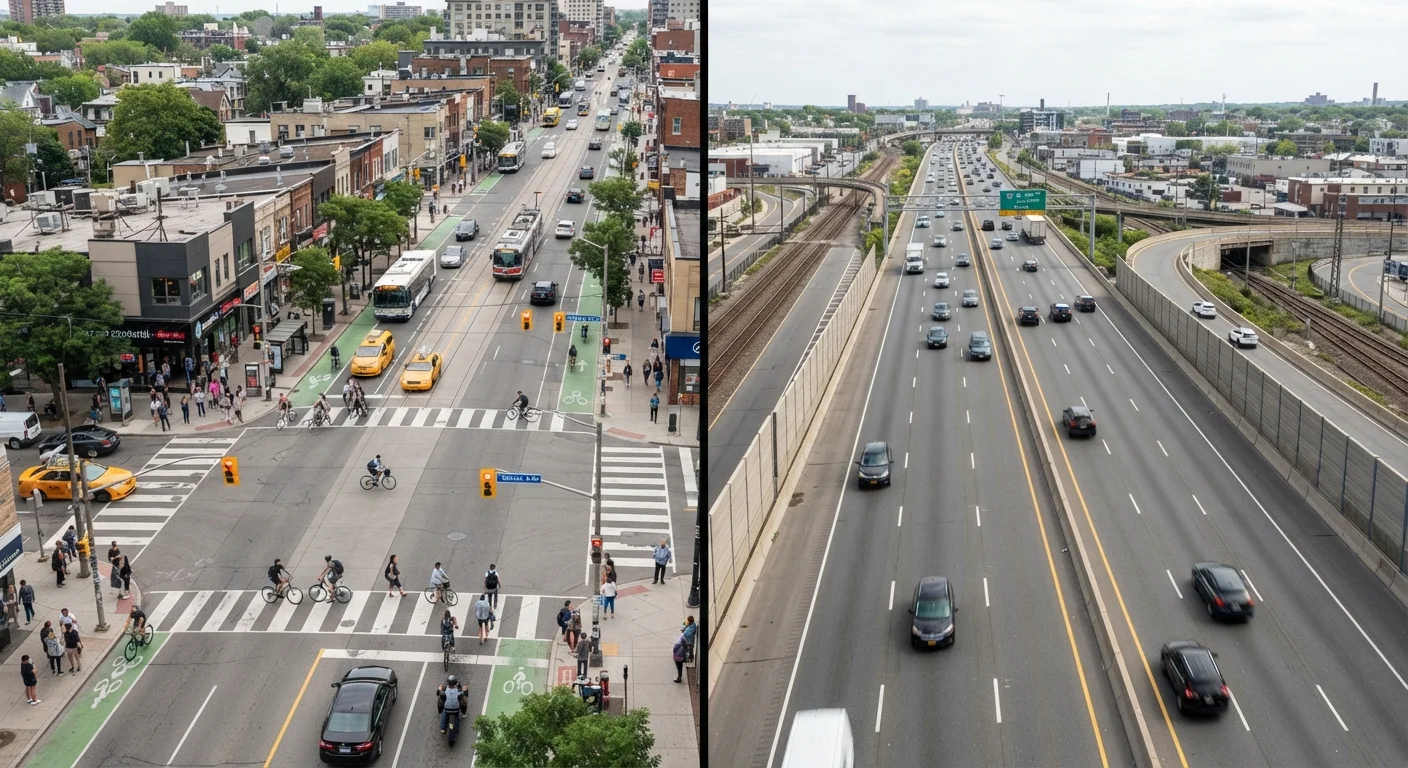
Key Takeaways
Option A
Motorway Driving
High-speed, sustained concentration over long distances.
Best for: Long-distance travel where maintaining safe following distances and lane discipline at speed are the primary concerns.
Option B
Urban Road Driving
Low-speed, high-complexity navigation through unpredictable environments.
Best for: Daily commuting and local trips where hazard scanning, junction awareness, and pedestrian interaction are constant demands.
If you drive long interstate or highway routes regularly
Motorway Driving habits
Sustained speed management, early lane positioning, and maintaining large following gaps are the skills that matter most on open roads.
If your daily driving is mostly city commuting
Urban Road Driving habits
Close-range hazard scanning, junction priority awareness, and speed modulation in dense traffic are the skills your environment demands every day.
If you regularly switch between both environments on a single journey
A deliberate mental transition approach
Neither set of habits alone is sufficient — drivers who consciously reset their awareness style at each transition make fewer errors in both settings.
Why Road Type Changes Everything About How You Should Drive
Most drivers understand that speed limits change between road types. What's less commonly recognized is that the entire cognitive framework for safe driving — how you scan, where you look, how far ahead you plan, and what you treat as a hazard — should also shift depending on whether you're on a motorway or navigating urban streets.
The consequences of carrying urban habits onto a motorway, or motorway habits into a city, go beyond inconvenience. They create measurable risk. Safe driving across every road situation requires understanding not just the rules of each environment, but the mental model each demands.
| Criterion | Motorway Driving | Urban Road Driving |
|---|---|---|
| Primary hazard type | High-speed proximity, lane changes, fatigue | Pedestrians, cyclists, junctions, signals |
| Scanning focal distance | Far ahead (12+ seconds travel time) | Close range (immediate surroundings) |
| Speed management style | Sustained, consistent speed | Frequent modulation at signals and junctions |
| Following distance | 2+ second rule; increases in poor conditions | Shorter gaps, but higher stop frequency |
| Lane discipline | Keep right; pass on left; signal early | Follow lane markings; yield at junctions |
| Dominant psychological risk | Complacency / highway hypnosis | Cognitive overload / distraction |
| Overtaking frequency | Regular; requires advance planning | Rare; more regulated by layout |
Hazard Scanning: Close Range vs. Distant Anticipation
On urban roads, hazards emerge suddenly and from many directions — a pedestrian stepping off a curb, a cyclist filtering between lanes, a car reversing from a driveway. Effective urban scanning means repeatedly checking mirrors, watching for movement at junctions, and anticipating the behavior of vulnerable road users within a tight radius around your vehicle.
On a motorway, the hazard landscape is completely different. The relevant threats are typically further away — a vehicle braking hard three cars ahead, a lane merge 400 meters up the road, or a debris object you'll reach in seconds at 70 mph. Motorway scanning demands a longer focal range and an earlier processing window. Drivers who continue scanning at urban distances on a motorway often have dangerously short reaction time because their eyes aren't tracking far enough ahead.
Defensive driving principles emphasize that anticipation — not just reaction — is what separates safe drivers from those who are merely lucky. The distance at which anticipation must begin is substantially longer at motorway speeds.
~50%
Fatal crashes on high-speed roads involving speed
The NHTSA consistently reports that speed is a contributing factor in roughly half of all fatal highway crashes in the United States.
65%
Urban pedestrian fatalities as share of all pedestrian deaths
According to NHTSA data, the majority of pedestrian fatalities in the US occur in urban areas, underscoring the complexity of city driving environments.
2 seconds
Minimum recommended following distance at any speed
The two-second rule is the baseline recommended by the National Safety Council, with greater gaps advised in adverse weather or at higher speeds.
Lane Discipline, Following Distance, and Speed Management
Urban road lanes are typically narrower, more frequently blocked, and governed by a greater variety of signals and markings. Following distances shrink in slow-moving traffic, but drivers must compensate by staying alert for sudden stops. Speed management is reactive — traffic signals, pedestrian crossings, and yielding at junctions constantly demand modulation.
Motorway lane discipline operates on different principles. Keeping left except to overtake is a fundamental rule on multi-lane motorways in the US context, where slower traffic should generally keep right and passing occurs on the left. Speed limits and how they vary by road type interact directly with following distance — at 70 mph, a two-second gap translates to roughly 205 feet, which is the minimum recommended under ideal conditions, not a comfortable buffer.
Overtaking safely on motorways also requires earlier planning than most drivers apply — assessing speed differentials and gap sizes well in advance, not at the moment of commitment.
The Psychological Shift Between Environments
Complacency is the dominant risk on motorways. Long stretches of similar scenery, low cognitive load, and monotonous speed can induce a form of highway hypnosis — a state of reduced conscious awareness despite continued vehicle operation. Drivers should take regular breaks on journeys over two hours and use variable lane changes and active mirror checks to maintain engagement.
Urban driving carries the opposite psychological risk: cognitive overload. The sheer volume of signals, signs, pedestrians, cyclists, and junction decisions can overwhelm attention, leading drivers to miss hazards while processing competing information. Slowing down slightly below the limit in complex urban zones is not over-caution — it's a rational response to the information load.
Transitioning from one environment to the other requires a deliberate mental reset. Drivers arriving from a long motorway run and entering city streets often take several minutes to recalibrate their speed perception and hazard sensitivity. Road safety myths include the assumption that experienced drivers automatically adapt — research consistently shows transition errors are common even among confident, long-term drivers.
Transitioning Between Road Types Mid-Journey
If your route takes you from a motorway directly into urban traffic, give yourself a brief moment to consciously recalibrate before the transition — check your mirrors, reduce speed proactively, and widen your hazard scan. This is particularly relevant at the end of long highway runs when fatigue may have dulled your responsiveness. Night driving adds a further layer of complexity to this transition, as reduced visibility compounds the adjustment challenge.