

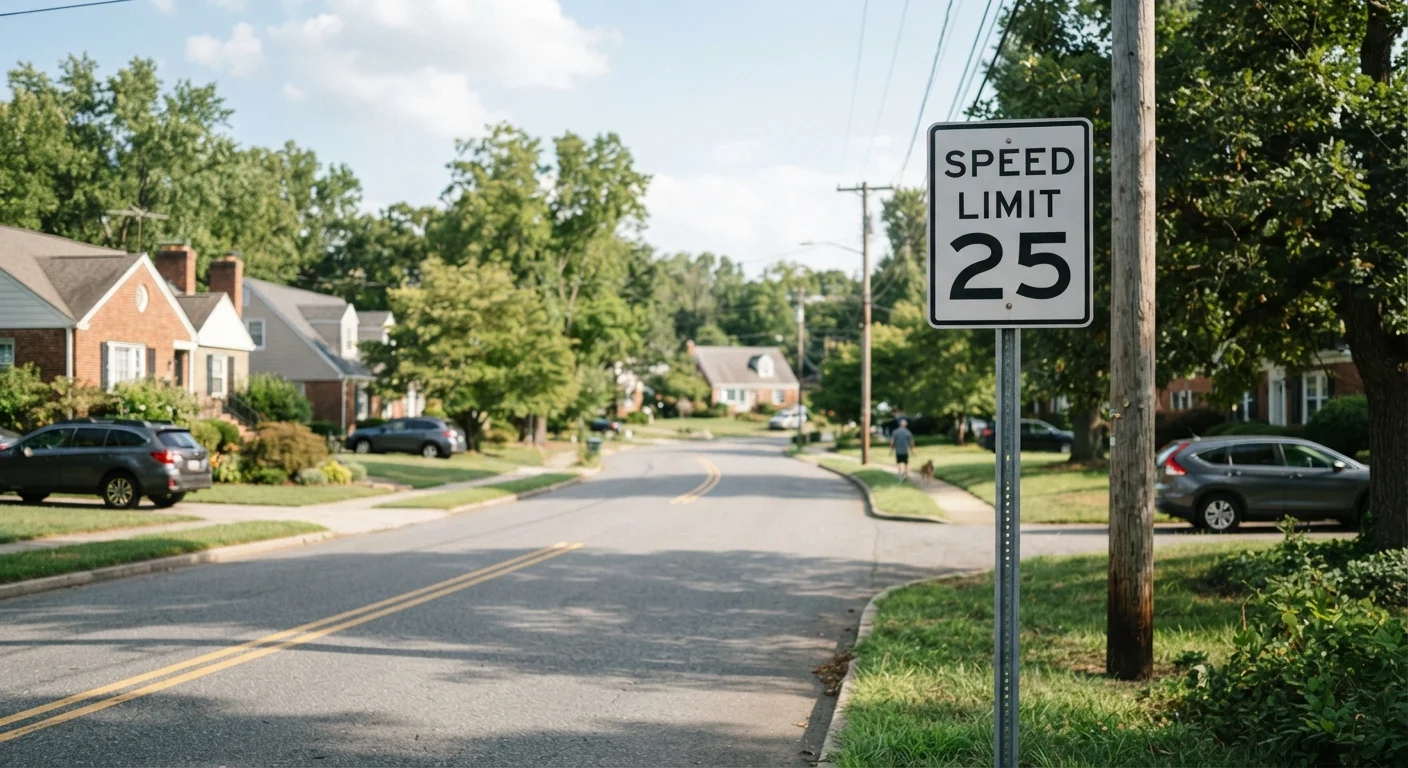
How Speed Limits Are Set — and Who Sets Them
Speed limits in the United States are established at multiple levels of government. The federal government sets standards and guidelines, but individual states have primary authority to post statutory limits on roads within their borders. Local municipalities can further lower limits on streets they control, which is why a 35 mph residential street can abruptly become a 25 mph school zone within the same neighborhood.
Engineers and traffic authorities typically use a method called the 85th-percentile speed study to inform posted limits. This measures the speed at or below which 85 percent of free-flowing drivers naturally travel on a given road — a figure used alongside factors like crash history, pedestrian activity, and road geometry. The goal is a limit that reflects realistic conditions while discouraging the most dangerous outliers.
For a broader perspective on how road type shapes the full driving experience, see how habits should shift between motorway and urban roads.
Standard Limits by Road Type
While limits vary by state, some common benchmarks apply across most of the country:
- Residential streets: Typically 25–30 mph. Some cities have moved to default 25 mph limits city-wide.
- Urban arterials and collector roads: Usually 30–45 mph depending on lane width, intersections, and pedestrian density.
- Rural two-lane highways: Commonly 55 mph, though this varies significantly by state terrain and traffic volume.
- Divided highways and expressways: Often 65–70 mph, with some states permitting up to 75 or 80 mph in low-density areas.
- Interstates in rural areas: Can reach 80–85 mph in states such as Texas and Utah, though these are exceptions rather than the norm.
Statutory speed limit
A default speed limit established by state law that applies on a given road type even when no sign is posted. Drivers are expected to know their state's statutory limits.
Variable speed limit (VSL)
An electronically displayed speed limit that changes in response to real-time traffic, weather, or incident conditions. VSLs carry full legal authority when active.
85th-percentile speed
The speed at or below which 85 percent of free-flowing vehicles travel under normal conditions. Traffic engineers use this figure as a key input when setting posted limits.
Advisory speed
A recommended (not legally enforceable) speed displayed on a yellow warning sign, typically for curves, ramps, or intersections. It reflects safe navigation of a specific road feature.
Work zone speed limit
A temporarily reduced limit posted in active highway construction areas. It is legally binding whether or not workers are physically present, and fines are typically doubled.
Speed is directly tied to stopping distance. The science behind stopping distances shows just how dramatically reaction time and braking distance increase with every additional 10 mph.
Variable and Temporary Speed Limits
Not all speed limits are static. Variable speed limits (VSLs) — also called dynamic speed limits — are electronically displayed signs that change based on real-time conditions such as weather, congestion, incidents, or road work. VSLs are increasingly common on urban freeways and smart highway corridors. When a VSL is active, it carries the same legal force as a fixed posted sign, and drivers are expected to comply immediately.
Temporary work zone limits are another important category. Federal law ties highway funding to states enforcing reduced limits in active construction zones, and fines are commonly doubled in these areas. The presence of workers is not always required for the lower limit to apply — if signs are posted, the limit is in effect.
School Zone Limits: Timing Matters
School zone speed limits — typically 15–25 mph — are only enforceable during the hours displayed on the accompanying sign or when a flashing beacon is active. Outside those windows, the standard road limit applies. However, children may be present at other times, so cautious driving near schools is always advisable regardless of the posted schedule.
School zone limits — typically 15–25 mph — are enforceable only during designated hours, which are usually marked on the sign itself. Flashing beacons indicate when the lower limit is active. Ignoring a school zone limit carries significant fines in most states.
Edge Cases Every Driver Should Understand
Several situations create confusion about which limit actually applies:
- No posted sign: Most states have a statutory (default) speed limit that applies when no sign is present. Common defaults are 25 mph in urban areas, 55 mph on undivided rural roads, and 65–70 mph on divided highways. Check your state's vehicle code if you're uncertain.
- Minimum speed limits: Some highways post a minimum as well as a maximum. Driving significantly below traffic flow can be just as hazardous as speeding and may carry a fine.
- Advisory speeds: Yellow warning signs with speed numbers (e.g., on a sharp curve) are not legally enforceable limits — they are engineering recommendations for safe navigation of that specific feature. However, exceeding them in poor conditions can support a reckless driving charge.
Understanding speed in context matters well beyond the posted number. Your actual safe speed depends on visibility, road surface, traffic density, and vehicle load. Safe following distance rules also need to scale up as speeds increase. And when assessing whether to overtake, speed differentials become critical — overtaking safely requires accurate judgment of your own speed and the vehicle ahead.
For a comprehensive look at how speed awareness fits into an overall safe driving approach, the complete overview of safe driving covers the full range of road situations every driver encounters.