

Key Takeaways
Safe Following Distance
Safe following distance is the amount of space a driver should maintain between their vehicle and the one directly ahead. It gives you enough time and room to react and brake safely if the car in front slows or stops suddenly. The widely taught 'two-second rule' offers a practical way to estimate this gap in most everyday driving conditions.
Stopping distance is the sum of reaction distance (the distance traveled while the driver perceives and responds to a hazard) and braking distance (the distance traveled while the brakes are applied). Both components increase with speed, making following distance exponentially more critical at highway speeds.
How the Two-Second Rule Works
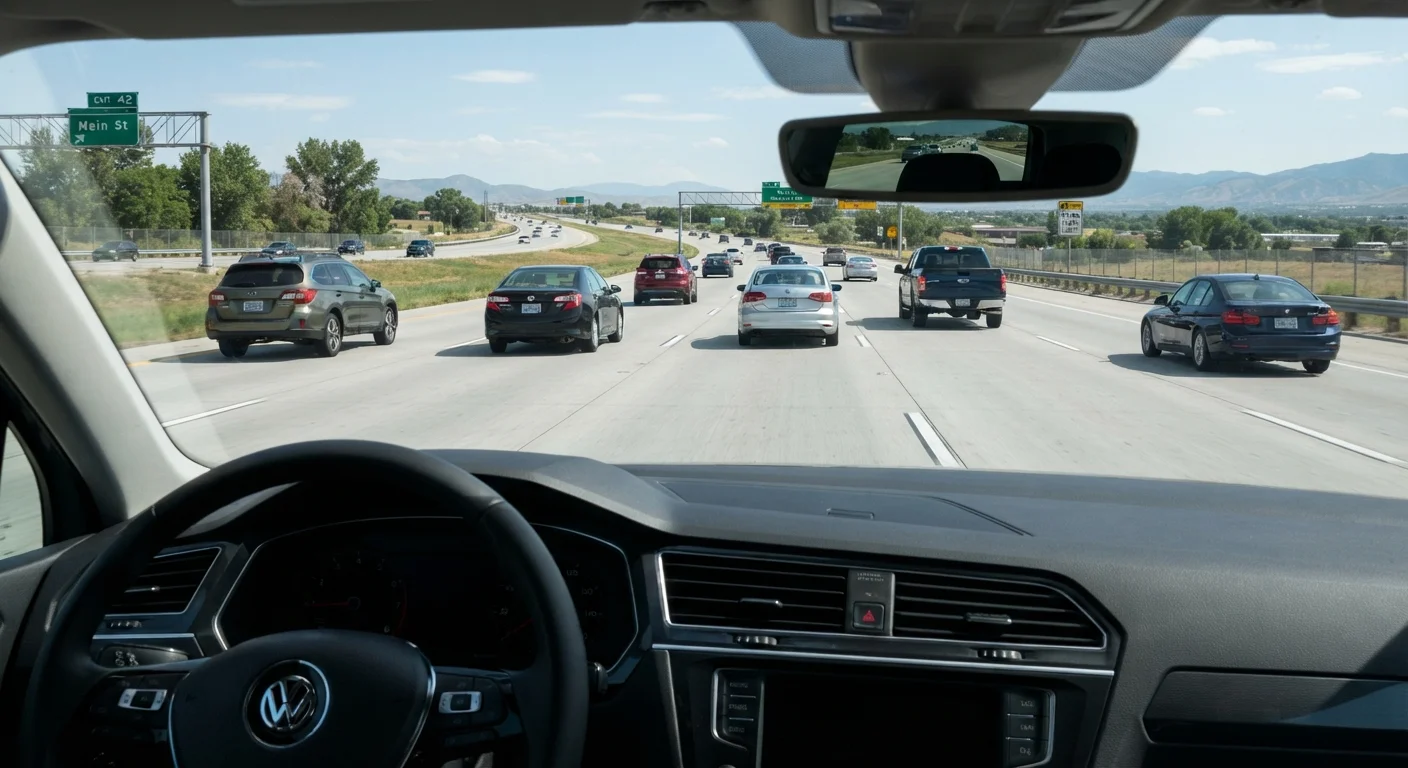
The two-second rule is a straightforward method for gauging whether you're keeping a safe gap behind the car ahead. As the vehicle in front passes a stationary landmark — a road sign, a bridge pillar, a painted line — you begin counting: one one-thousand, two one-thousand. If you reach that same point before finishing the count, you're too close and need to ease off the accelerator.
At 60 mph, two seconds translates to roughly 176 feet — just over half the length of a football field. That gap provides time for your brain to register a hazard, your foot to move from accelerator to brake, and your vehicle to actually slow. This sequence — perception, reaction, braking — takes longer than most drivers expect, especially when traveling at speed.
The rule is taught because it scales reasonably with speed: two seconds at 30 mph gives you less physical space than two seconds at 60 mph, but the additional braking demand at higher speeds is also reflected in the larger gap. It's a useful approximation, not an engineering guarantee. For a deeper look at how speed affects hazard response, see our guide to speed limits and their reasoning.
~29%
Share of all U.S. crashes that are rear-end collisions
According to the National Highway Traffic Safety Administration (NHTSA), rear-end crashes consistently represent a significant portion of all reported traffic collisions.
~300 ft
Stopping distance at 60 mph on dry pavement
This includes an estimated reaction distance of around 132 feet plus braking distance, based on widely cited driver education data.
6–10x
Increase in stopping distance on ice vs. dry road
Ice dramatically reduces tire-to-road friction; safety authorities note stopping distances can increase by six to ten times compared with dry conditions.
When Two Seconds Isn't Enough
The two-second rule was designed for ideal conditions: dry pavement, good visibility, an alert driver, and a well-maintained vehicle. The moment any of those variables changes, the minimum gap must grow.
Weather and Road Surface
Wet roads can double stopping distances. Ice can multiply them by six to ten times. In rain or snow, a four-second gap is a practical starting point; in icy or foggy conditions, more space is warranted. Visibility reduction compounds the problem — if you can't see far ahead, you have even less time to respond to events further up the road.
Speed
At interstate speeds, two seconds may feel generous but leaves little physical margin. Defensive driving programs generally recommend three seconds as a minimum baseline on freeways, with four or more seconds in heavier traffic where chain-reaction braking is more likely.
Vehicle Type and Load
Trucks, SUVs with roof loads, and vehicles towing trailers have higher stopping distances due to greater mass. Motorcycles, while lightweight, depend heavily on road surface conditions. If you're behind a large commercial truck, remember that its stopping distance at highway speed can exceed the length of a city block. Tailgating is far more dangerous than most drivers recognize — especially behind vehicles with different braking profiles than your own.
Use a Landmark, Not Your Speedometer
Rather than estimating distance by eye, use the two-second counting method every time. Choose a fixed object on the road — a sign, a shadow line, an overpass — and count after the car ahead passes it. This takes the guesswork out of spacing and works at any speed. If conditions are poor, count to four before that object disappears behind you.
Building the Habit of Proper Spacing
Consistent following distance is a skill that requires active attention, especially when traffic is dense and other drivers are cutting in. A practical approach: if a vehicle merges into your gap, ease off the accelerator gradually to re-establish space rather than braking sharply. This also reduces the accordion effect — where a single hard brake ripples back through a line of vehicles.
Driver fatigue, distraction, and overconfidence are among the most common reasons drivers follow too closely without realizing it. Checking your gap periodically — particularly on long highway drives — helps counter the natural tendency to drift closer to the car ahead over time.
Safe following distance connects to broader defensive driving principles. Whether you're navigating a busy freeway or a two-lane rural road, space translates directly into options. See our complete overview of safe driving across every road situation for how following distance fits within a wider set of habits. When following distance and timing intersect with overtaking, the stakes rise further — our guide to overtaking safely covers how to assess those situations. Maintaining adequate space isn't just good practice — it's one of the most accessible, zero-cost adjustments any driver can make immediately.