

Key Takeaways
Tailgating
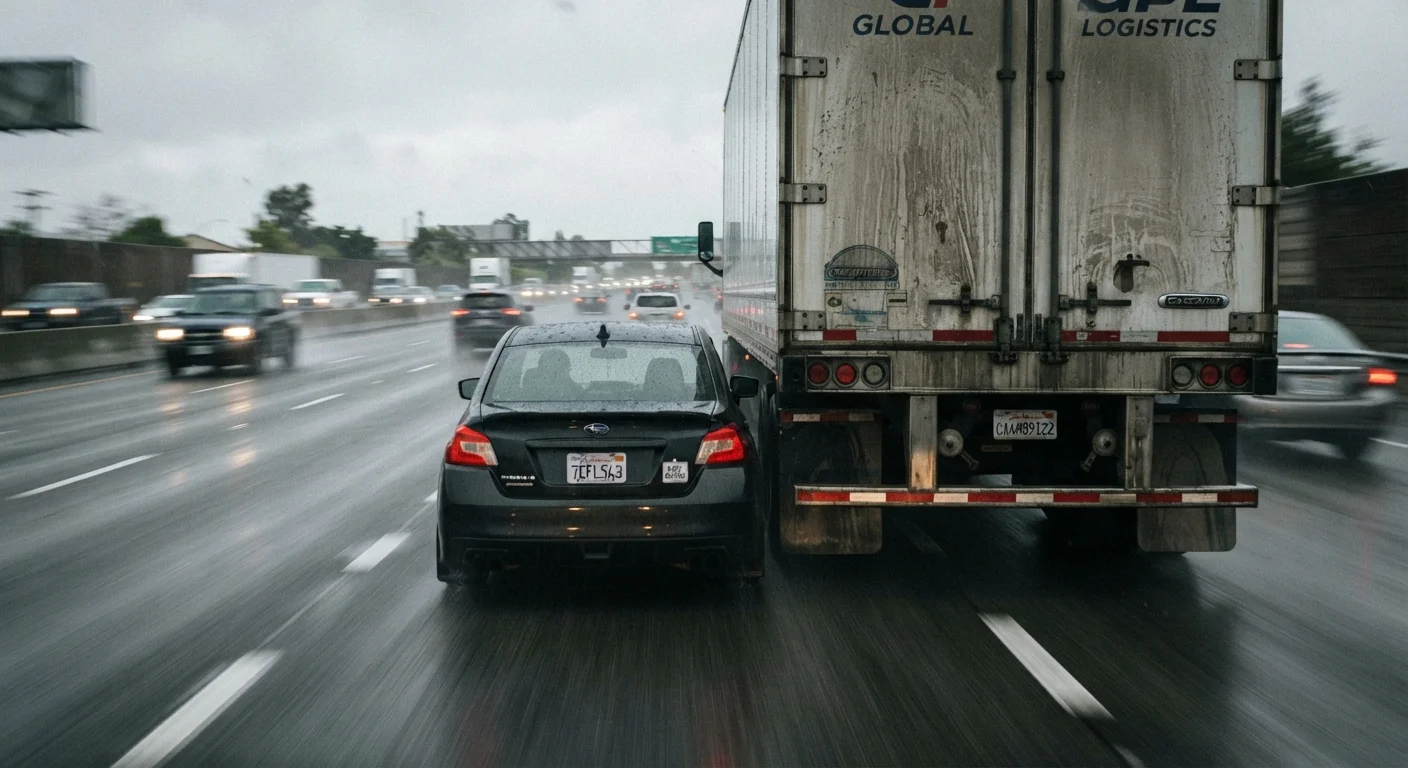
Tailgating means driving too closely behind the vehicle in front — leaving less space than is needed to stop safely if that driver brakes suddenly. It is one of the most common driver behaviors that leads to rear-end collisions. Most traffic safety guidelines recommend maintaining a following distance of at least two to three seconds under normal conditions.
Following distance is typically measured in time rather than vehicle lengths, because the stopping distance required increases with the square of speed — meaning a small increase in speed demands significantly more space to brake safely.
The Physics Behind the Risk
Most drivers know, in the abstract, that following too closely is dangerous. What many underestimate is the precise, unforgiving mathematics that govern stopping distances at speed.
When a hazard appears — a car braking ahead, debris on the road, a pedestrian stepping off a curb — a driver must first perceive the danger, then decide to act, then move their foot to the brake. This perception-reaction sequence typically takes between 1.5 and 2.5 seconds, depending on alertness and distraction level. At 60 mph, the vehicle covers roughly 132–220 feet before braking even begins. Once the brakes engage, further distance is needed to bring the car to a complete stop — and that braking distance increases with the square of speed, not linearly.
The practical result: a driver following one second behind the vehicle in front at highway speed has almost no margin for error. A gap that feels comfortable in slow urban traffic is dangerously insufficient at freeway speeds.
~33%
Of all US traffic crashes that are rear-end collisions
The National Highway Traffic Safety Administration (NHTSA) has consistently identified rear-end crashes as one of the most frequent crash types on US roads.
1.5–2.5 sec
Typical human perception-reaction time before braking
Traffic engineering literature widely cites this range as the standard assumption for estimating stopping distances in road design.
2x+
Increase in stopping distance on wet roads
The Highway Loss Data Institute notes that wet pavement can more than double the distance required to stop compared with dry conditions at the same speed.
Why Drivers Misjudge Their Own Following Distance
Tailgating is rarely intentional in the way aggressive driving is often depicted. Most drivers who follow too closely do so because they consistently misjudge how much space they are actually leaving.
Several factors distort perception. At high speeds, the visual scene compresses — nearby vehicles appear closer than they feel. When surrounded by traffic moving at the same pace, drivers anchor to the flow rather than to objective distance. There is also a well-documented tendency to feel a false sense of security when the driver ahead is visible and steady — right up until they brake unexpectedly.
Fatigue makes this worse. Drowsy driving impairs reaction time and judgement in ways that closely mirror alcohol intoxication, yet many drivers feel alert enough to follow closely even when they are not. Distraction — a glance at a phone, a conversation with a passenger — compounds the problem further. See our article on how passenger behaviour can affect driver attention for more on this dynamic.
Use the Three-Second Rule Every Trip
Pick a fixed road marker and count three full seconds between when the car ahead passes it and when you do. If you arrive before finishing the count, ease back. In poor weather or when fatigued, increase the gap to six seconds or more. Making this a habitual check — not just a one-time thought — is what keeps the distance meaningful.
Common Misconceptions About Tailgating
A number of persistent beliefs lead drivers to underestimate the risk. The idea that a skilled driver can compensate for a tight gap through faster reflexes is one example — human reaction time has a physiological floor that training does not significantly lower. Another is the assumption that modern anti-lock brakes or driver assistance systems can override the laws of physics. These technologies help — but they cannot create stopping distance that does not exist.
The belief that tailgating is only dangerous when a driver is being aggressive is also misleading. Cruising in dense highway traffic while matching the pace of the car ahead can produce the same inadequate following distances as deliberate pressure-driving. Many driving beliefs that feel like common sense turn out to be contradicted by research — this is one of them.
Maintaining a Safe Following Distance in Practice
The three-second rule is the most practical tool available to everyday drivers. Pick a stationary object — a bridge, a sign, a road marking. When the vehicle ahead passes it, count slowly: one-thousand-one, one-thousand-two, one-thousand-three. If you reach the marker before finishing, you are following too closely.
In wet conditions, increase that buffer to at least six seconds — wet roads can more than double stopping distances. In fog, ice, or when towing a trailer, add further margin still. Large vehicles such as trucks and buses require extra attention, because their braking distances are substantially longer and their brake failure consequences more severe.
Overtaking decisions should also factor in following distance logic. Safe overtaking depends on accurately reading speed differentials and available gaps — the same spatial awareness that prevents tailgating. Building the habit of consistent gap management, rather than treating each situation as isolated, is what separates reactive driving from genuinely safe driving.
Following Distance and Fuel Efficiency
Maintaining a larger following distance also has a secondary benefit: it allows smoother, more gradual acceleration and deceleration, which improves fuel economy compared to the constant micro-braking of close-following driving. While this should not be the primary motivation for safe gap management, it is a practical co-benefit worth knowing.