

Key Takeaways
Why Junction Errors Are So Costly
Intersections, roundabouts, and merge zones are the pressure points of any road network. They are where vehicles traveling different paths must negotiate shared space in real time — and where misunderstanding the rules creates the conditions for a collision. As part of a broader approach to safe driving, getting junction behavior right is non-negotiable.
The errors described below are not limited to new drivers. Experienced drivers develop habits that go uncorrected, especially in scenarios they encounter infrequently — like an unfamiliar multi-lane roundabout or an unmarked rural intersection. Understanding why these mistakes happen is the first step to consistently avoiding them.
~40%
Of all U.S. crashes occur at intersections
The Federal Highway Administration estimates that roughly 40 percent of all crashes in the U.S. involve intersections, making junction behavior one of the most consequential areas of driver skill.
75%
Reduction in fatal crashes at roundabout conversions
Research published by the Insurance Institute for Highway Safety (IIHS) has found that converting conventional intersections to roundabouts can reduce fatal crashes by approximately 75 percent at those locations.
~50%
Of merging conflicts involve speed mismatch
Transportation safety researchers consistently identify speed differential — entering traffic moving significantly slower than highway traffic — as a leading factor in merge-zone conflicts.
Roundabout Rules Most Drivers Misapply
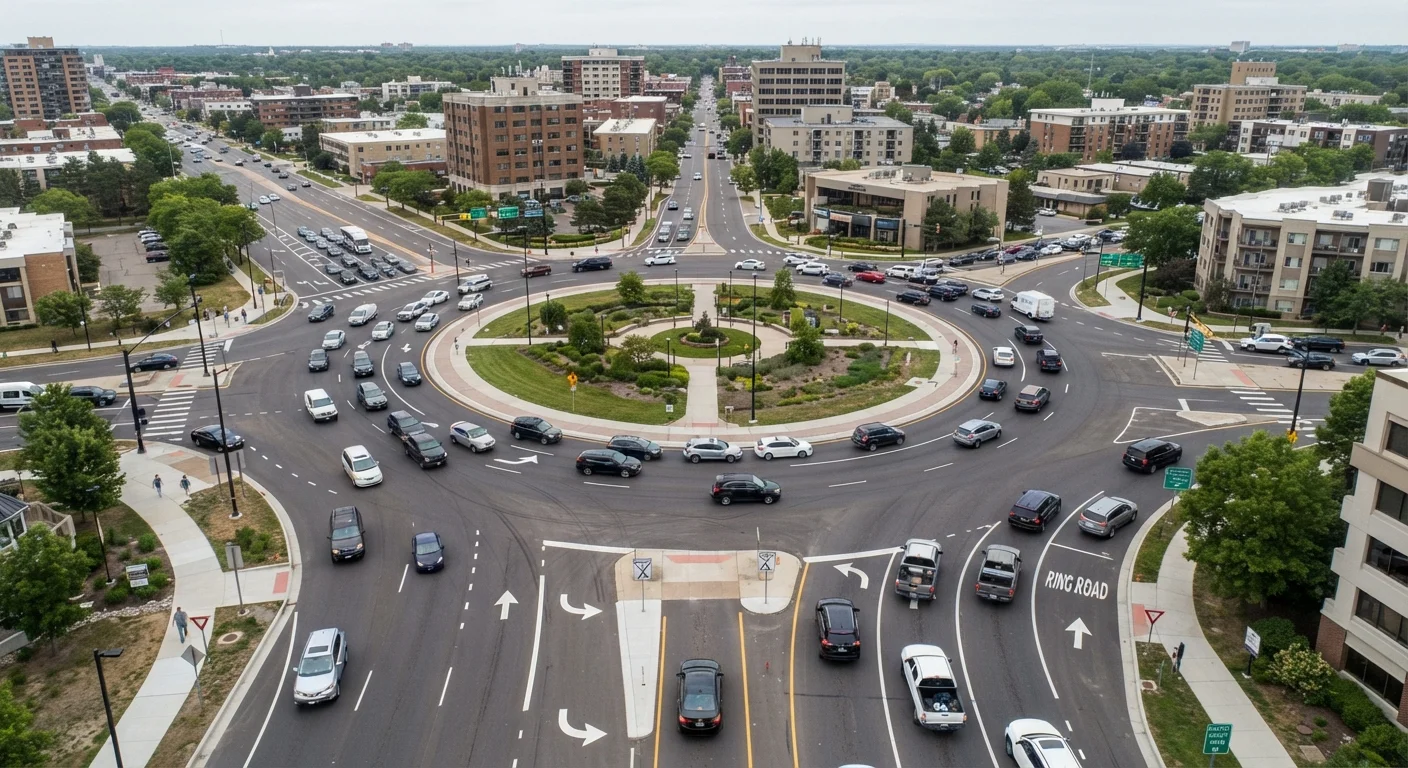
Roundabouts remain one of the most misunderstood junction types in the U.S., partly because they were introduced widely later than in many other countries and partly because their rules genuinely differ from four-way stop logic drivers have internalized over years.
Treating a roundabout like a four-way stop and yielding to entering traffic instead of circulating traffic.
Why it happens: Drivers unfamiliar with roundabouts fall back on four-way stop logic, where traffic alternates. The 'yield to the left' instinct gets confused when circular geometry is involved.
Choosing the wrong lane before entering a multi-lane roundabout.
Why it happens: Roundabout lane markings can be difficult to read at approach speeds, and drivers often don't look far enough ahead to assess which exit they need.
Merging onto a highway without adjusting speed to match the flow of traffic.
Why it happens: Many drivers treat the on-ramp as a stopping point or coast too slowly, underestimating how much the speed differential matters at 65–70 mph.
Assuming the vehicle on the right always has priority at uncontrolled intersections.
Why it happens: The 'right has right of way' rule is real but limited in scope. Drivers over-generalize it to situations where signs, signals, or specific road configurations override it.
Failing to signal when exiting a roundabout, leaving other drivers uncertain about your intentions.
Why it happens: Drivers concentrate on navigating the circle and forget that their signal still communicates to pedestrians and waiting traffic whether they plan to exit or continue.
Merging too late on a lane-drop or highway exit, cutting across traffic at the last moment.
Why it happens: Late merging sometimes feels efficient, but when it becomes habitual, it forces abrupt lane changes that other drivers cannot anticipate.
For a broader look at how road type affects driver behavior, see our piece on motorway driving versus urban roads.
Don't Stop Inside a Roundabout
Stopping in the circulating lane to let entering vehicles in is a common but dangerous impulse. It disrupts traffic flow and can cause rear-end collisions from drivers behind who don't expect a sudden stop. Maintain steady, predictable movement through the roundabout unless a hazard directly ahead requires you to stop.
Right of Way: What the Rules Actually Say
Right of way rules exist to create predictability — but they only work when all drivers understand them the same way. Misreading who must yield at an uncontrolled intersection, a merge, or a pedestrian crossing doesn't just cause inconvenience; it creates genuine danger for everyone nearby.
Right of Way Is Yielded, Not Taken
The phrase 'right of way' describes who must yield, not who is legally permitted to force their way through. Even when you technically have the right of way, you are still legally and ethically responsible for avoiding a collision if one is imminent. Never assume another driver will stop — always be prepared to yield in ambiguous situations.
These misunderstandings are closely linked to the kinds of road safety myths many drivers carry without realizing it. The belief that confident driving is always correct driving, for instance, can make a driver less likely to pause and re-check the rules at an unfamiliar junction type.
Developing careful, consistent habits at every intersection — checking for control signs before defaulting to any assumed rule, leaving time to scan, and signaling every intention — is the foundation of safe junction navigation. Combining that with the kind of spatial awareness needed for high-stakes maneuvers like overtaking builds a driver who is genuinely safe across situations, not just familiar ones.