

| Most common style in US homes | Transitional (blending traditional and contemporary) (Houzz U.S. Houzz & Home Study, 2023) |
| Standard ceiling height | 8–9 feet in most modern US construction (National Association of Home Builders) |
| Rule of three | Objects grouped in odd numbers (especially threes) look more natural and visually balanced (Long-standing interior design principle) |
| 60-30-10 color rule | 60% dominant color, 30% secondary color, 10% accent color — a widely used starting framework (Common interior design guideline) |
| Chair rail height | Typically 32–36 inches from the floor |
Why Interior Design Vocabulary Matters
Whether you're briefing a decorator, scrolling through inspiration boards, or simply trying to describe why a room feels off, design terminology gives you the words to work with. This glossary covers the terms that come up most often — in renovation conversations, furniture listings, and style guides — explained in plain, practical language.
If you're starting from scratch with a new space, our room-by-room decorating guide is a useful companion to this reference. And for those navigating structural vocabulary in a renovation context, see A Homeowner's Glossary of Structural Terms.
| Most common style in US homes | Transitional (blending traditional and contemporary) (Houzz U.S. Houzz & Home Study, 2023) |
| Standard ceiling height | 8–9 feet in most modern US construction (National Association of Home Builders) |
| Rule of three | Objects grouped in odd numbers (especially threes) look more natural and visually balanced (Long-standing interior design principle) |
| 60-30-10 color rule | 60% dominant color, 30% secondary color, 10% accent color — a widely used starting framework (Common interior design guideline) |
| Chair rail height | Typically 32–36 inches from the floor |
Core Design Concepts
These foundational terms describe how spaces are planned, balanced, and experienced as a whole.
Biophilic design
An approach that brings natural elements — plants, natural light, water features, organic textures — into interior spaces. The goal is to strengthen occupants' connection to nature, which research associates with improved wellbeing and reduced stress.
Wainscoting
Decorative wood paneling applied to the lower portion of a wall, typically from the floor to around chair-rail height (roughly 32–36 inches). It adds architectural interest and can protect walls from scuffs and bumps.
Sightline
The visual path your eye naturally follows when standing in or entering a room. Designers arrange furniture and focal points to guide sightlines toward pleasing features and away from clutter or awkward angles.
Visual weight
How heavy or substantial an object appears relative to others in a room. Dark colors, large scale, and dense textures add visual weight; light colors and open frames reduce it. Balancing visual weight creates a sense of stability.
Negative space
The intentionally empty or undecorated areas in a room. Rather than a design failure, negative space gives the eye a place to rest and prevents a space from feeling cluttered or overwhelming.
Juxtaposition
Placing contrasting elements side by side — rough beside smooth, modern beside antique — to create visual tension and interest. Thoughtful juxtaposition prevents a room from feeling flat or predictable.
Color temperature
A descriptor for how warm or cool a color reads. Warm tones (reds, oranges, yellows) advance visually and feel energizing; cool tones (blues, greens, grays) recede and feel calming. Both paint colors and light bulbs are described using this concept.
Transitional style
A design approach that blends traditional and contemporary elements — think classic furniture silhouettes in neutral, updated fabrics. It's one of the most common styles in American homes because it's flexible and broadly appealing.
Layering
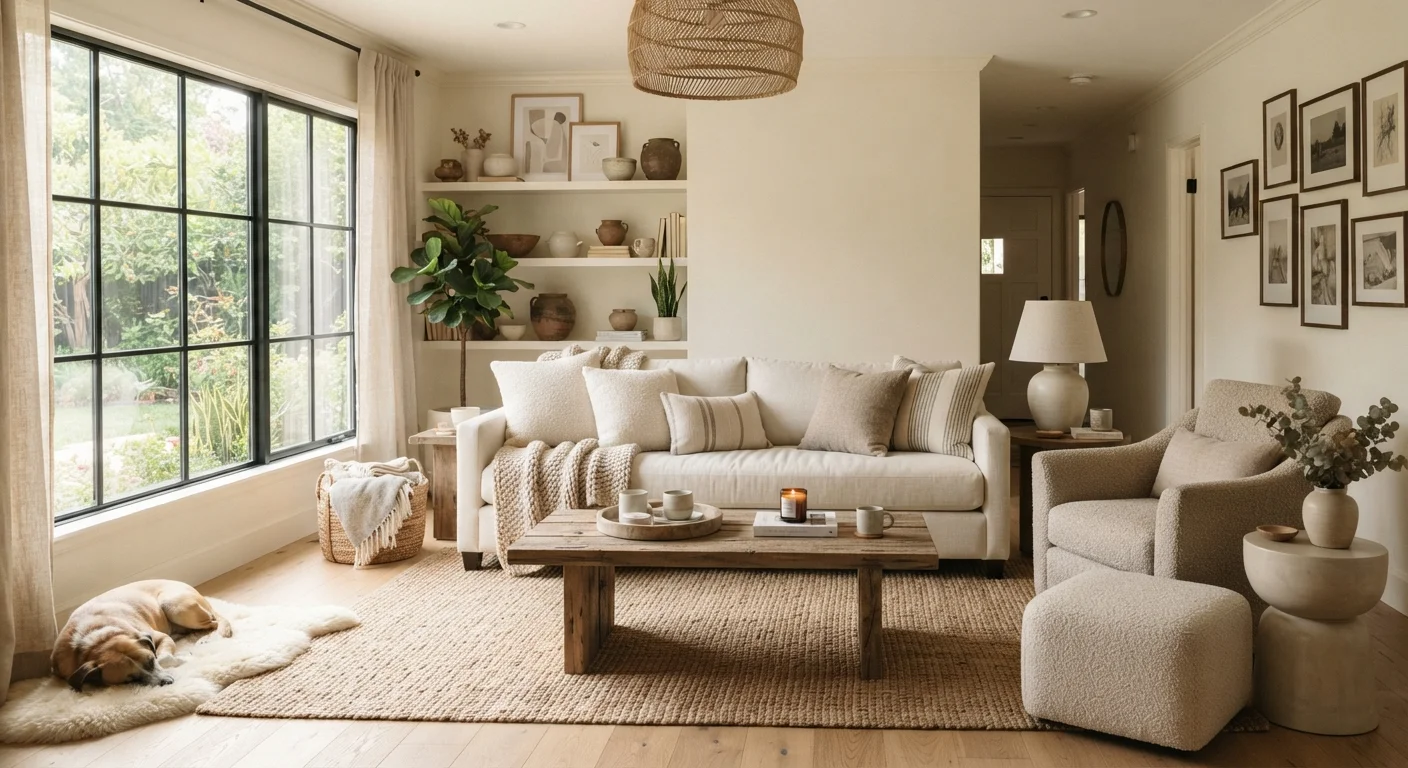
The practice of building up a room's look through multiple levels of texture, color, and material — rugs over hardwood, throw pillows over upholstery, artwork over a painted wall. Layering adds depth and makes a space feel considered rather than flat.
Cornice
A decorative horizontal molding that runs along the top of a wall where it meets the ceiling, or above windows. Cornices frame a room and give it a more finished, architectural character.
Focal point
The dominant visual element in a room that immediately draws the eye — a fireplace, a large piece of art, or an accent wall. Most well-designed rooms are organized around one clear focal point per space.
Scale
The size of objects relative to the room and to each other. A sofa that's too large for a small room overwhelms the space; furniture that's too small looks lost. Getting scale right is one of the most impactful — and often overlooked — aspects of decorating.
Understanding these concepts helps you diagnose what's working in a room and what isn't — before spending money on changes.
Finishes, Materials, and Architectural Details
Much of interior design vocabulary relates to how surfaces look and feel, and to the built-in architectural features that give a room its character.
Architectural Terms vs. Decorating Terms
Some design vocabulary — like 'cornice,' 'wainscoting,' and 'chair rail' — describes built-in architectural features that are part of the room's structure or millwork, not moveable decor. Changes to these elements may require carpentry work and, in some cases, permits. Always confirm local requirements before making structural or semi-structural modifications to your home.
When reviewing contractor quotes that mention finishes or architectural millwork, terms like wainscoting or cornice can appear as line items. For a broader breakdown of quote language, see Reading a Builder's Quote.
90%
Time Americans spend indoors
According to the U.S. Environmental Protection Agency, Americans spend approximately 90% of their time indoors — making the quality of interior environments a significant wellbeing factor.
60-30-10
Color proportion rule of thumb
Interior designers widely cite this ratio as a practical starting framework for distributing color across dominant, secondary, and accent elements in any room.