

Key Takeaways
Start here
The Geography Behind the Grandeur
Next
How Seasons Shape Your Experience
Then explore
What Each Park Actually Offers
Before you book
Practical Considerations Before You Go
The Geography Behind the Grandeur
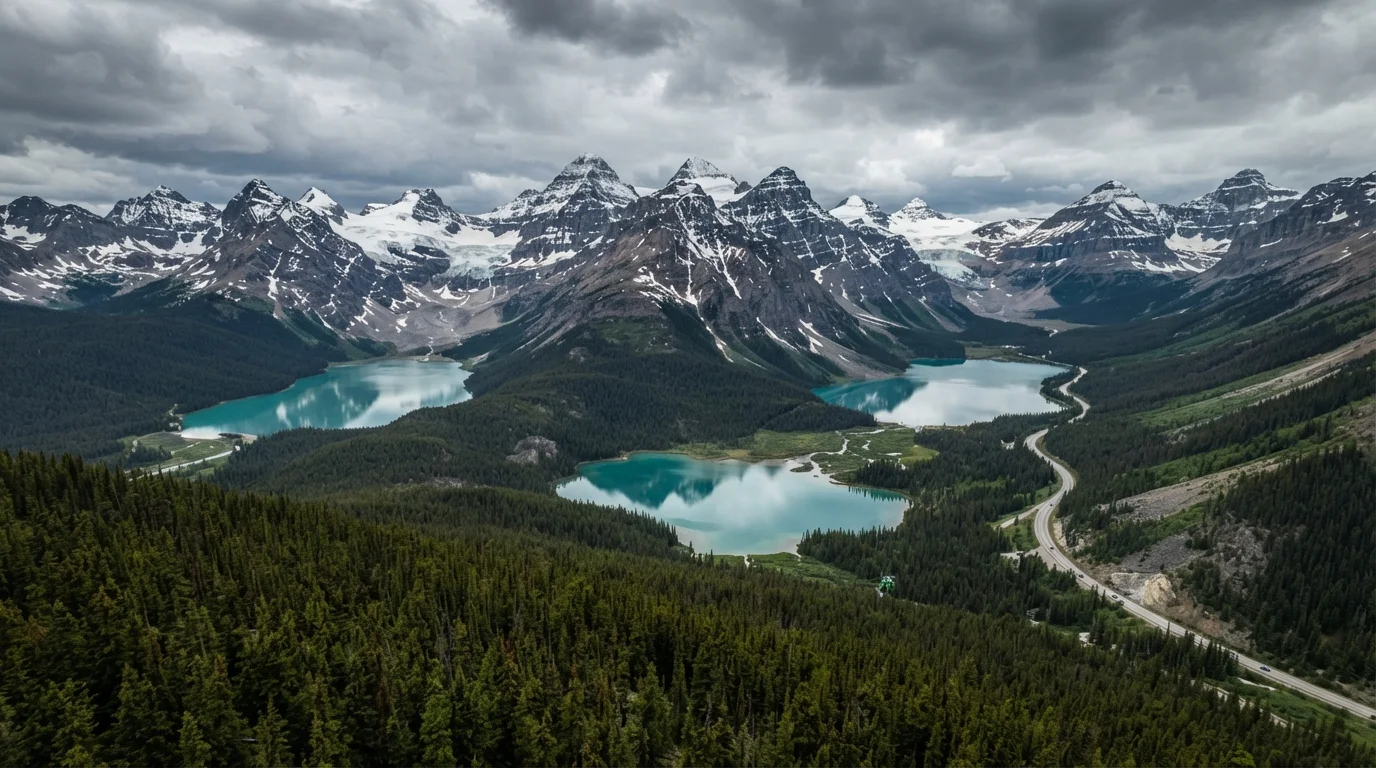
The Canadian Rockies form a roughly 1,000-kilometre arc along the border of Alberta and British Columbia — a chain of sedimentary peaks pushed skyward by tectonic collision over hundreds of millions of years. What makes the region visually arresting isn't just the height of the mountains (many summits exceed 3,000 metres) but the interplay of forces that shaped them: glaciers carving U-shaped valleys, rivers running vivid turquoise from glacial rock flour, and treelines that drop sharply, leaving vast alpine meadows exposed to the sky.
At the heart of the region sit four UNESCO World Heritage–listed national parks: Banff, Jasper, Yoho, and Kootenay. Together they protect more than 20,000 square kilometres of mountain wilderness. The Continental Divide — the spine that separates rivers draining to the Pacific from those draining to the Atlantic — runs directly through this landscape, meaning Yoho and Kootenay lie in British Columbia while Banff and Jasper sit in Alberta.
Continental Divide
The mountain ridge that separates rivers flowing west toward the Pacific Ocean from those flowing east toward the Atlantic. In the Canadian Rockies, it marks the border between Alberta and British Columbia.
Glacial rock flour
Fine particles of rock ground down by glacial movement that suspend in meltwater, giving many Rockies lakes their characteristic turquoise or milky-green colour.
Alpine treeline
The elevation above which trees can no longer grow due to cold temperatures and thin soils. Above the treeline, landscapes shift to open meadows, rocky terrain, and eventually permanent snow or ice.
Shoulder season
The periods just before and after peak tourist season — typically spring and fall in the Rockies — when visitor numbers drop, prices may ease, and conditions can still be excellent for travel.
Dark-sky preserve
A protected area officially designated to minimise light pollution, allowing unusually clear views of stars and celestial objects. Jasper National Park holds one of the largest such designations in the world.
Understanding this geography helps set realistic expectations. Distances that look short on a map often involve passes, switchbacks, and altitude changes that add significant travel time. The landscape does not simply sit in the background — it actively shapes every decision a traveller makes.
How Seasons Shape Your Experience
The Canadian Rockies don't have a single "best" season so much as a series of trade-offs worth understanding before you book. As our guide on how climate and seasons shape the traveller experience explains, timing affects everything from road access to wildlife sightings to the sheer volume of other visitors sharing the trail with you.
- Summer (late June–August): Maximum daylight, all roads and facilities open, wildflowers in bloom — but also the highest visitor numbers. Parking at iconic sites like Lake Louise can fill before 8 a.m. on peak weekends.
- Shoulder season (May–June, September–mid-October): Crowds thin dramatically. September in particular offers golden larch forests, active elk and bear, and crisp air. Some high-elevation roads and campgrounds close after Thanksgiving (Canadian Thanksgiving falls in October).
- Winter (November–April): Banff's ski areas draw winter visitors, and the frozen lakes create a completely different kind of beauty. However, the Icefields Parkway can close in severe weather, and many backcountry routes are accessible only to experienced winter travellers.
September Is a Sweet Spot Worth Knowing
If your schedule allows any flexibility, September consistently delivers some of the Rockies' most rewarding conditions. The larch trees at higher elevations turn vivid gold, elk rut activity peaks in Banff and Jasper, and the dramatic drop in visitor numbers means you can park at trailheads that would be gridlocked in July. Pack layers — temperatures swing significantly between morning and afternoon.
For a deeper look at interpreting seasonality before committing to dates, see our article on reading a destination's seasonal complexity before you book.
What Each Park Actually Offers
Treating the four parks as interchangeable misses what makes each one worth understanding on its own terms.
Banff National Park
Canada's oldest national park (established 1885) and by far its most visited. The town of Banff provides full amenities — accommodation, restaurants, gear shops — making it the logical base for first-timers. Iconic sites include Lake Louise, Moraine Lake (advance reservations or shuttle required), and the Bow Valley Parkway. The density of infrastructure is an asset and, depending on your preference, a limitation.
Jasper National Park
Significantly larger than Banff and noticeably quieter, Jasper rewards travellers willing to drive farther. The Columbia Icefield — the largest icefield in the Rockies south of Alaska — sits on the boundary between the two parks and is best approached from Jasper's side. The park's dark-sky preserve designation makes it one of the largest in the world, offering exceptional stargazing.
Yoho National Park
Small in area but extraordinary in concentration. Yoho holds Takakkaw Falls (one of Canada's highest waterfalls), the Burgess Shale fossil beds (a UNESCO site within a UNESCO site), and the emerald Emerald Lake. Its BC location means it often sees slightly different weather patterns than its Alberta neighbours.
Kootenay National Park
Often the last on travellers' lists and quietly one of the most rewarding. Kootenay runs along Highway 93 South from the Continental Divide down to the warmer Columbia Valley, meaning it spans dramatic climate and vegetation zones — from alpine tundra to semi-arid grassland — within a single drive. The Radium Hot Springs pools, operated by Parks Canada, sit at its southern entrance.
Practical Considerations Before You Go
A few structural realities shape how any trip to the Canadian Rockies actually unfolds.
Verify Entry Requirements Before You Arrive
Parks Canada policies, fee structures, and reservation systems do change. Before your trip, check the official Parks Canada website for the most current entry fees, campground reservation windows, and any temporary closures or access restrictions. Trail and road conditions in particular can shift quickly with weather, and visitor centres are the most reliable source of real-time information.
Entry fees and passes: Parks Canada's Discovery Pass covers entry to all four parks (and most of Canada's national parks and historic sites) for a full year. For stays of four or more days across multiple parks, it generally represents good value compared to purchasing individual day passes.
Reservations: Campground and backcountry permit reservations through Parks Canada's online system open months in advance for peak-season dates. Many front-country campgrounds and backcountry quotas fill quickly — treating reservations as non-negotiable planning steps, rather than optional, saves significant frustration.
Wildlife awareness: All four parks support populations of grizzly bears, black bears, elk, wolves, and cougars. Parks Canada provides bear spray guidance at visitor centres; carrying it in bear country and knowing how to use it is strongly advised. Feeding wildlife is illegal and genuinely dangerous.
Altitude and conditions: Elevation affects exertion levels, and weather in the Rockies changes rapidly at any time of year. Layered clothing, sun protection, and sufficient water are basics for any trail. Always verify current trail conditions and closures with park visitor centres before heading out — conditions on the ground may not match what an online review described weeks earlier.
The Canadian Rockies reward curiosity and preparation in roughly equal measure. Whether you're drawn by the glaciers, the wildlife, the geology, or simply the scale of the landscape, understanding the distinct character of each park — and what the seasons actually deliver — transforms a beautiful trip into a genuinely memorable one. For a thought-provoking contrast in mountain wilderness, it's worth exploring how the Scottish Highlands offer a completely different kind of dramatic terrain shaped by history and culture rather than sheer geological scale.