

Key Takeaways
Iceland's Seasonal Transformation
Iceland experiences four dramatically distinct seasons driven by its subarctic location and proximity to the Arctic Circle. Each season fundamentally changes the country's daylight hours, weather, landscape color palette, and the types of experiences accessible to visitors. Unlike many destinations where seasons bring minor shifts, Iceland's transformation is extreme — from near-total darkness in winter to nearly 24-hour daylight in summer.
Iceland straddles the North Atlantic at roughly 64°N latitude, placing much of it just below the Arctic Circle. This positioning drives the extreme photoperiod swings — ranging from about four hours of daylight in December to nearly 24 hours in June — that define each season's character.
Winter: Darkness, Ice, and the Aurora
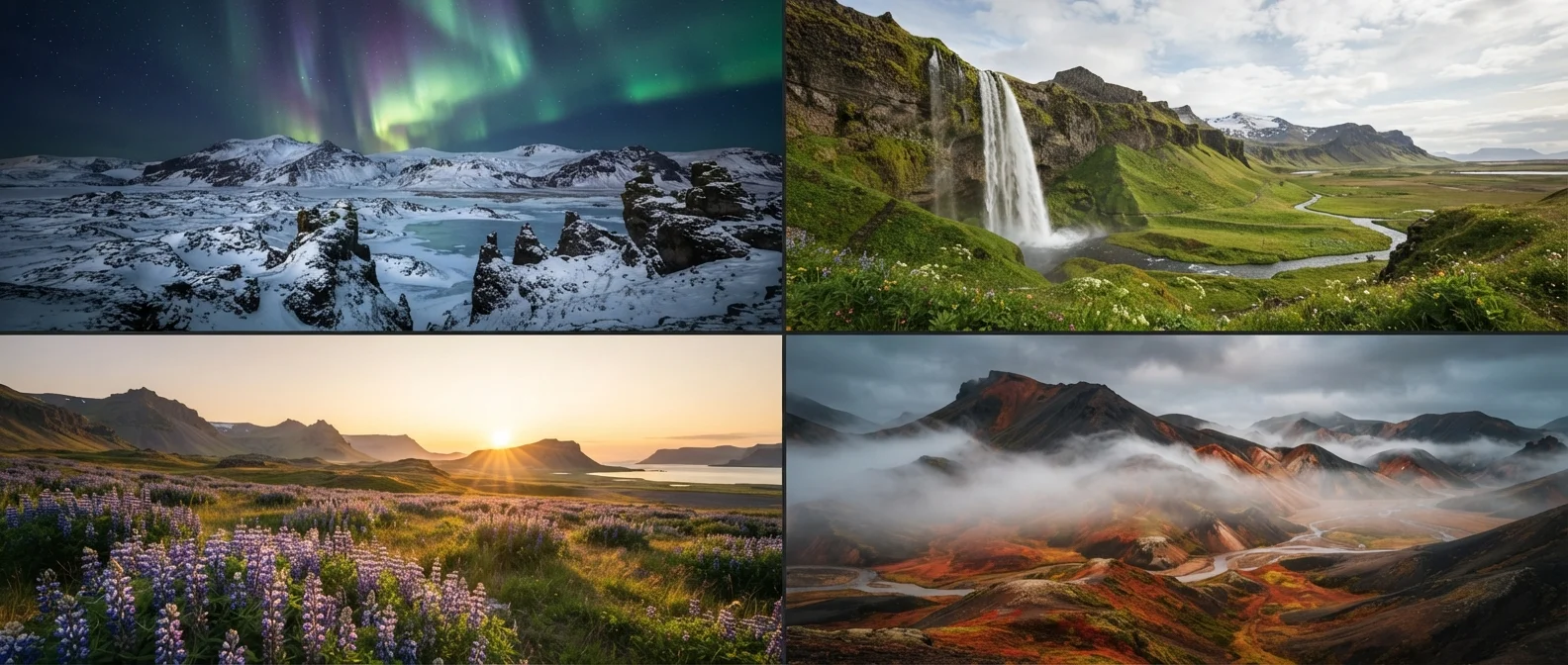
Iceland in winter is a study in extremes. From November through February, daylight shrinks to as few as four hours, casting the landscape in a long, blue-gray twilight that photographers travel thousands of miles to capture. The compensation for all that darkness is the aurora borealis — the northern lights — which dance across Iceland's skies on clear nights with a frequency unmatched at most accessible latitudes.
Snow-capped volcanic peaks, ice-blue glacier caves accessible only in cold months, and frozen waterfalls transform familiar landmarks into entirely new subjects. The famous Diamond Beach near Jökulsárlón, where glacial ice washes ashore against black sand, is at its most dramatic when winter light catches the ice at low angles. Road conditions can be challenging, and some routes close entirely — checking advisories from the Icelandic Road and Coastal Administration before driving is essential.
Glacier Cave Access Changes Annually
The natural glacier ice caves inside Vatnajökull and other glaciers are only safe to enter during winter months when the ice is stable. The specific caves accessible each season vary depending on glacier movement and conditions. Access is always arranged through guided tours, as independent entry is considered dangerous. Availability and locations shift year to year.
Spring: Waterfalls at Full Force and the Return of Green
March through May brings a rapid, visible awakening. Snowmelt sends Iceland's waterfalls — Seljalandsfoss, Skógafoss, Hraunfossar — surging to their highest volumes of the year. The moss-covered lava fields shift from winter brown to vivid green almost week by week, and migratory birds, including the beloved Atlantic puffin, return to coastal cliffs by April.
Daylight rebounds quickly: by late April, Iceland enjoys 15 or more hours of usable light. Aurora sightings remain possible through March in areas with dark skies. Spring is also when the highland roads remain closed, so travelers are still working with the Ring Road and southern Iceland's established routes — but without the summer crowds. As seasonal timing shapes the entire traveler experience, spring in Iceland rewards those willing to layer up and embrace variable weather.
~4 hrs
Daylight in Reykjavik in late December
Iceland's capital receives roughly four hours of usable daylight around the winter solstice, according to astronomical data for its latitude.
~24 hrs
Continuous daylight near summer solstice
Around June 21, the sun does not fully set in Iceland, producing the midnight sun phenomenon that defines the summer travel experience.
Late June–Early Sept
Icelandic Highlands open window
Highland mountain roads (F-roads) are typically accessible only during this narrow summer window, as confirmed by Icelandic road authorities each year.
Summer: Midnight Sun, Wildflowers, and the Highlands
June through August is Iceland's season of abundance and accessibility. The midnight sun — the phenomenon where the sun never fully dips below the horizon — allows hiking, photography, and sightseeing at midnight without a headlamp. Vast fields of violet lupine blanket roadsides, valleys fill with wildflowers, and temperatures reach their modest peak, generally between 50°F and 65°F (10°C–18°C) along the coast.
Most critically, summer is the only window when the Icelandic Highlands open. Routes through the interior reveal a raw, other-worldly terrain of rhyolite mountains, geothermal hot springs, and obsidian deserts untouched by tourism infrastructure. These areas demand a capable 4WD vehicle and careful preparation. For travelers curious about how Iceland's layered seasonality compares to other dramatic Northern European landscapes, the Scottish Highlands offer their own form of seasonal depth.
“Iceland is one of the few places on Earth where the same landscape genuinely looks like a different planet depending on when you arrive. The seasonal contrast isn't subtle — it's foundational to understanding the place.”
— Árni Sigurðsson, Icelandic naturalist and wilderness guide
Autumn: Color, Quiet, and the Aurora's Return
September and October represent Iceland's most underappreciated season. The landscape shifts to amber, rust, and ochre as summer vegetation turns — a palette that rivals any New England fall. Highland roads begin to close again as temperatures drop, but the Ring Road remains fully accessible, and waterfalls still run strong from summer snowmelt.
Crucially, autumn brings the return of genuinely dark nights, making it aurora season again without the bitter cold of midwinter. September often delivers both long evenings and statistically favorable aurora activity tied to the equinox. Crowd levels fall sharply after mid-August, making popular sites feel different in character entirely. Understanding how to read a destination's seasonal complexity before booking helps travelers recognize why shoulder seasons like Iceland's autumn often deliver outsized experiences for the effort.
Time Your Trip to Your Interests
Before booking, identify your one or two must-have experiences — aurora, midnight sun, highland hiking, or puffin watching — and plan your travel window around those specifically. Iceland's seasons are distinct enough that the 'right' time depends entirely on what you're there to see. Checking seasonal road and weather conditions with official Icelandic sources before finalizing plans is always worthwhile.