

Key Takeaways
Why Dividing Perennials Matters
Perennials are often celebrated as low-maintenance garden workhorses — they return each year without replanting. But over time, many species form increasingly large clumps that become crowded at the root zone. This congestion reduces airflow, diminishes flowering, and can leave the center of the plant dead or woody while the outer edges continue to grow.
Dividing a perennial breaks this cycle. It removes the spent central growth, gives younger sections more space and nutrients, and can dramatically improve bloom quality. It also produces free plants — divisions from a single clump can fill new beds, fill gaps in existing plantings, or complement other species. For ideas on how divided plants might work alongside others, see our guide to companion planting.
Most perennials benefit from division every three to five years, though fast-spreading species like bee balm or yarrow may need attention more frequently. Slow growers like hostas can go longer between divisions without issue.
Give Divided Plants Away
If you have more divisions than garden space, pot them up in containers with fresh potting mix and offer them to neighbors or local plant swaps. It's a practical way to share plants and reduce waste — and container gardening is a great temporary home for divisions while you plan permanent spots.
What You'll Need Before You Start
Successful division is as much about preparation as technique. Gather your tools and prepare planting areas before you lift a single clump — exposed roots dry out faster than most gardeners expect.
Sharpened spade or garden fork
Used to dig up and divide the root clump cleanly with minimal root tearing.
Hori-hori knife or old serrated knife
Useful for slicing through dense or fibrous root clumps that a spade can't easily separate.
Gardening gloves
Protects hands from sharp roots, soil, and cutting tools during the division process.
Bucket of water
Keeps bare-root divisions moist while you prepare planting holes.
Compost or aged organic matter
Amends planting holes to improve drainage and provide nutrients for transplanted divisions.
Watering can or garden hose
Used to thoroughly water divisions immediately after replanting to reduce transplant shock.
What you will need
Don't Divide Stressed or Dry Plants
Never divide perennials during a drought or heat wave. Plants under heat or water stress have fewer resources to recover from root disturbance. Water thoroughly one to two days before dividing, and choose a cool, overcast day whenever possible to minimize transplant shock.
Step-by-Step: How to Divide and Replant
Follow these steps in order for the best results. The process applies to most common garden perennials, though very dense ornamental grasses may require more effort to separate and occasionally benefit from a handsaw for particularly thick crowns.
Choose the Right Time to Divide
Timing is the most important factor in successful division. As a general rule, divide spring-blooming perennials (such as phlox or astilbe) in early fall, and divide fall-blooming perennials (such as asters or rudbeckia) in early spring. This gives plants a full season to establish before their next bloom cycle.
In most US climates, early fall — roughly six weeks before the first expected frost — is the most forgiving window for a wide range of perennials.
Water the Clump Thoroughly
One to two days before dividing, water the entire clump deeply. Moist soil clings to roots during lifting, cushioning them from damage. Well-hydrated plants also recover from root disturbance more readily than those in dry soil.
Dig Up the Entire Clump
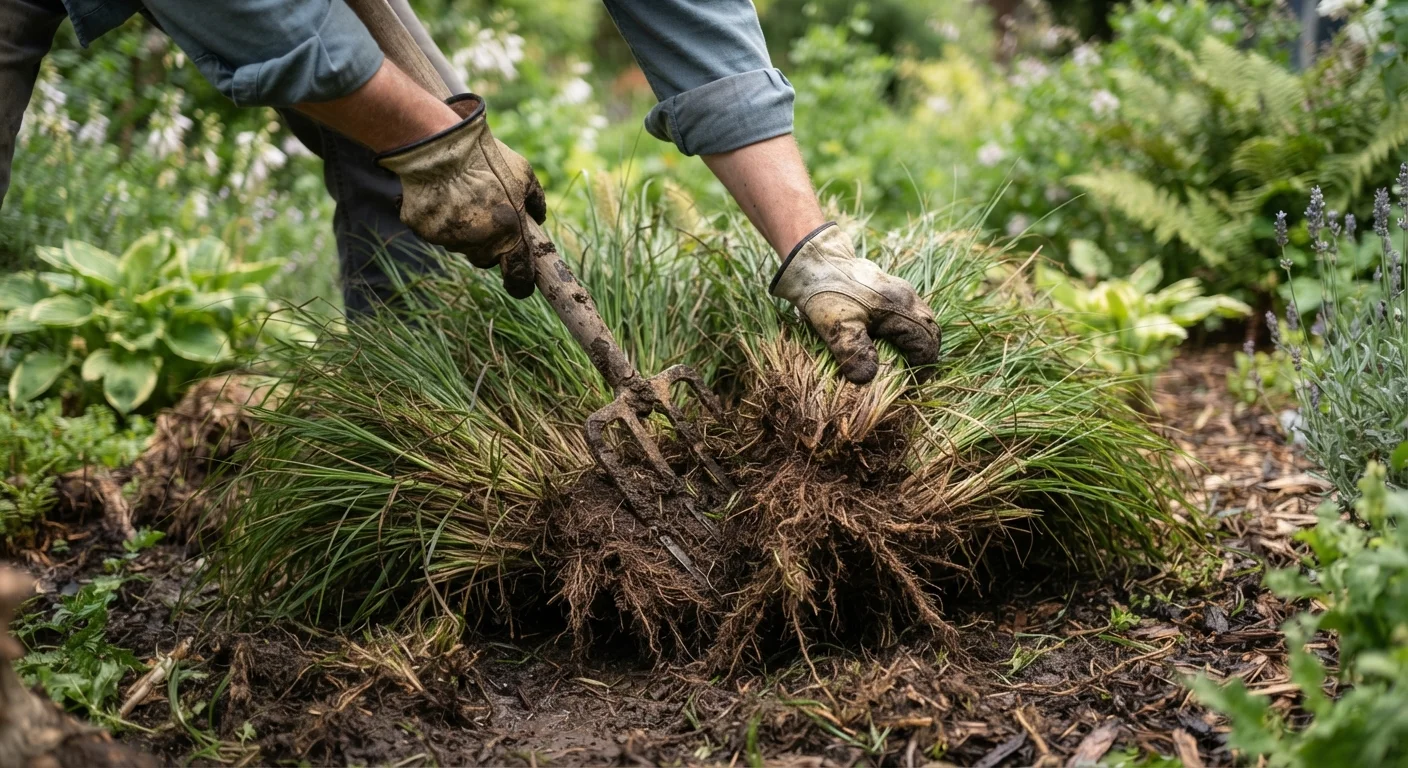
Using a sharpened spade or garden fork, cut straight down around the perimeter of the clump, roughly six to eight inches out from the visible crown. Work the fork or spade underneath and lever the root mass upward, lifting the entire clump free. Shake or brush away loose soil to expose the root structure.
Divide the Root Mass
Examine the clump and identify healthy, vigorous sections — usually the outer edges of the crown, which have the freshest growth. The woody, dead center of an old clump can typically be discarded.
For loose, easily separated clumps (such as daylilies or ornamental grasses), pull or tease sections apart by hand or with two garden forks placed back-to-back. For dense, fibrous clumps, use a sharp hori-hori knife or spade to cut cleanly through the root mass. Each division should have at least three to five healthy shoots and a good portion of root attached.
Prepare Planting Holes
Dig a hole for each division roughly twice the width of the root section and deep enough so the crown sits at the same level it was growing previously. Mix a generous amount of compost or aged organic matter into the excavated soil to improve structure and provide early nutrition.
Replant and Water In
Place each division in its hole, spreading roots naturally. Backfill with the amended soil, firming gently around the crown to eliminate large air pockets. Water thoroughly immediately after planting, ensuring moisture reaches the full root zone. Maintain consistent soil moisture — not waterlogged, but never fully drying out — for the first three to four weeks.
Sterilize Tools Between Plants
Dirty cutting tools can transfer soil-borne diseases between clumps. Wipe blades with a diluted household bleach solution (one part bleach to nine parts water) or isopropyl alcohol between each division, especially if you notice any signs of crown rot or unusual discoloration.
Once your divisions are established, consider whether their new placement suits their needs — light, moisture, and neighbors all affect long-term performance. Our article on native vs. exotic ornamentals can help you think through plant placement more broadly.
After Division: Ongoing Care
Newly divided perennials are in recovery mode for several weeks. During this period, keep soil consistently moist and hold off on fertilizing — fresh roots are sensitive and concentrated fertilizer can burn them. A light, balanced fertilizer can be introduced once you see clear signs of new growth.
Don't be discouraged if divisions look limp or droopy in the first few days. Some wilting immediately after transplanting is normal as the plant adjusts. As long as the soil stays moist and temperatures remain moderate, most healthy divisions will rebound within a week.
For plants that were divided in fall, a layer of straw or shredded leaf mulch over the crown before the ground freezes can protect shallow root systems through winter. Remove this mulch in early spring before new shoots emerge. If you're also working on the woody plants in your landscape, our guide to pruning shrubs and trees covers complementary seasonal timing.