

Key Takeaways
Option A
Native Plants
The ecologically integrated, low-maintenance choice.
Best for: Gardeners who want to support local wildlife, reduce water and chemical inputs, and plant species adapted to their regional climate.
Option B
Exotic Ornamentals
The versatile, design-forward alternative.
Best for: Gardeners seeking bold seasonal color, unusual forms, or plants not naturally found in their region for aesthetic or structural purposes.
If you want to reduce watering and ongoing maintenance
Native Plants
Native species are naturally adapted to regional rainfall patterns and soil conditions, meaning they generally require far less supplemental irrigation and fertilization after establishment.
If you want dramatic seasonal color or unusual plant forms
Exotic Ornamentals
Exotics offer a far broader palette of colors, textures, and bloom times that may not be available from plants native to your region.
If supporting pollinators and local wildlife is a priority
Native Plants
Native plants have co-evolved with local insects and birds, providing more reliable food and habitat value than most ornamental exotics.
If you're designing a formal or structured garden space
Exotic Ornamentals
Many exotic species have been selectively bred for compact, uniform growth habits and predictable flowering that suits formal design styles.
If you want to blend ecology with visual interest
Native Plants
A thoughtfully planned native garden can be highly ornamental while delivering genuine ecological benefit — the two goals are not mutually exclusive.
Defining the Terms: What 'Native' and 'Exotic' Actually Mean
A native plant is one that occurs naturally in a specific region without human introduction — it evolved alongside local soils, climate patterns, insects, and wildlife over thousands of years. A plant native to the tallgrass prairies of Illinois, for example, is not automatically native to the Pacific Northwest. Nativeness is always place-specific.
An exotic ornamental (sometimes called a non-native or introduced plant) is any species brought to a region from elsewhere — whether from another continent, another country, or simply another climate zone. Many beloved garden staples fall into this category, including Japanese maples, lavender (in most of the US), and hybrid tea roses.
Importantly, not all exotic plants are invasive, and not all native plants are low-maintenance. Understanding what these labels mean — and what they don't — is the foundation for making genuinely informed planting decisions. For a deeper look at how native species reshape garden dynamics, see how native plants change how a garden functions.
Side-by-Side: Key Differences at a Glance
The table below compares native plants and exotic ornamentals across the criteria that matter most to everyday gardeners — from water needs and wildlife value to design flexibility and invasive risk.
| Criterion | Native Plants | Exotic Ornamentals |
|---|---|---|
| Water needs (established) | Generally low — adapted to local rainfall | Varies widely by species and origin |
| Wildlife and pollinator support | High — co-evolved with local species | Low to moderate — depends on species |
| Invasive risk | None — by definition | Varies; some species are highly invasive |
| Design flexibility | Moderate — limited to regionally native species | High — global palette available |
| Establishment period | 1–2 seasons before low-maintenance | Ongoing care often required |
| Fertilizer needs | Minimal once established | Often moderate to high |
| Seasonal color options | Good within regional palette | Extensive, including tropical tones |
| Availability at nurseries | Improving, but still variable | Widely available year-round |
Ecological Impact: Why It Matters More Than You Might Think
One of the most significant — and often underappreciated — differences between native and exotic plants is their relationship to local ecosystems. Native plants support what ecologists call food webs: native caterpillars that feed on specific native trees, for example, are essential food sources for nesting birds. Research by entomologist Doug Tallamy has documented how a single native oak can support hundreds of species of moth and butterfly larvae, while many exotic ornamentals support very few.
This doesn't mean exotic plants are ecologically worthless. Many provide nectar for generalist pollinators, offer shelter, or contribute to soil health. But their ecological contribution is typically narrower than that of well-chosen natives.
70%
Of bird species rely on insects as primary food source
Research cited by the National Audubon Society highlights that the majority of North American land birds depend on insect prey — which native plants disproportionately support.
4,000+
Invasive plant species tracked in the US
The USDA estimates thousands of non-native plant species have been introduced across the country, with a significant subset causing measurable ecological harm.
The risk of invasiveness is also a real concern with exotics. Species like English ivy (Hedera helix), Japanese barberry (Berberis thunbergii), and burning bush (Euonymus alatus) have escaped garden settings and displaced native vegetation across wide areas of the US. Always cross-reference your state's invasive species list before planting any non-native species — your local cooperative extension office is a reliable starting point.
Maintenance, Water, and Practicality
Native plants are often described as low-maintenance — and this is broadly true, with an important caveat: once established. The first one to two growing seasons typically require consistent watering to help roots develop. After that, most native species are well-matched to local rainfall patterns and soil conditions, reducing the need for irrigation, synthetic fertilizers, and pesticides.
Exotic ornamentals vary enormously. Some thrive with minimal intervention; others require regular feeding, pest management, winter protection, or carefully managed irrigation. Tropicals grown outside their hardiness zones may need to be overwintered indoors or treated as annuals, adding both cost and labor.
Companion planting strategies can help reduce maintenance demands for both native and exotic plantings by encouraging beneficial insect activity and natural pest suppression.
Check Your Regional Invasive Species List First
What is considered invasive varies significantly by state and even by region within a state. A plant deemed low-risk in the Southwest may be problematic in the Southeast due to differing climate and ecosystem conditions. Your state's department of agriculture or local cooperative extension service maintains updated invasive species lists and can advise on safer alternatives.
If you're working with containers rather than in-ground beds, both native and exotic species can be used effectively — though soil mix, drainage, and watering rhythms will need closer management. See our guide to container gardening on patios and terraces for practical guidance.
Design Considerations: Aesthetics Don't Have to Be Sacrificed
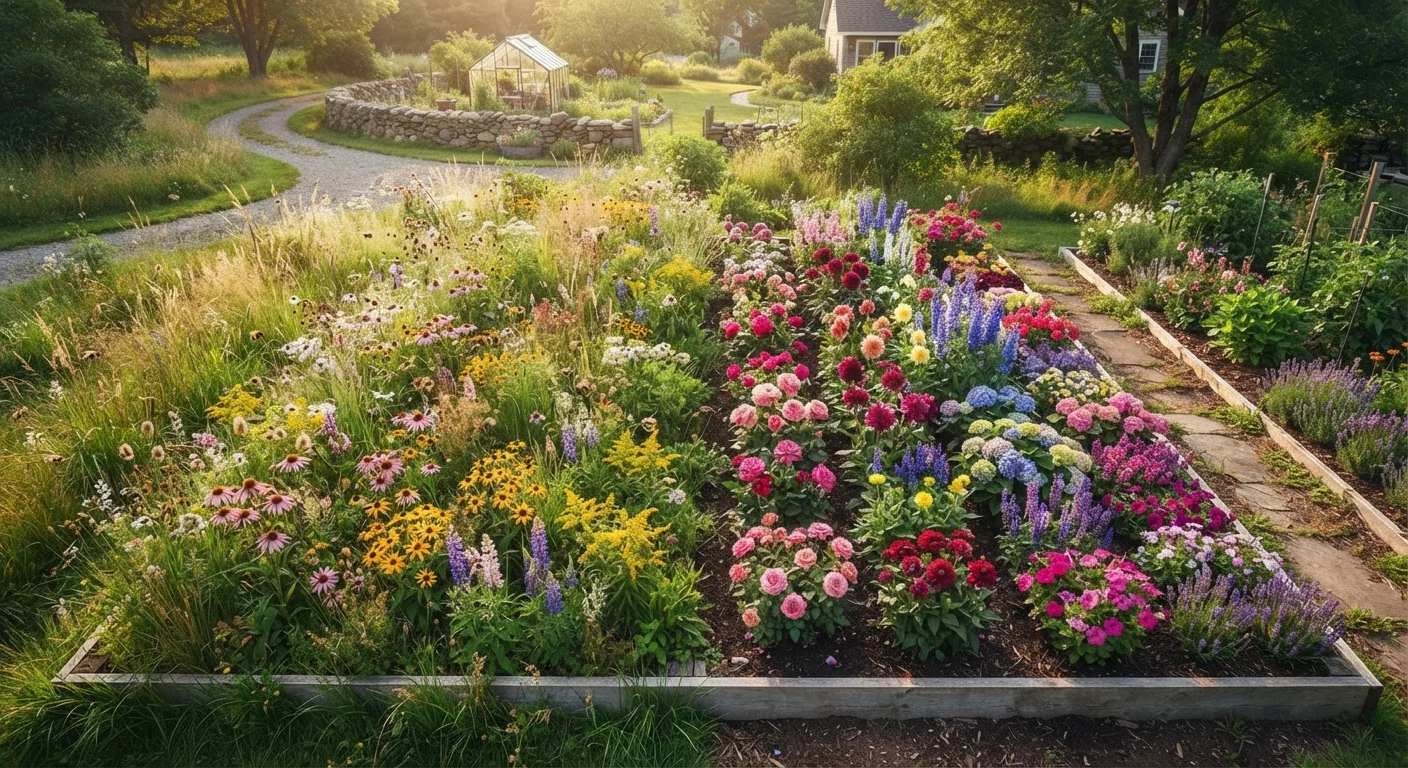
A common misconception is that native gardens are wild and unkempt while exotic plantings are polished and designed. Neither is inherently true. Native gardens can be structured, elegant, and carefully curated — think prairie-style plantings with ornamental grasses, coneflowers, and black-eyed Susans arranged with clear intentionality.
Equally, many gardeners find that a mixed approach — anchoring beds with regionally native species while adding selected non-invasive exotics for seasonal color or structural interest — delivers the best of both worlds. Choosing non-invasive ornamentals that complement native plantings is a practical middle path that many landscape designers now recommend.
When dividing and expanding your plantings, consider that many native perennials respond especially well to division and replanting. Our guide to dividing and replanting perennials covers timing and technique in detail.