

Key Takeaways
Why Drought-Tolerant Gardening Matters
Water scarcity is a reality for gardeners across much of the United States, from the arid Southwest to drought-prone regions of the Southeast and Pacific Coast. Even areas with historically reliable rainfall are experiencing more frequent dry spells due to shifting weather patterns. For home gardeners, this creates a practical challenge: how do you maintain a beautiful, productive outdoor space while using water responsibly?
Drought-tolerant gardening — sometimes called xeriscaping — isn't about accepting a sparse or barren yard. It's about working with your climate rather than against it, selecting plants suited to your conditions, and using proven techniques that reduce water demand without sacrificing beauty or biodiversity. Done well, a water-wise garden can actually require less maintenance than a thirsty, high-input one.
30–60%
Household water used outdoors on average
According to the U.S. Environmental Protection Agency, outdoor water use — primarily for irrigation — accounts for roughly 30 to 60 percent of total household water consumption in many regions.
50%
Outdoor water that goes to waste
The EPA estimates that as much as half of all outdoor water used in the U.S. is wasted due to evaporation, runoff, or overwatering — problems that smart irrigation and drought-tolerant landscaping directly address.
70%
Soil moisture loss reduced by mulching
Research from cooperative extension programs across the U.S. indicates that a proper mulch layer can reduce soil surface evaporation by up to 70 percent compared to bare soil.
Choosing the Right Plants
Plant selection is the single most impactful decision in drought-tolerant gardening. The goal is to prioritize species that have evolved to thrive with minimal supplemental water in conditions similar to yours. Before purchasing anything, confirm your USDA hardiness zone — our plain-language zone reference guide explains how to find yours and what it means for plant choices.
Strong categories to explore include:
- Native perennials: Plants like purple coneflower (Echinacea purpurea), black-eyed Susan (Rudbeckia hirta), and prairie dropseed grass are adapted to local rainfall patterns and typically need little supplemental watering once established.
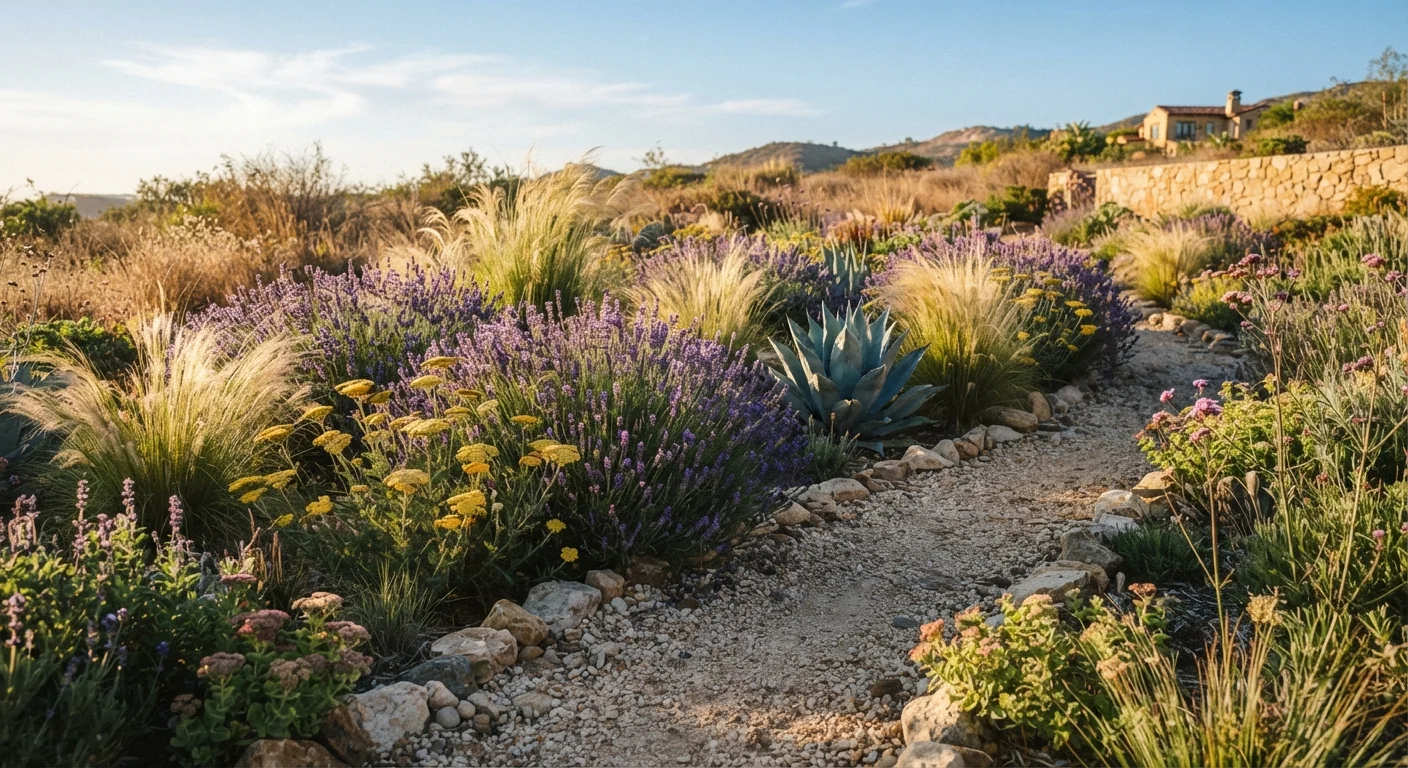
- Mediterranean herbs: Lavender, rosemary, and thyme originate in dry-summer climates and perform reliably in similar U.S. conditions.
- Ornamental grasses: Varieties like blue grama, little bluestem, and feather reed grass are hardy, low-maintenance, and offer year-round visual interest.
- Succulents and cacti: Beyond obvious desert species, many succulents tolerate a wide range of climates as long as soil drainage is adequate.
When shopping at a nursery, ask specifically for plants propagated from local or regional seed sources rather than cultivars bred primarily for aesthetics. Locally sourced natives are far more likely to thrive under your actual growing conditions.
Plants grown from regional seed stock are already adapted to local soil, temperature swings, and rainfall patterns, giving them a significant survival advantage over generic cultivars.
Plant in fall rather than spring where your climate allows. Cooler temperatures and autumn rain give roots months to establish before the stress of summer heat arrives.
Fall planting reduces transplant shock and establishment watering needs, as cooler, often wetter conditions do much of the irrigation work naturally.
When shopping for plants, look for those labeled drought-tolerant, xeric, or native to your region. Note that even drought-tolerant plants typically need regular watering during their first one to two growing seasons while root systems establish.
Preparing Your Soil for Water Retention
Healthy soil is foundational to a water-efficient garden. Two common problems work against you: sandy soil drains too quickly for roots to absorb moisture, while heavy clay can become waterlogged and then crack dry — neither extreme supports plant health.
The solution in both cases is organic matter. Working 2–4 inches of compost into your planting beds improves sandy soil's ability to hold moisture and loosens clay soil to improve drainage and aeration. This single amendment creates conditions where plant roots can access water more consistently between rain events.
Simple Soil Test Before You Amend
Before adding compost or other amendments, do a simple jar test: fill a jar with soil and water, shake it, and let it settle for 24 hours. Sandy soils will show a thick sand layer with little clay or silt; clay soils will show the reverse. This gives you a practical baseline for how much organic matter to add — and how urgently.
Avoid over-tilling, which destroys beneficial soil structure and can accelerate moisture loss. Instead, top-dress beds with compost annually and let earthworms and microbial activity work it in naturally over time. Where possible, minimize soil disturbance to preserve existing moisture-holding capacity.
Mulching: Your Garden's Best Defense
If there's one practice that delivers the most return for the least effort in a drought-tolerant garden, it's mulching. A 2–4 inch layer of organic mulch — shredded bark, wood chips, straw, or shredded leaves — acts as an insulating blanket over the soil. It slows evaporation, moderates soil temperature, suppresses weeds that compete for water, and gradually breaks down to enrich the soil.
Apply mulch around (but not directly against) plant stems and tree trunks to prevent rot. Refresh the layer annually, as decomposition is a sign the mulch is doing its job. Inorganic mulches such as gravel or decomposed granite are also options in very arid regions, particularly around cacti and succulents, where excess moisture retention would be harmful.
For a full seasonal maintenance perspective, our year-round garden maintenance checklist covers when and how to apply mulch at each time of year.
Smart Irrigation Strategies
Even drought-tolerant gardens benefit from occasional supplemental irrigation — particularly during establishment periods or prolonged heat. The key is delivering water efficiently. Drip irrigation is generally the most water-efficient option for garden beds, delivering moisture directly to root zones at a slow rate that the soil can absorb without runoff. Our detailed comparison of drip irrigation versus sprinkler systems walks through the trade-offs in depth.
Whatever system you use, water deeply and infrequently rather than lightly and often. Deep watering encourages roots to grow downward toward more stable moisture reserves, making plants more resilient during dry spells. It's also worth reviewing common watering mistakes — our guide to garden watering myths covers frequent errors that can undermine even a well-planned garden.
Avoid Watering on a Fixed Schedule
Running an irrigation system on a set daily or weekly timer regardless of rainfall is one of the most common — and wasteful — mistakes in home gardens. Overwatering stresses plants, promotes shallow roots, and can lead to fungal problems. Use a rain sensor or smart controller that adjusts based on actual weather conditions, or simply check soil moisture before irrigating.
Timing also matters: water early in the morning to reduce evaporation loss and minimize fungal disease risk that can come from foliage staying wet overnight.
Maintenance Habits That Save Water
Beyond plants and infrastructure, a few ongoing habits significantly reduce a garden's water demand:
- Hydrozoning: Group plants with similar water needs together so you can irrigate zones precisely rather than watering everything uniformly.
- Weed control: Weeds compete aggressively for soil moisture. Regular, shallow cultivation or mulching keeps them in check without deep soil disruption.
- Pruning: Removing dead or excessive growth reduces the amount of leaf surface transpiring moisture on hot days.
- Rain gauge use: Track rainfall so you only supplement when genuinely needed, rather than watering on a fixed schedule regardless of conditions.
“The plants that survive drought are not the ones that avoid stress — they're the ones with the root systems deep enough to find water when the surface goes dry. Build the soil, and the roots will follow.”
— Cooperative Extension Horticulture Specialist, University cooperative extension program, western U.S.
Over time, a drought-tolerant garden becomes increasingly self-sufficient. As native plants establish deep root systems and soil health improves with annual organic amendments, supplemental watering needs typically decrease year over year — making water-wise gardening both an environmental and practical investment.