

Key Takeaways
Why Decorating 'Rules' Deserve Scrutiny
Interior design advice travels fast — passed from shelter magazines to Pinterest boards to well-meaning family members. Some of it is genuinely useful shorthand. Much of it, however, has hardened into rigid rules that stop people from making confident choices in their own homes.
The result: rooms that feel cautious, unfinished, or weirdly generic. Decorators and designers regularly break these so-called rules — not recklessly, but because they understand why the guideline exists and when it simply doesn't apply. This article unpacks the most persistent myths and replaces them with more nuanced, practical thinking.
For a deeper look at the fundamentals that actually do matter, see the principles behind rooms that feel 'just right'.
Myth
Dark colours make rooms feel smaller and should be avoided in compact spaces.
Fact
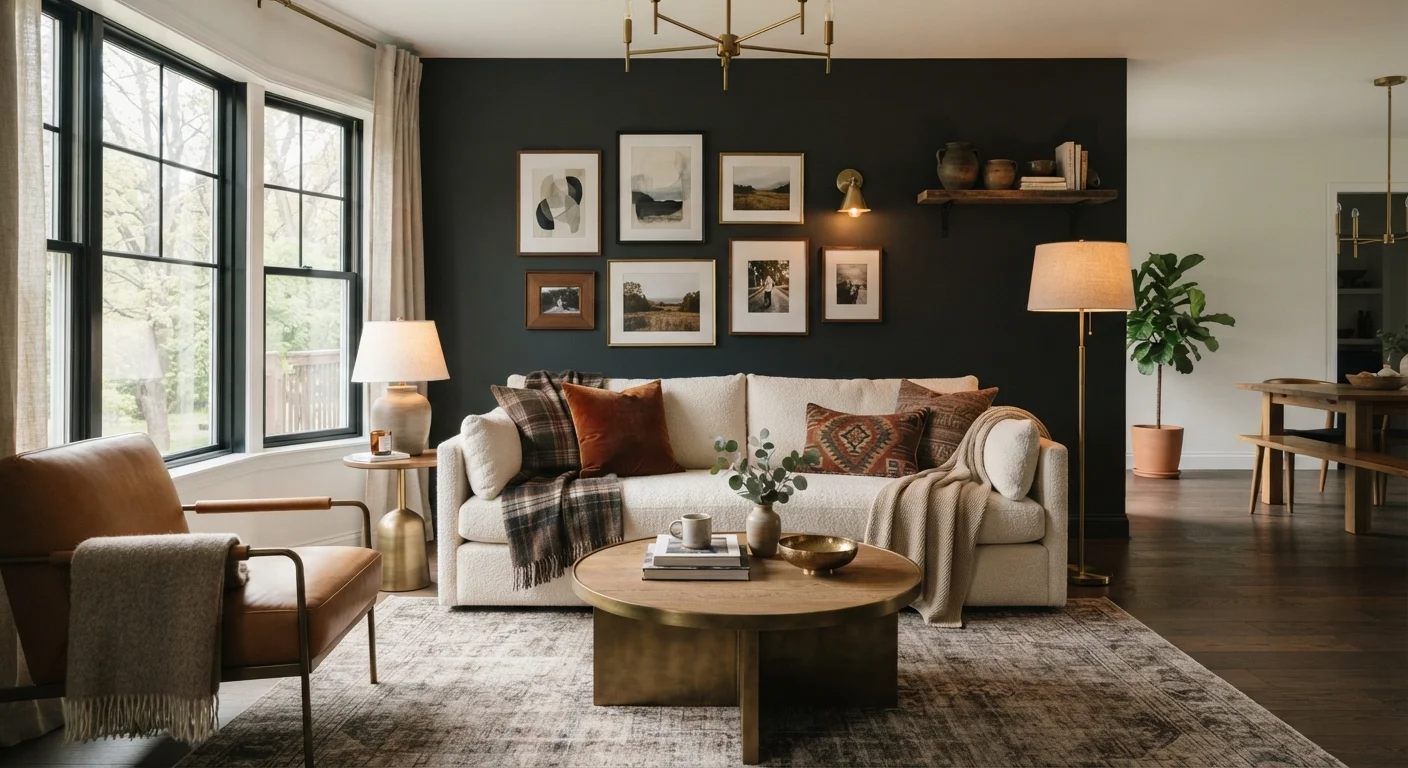
Dark colours can actually make a room feel more intimate and defined, and when used on all four walls and the ceiling, can paradoxically reduce the sense of cramped boundaries.
Light colours reflect more light, which is genuinely useful in rooms that lack natural light. But the logic that dark equals small isn't universal. A deep navy or forest green applied consistently — walls, ceiling, and trim in the same tone — creates an enveloping effect that eliminates the choppy visual edges that actually make rooms feel smaller. The factors that truly shrink a room's perceived size are more often furniture scale and clutter than paint colour.
Myth
You should never mix metals in a room — pick one finish and stick to it.
Fact
Mixing metals is standard practice in well-designed rooms; the key is choosing a dominant finish and using others as deliberate accents.
A single metal finish throughout a room can look flat and overly matched — the decorating equivalent of a head-to-toe monochrome outfit. Designers routinely pair warm brass with cool brushed nickel, or matte black with aged bronze. The guideline that actually holds is the 70/20/10 principle: let one metal dominate, use a second as a secondary player, and introduce a third very sparingly. Repetition — seeing each metal at least twice — is what creates cohesion rather than chaos.
Myth
Small rooms need small furniture to avoid feeling overcrowded.
Fact
Fewer, well-scaled pieces often work better in a small room than several undersized ones, which create visual noise and eat up floor space with legs and edges.
A single sofa that fits the wall properly will read as intentional. Four small chairs, a loveseat, two side tables, and a coffee table create a cluttered obstacle course that makes navigating — and visually processing — the room exhausting. In small spaces, prioritise one or two anchor pieces sized to the actual room dimensions, then leave breathing room. Built-in or wall-mounted storage also reduces the number of legs on the floor, which makes rooms feel considerably more open.
Myth
Furniture sets that match perfectly create a polished, coordinated look.
Fact
Perfectly matched furniture sets tend to look more like a showroom floor than a lived-in home, and they limit the room's visual interest.
The appeal of a matching suite is understandable — it removes the guesswork. But when every piece shares the same wood tone, silhouette, and finish, the eye has nowhere to travel. Well-designed rooms typically mix eras, materials, and silhouettes, unified instead by a shared colour palette or material thread (for example, a warm wood tone appearing in two or three different pieces). This approach reads as considered rather than assembled from a single catalogue page.
Myth
Rugs in a room should leave a wide border of floor visible on all sides.
Fact
Most rooms benefit from a larger rug than people default to — the common mistake is choosing a rug that's too small, which fragments the space.
A rug that only covers the coffee table area while the sofa legs float on bare floor visually cuts the room into disconnected zones. Interior designers generally recommend that the front legs of all major seating at minimum rest on the rug, and that the rug extends well past the furniture grouping. In a dining room, the rug should be large enough that chairs remain on it when pulled out. Going up a rug size — even when it feels counterintuitive — is one of the most consistent improvements a room can make.
Putting the Corrections Into Practice
Knowing a rule is a myth is only half the work — applying the correction confidently is the other half. A few practical habits help:
- Anchor with repetition. Mixed metals, patterns, or wood tones feel intentional when each element appears at least twice in the room. One brass lamp feels random; a brass lamp and brass cabinet hardware feel deliberate.
- Test paint before committing. Paint large swatches (at least 12 × 12 inches) on the actual wall and observe them across morning and evening light before deciding. Colour reads very differently on a small chip versus a full wall.
- Rent or borrow before you buy. Unsure whether a larger sofa works? Use painter's tape on the floor to map out the footprint before purchasing.
- Step back regularly. Design decisions made up close often look different from the doorway — the vantage point most visitors and your own eye will naturally use.
60%
Homeowners who cite colour choice as their biggest decorating uncertainty
According to a Houzz survey on home decorating challenges, colour selection consistently ranks as the top source of indecision among U.S. homeowners.
1 size up
The most common rug correction designers recommend
Interior designers frequently note that choosing the next rug size up from the initial instinct is one of the single most impactful low-effort changes in any room.
If a specific room still feels off after applying these corrections, a room-by-room décor audit can help identify what's actually holding it back. And don't overlook the role that texture plays — it's one of the most commonly skipped tools for adding depth and warmth to any space.
Trendy Corrections Can Become New Myths
Design advice cycles quickly, and today's 'rule-breaking' tip can become tomorrow's overused prescription. Treat any decorating guideline — including the corrections in this article — as context-dependent rather than universal. What works in a high-ceilinged loft may not translate to a 1970s ranch. Always evaluate advice against your specific room, its light, its proportions, and how you actually use the space.