

Key Takeaways
Our Verdict
Neither maximalism nor minimalism is objectively better — each delivers distinct emotional and practical benefits depending on the person living in the space. The most livable rooms tend to borrow from both: purposeful editing from minimalism, warmth and personality from maximalism. Understanding what each approach actually requires helps you make deliberate choices rather than defaulting to trend.
| Best for | Recommended |
|---|---|
| Those who feel energized by color, pattern, and curated collections | Maximalist approach |
| Those who feel calmer in uncluttered, visually quiet environments | Minimalist approach |
| Most everyday decorators who want comfort, personality, and order | Blended style |
What Each Style Actually Means
The terms get thrown around loosely, so it helps to define them on their own terms before comparing them.
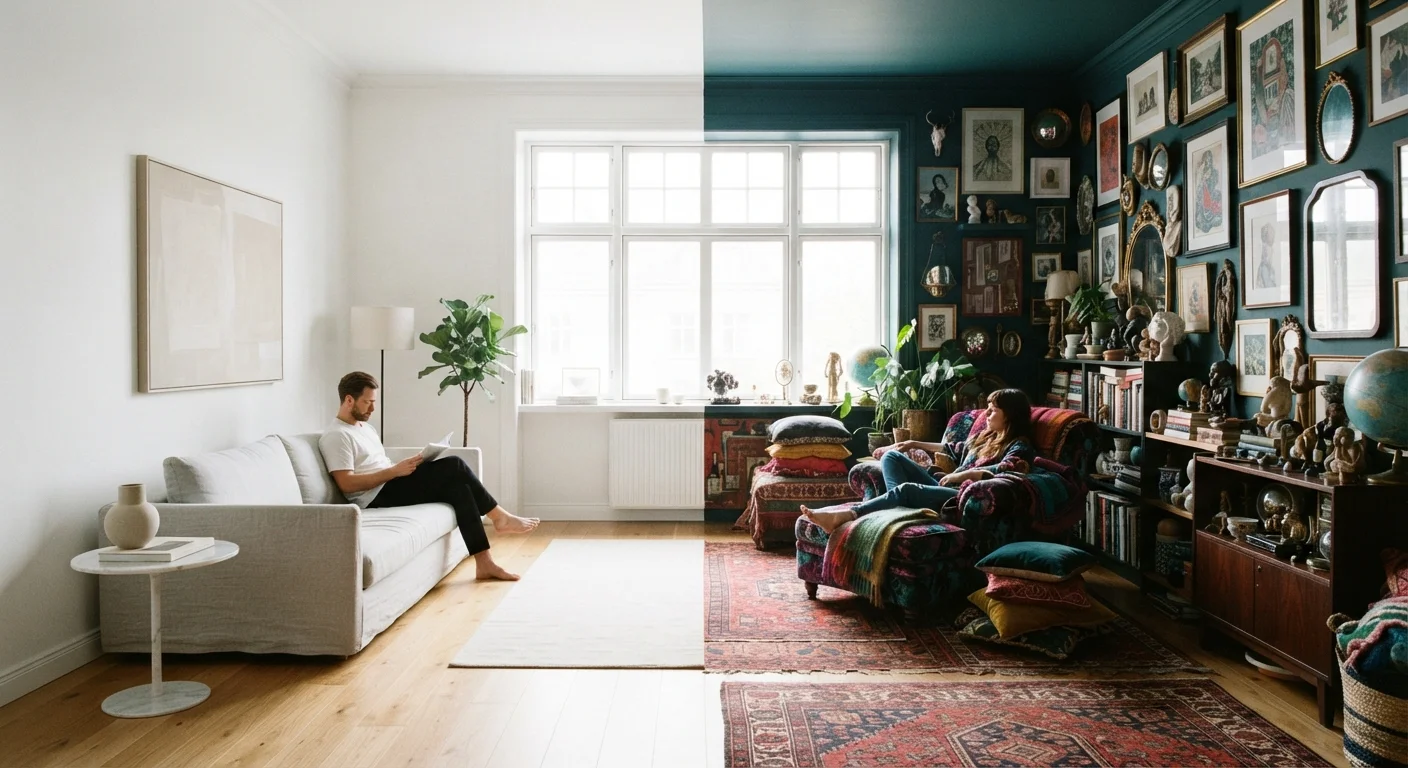
Maximalism is the deliberate layering of color, pattern, texture, and objects to create a rich, expressive environment. Done well, it communicates personality and warmth. Done poorly, it becomes overwhelming visual noise. The distinction lies in curation: a maximalist room should feel abundant, not accidental.
Minimalism, meanwhile, is the practice of reducing a space to what genuinely earns its place — functionally or aesthetically. It doesn't mean bare walls and a single chair. It means that every element is considered, and the space between objects is treated as a design asset, not a gap to fill.
Both approaches are design philosophies, not budgets. Neither requires spending more or less money than the other. And both can go wrong when applied without understanding their underlying principles. See our guide to what makes rooms feel cohesive for a deeper look at scale, balance, and contrast — fundamentals that apply to both styles.
| Maximalist | Minimalist | |
|---|---|---|
| Visual character | Layered, rich, expressive | Edited, calm, purposeful |
| Key risk | Tipping into clutter | Feeling cold or sterile |
| Maintenance demand | Higher — more surfaces and objects to clean | Lower — fewer items to manage |
| Flexibility to change | Easy to add; harder to subtract | Easy to keep edited; harder to layer in new pieces |
| Budget range | Any — thrift finds work well | Any — restraint isn't free by default |
| Best suited to | Collectors, creatives, social hosts | Those valuing calm, focus, or easy upkeep |
How to Recognize Your Natural Tendencies
Most people already have a gut preference — they just haven't named it yet. A few practical self-checks can clarify where you naturally sit:
- Walk into a room you love. Does it feel full and layered, or open and edited? Your emotional response to existing spaces is more reliable than your reaction to curated photos online.
- Look at your current shelves. Do you feel the urge to add more, or to clear things away? If you're unsure how to make a shelf look intentional rather than packed, shelf-styling strategies can help you see the difference between curated and cluttered.
- Think about maintenance honestly. Maximalist spaces with lots of objects and textiles require more routine cleaning and dusting. Minimalist spaces are easier to keep tidy but harder to maintain without a consistent habit of editing what comes in.
Try a Low-Commitment Test First
Before repainting walls or buying new furniture, test your style instincts with lower-stakes changes: rearrange what you have, remove a few items for a week, or add a single bold textile. Living with the change for a few days gives you more honest feedback than browsing inspiration images ever will.
Neither tendency is a personality flaw. Preferring more visual richness doesn't mean you're disorganized; preferring calm simplicity doesn't mean you're cold or unimaginative.
Where the Two Approaches Overlap
The most livable rooms in practice tend to be hybrids. Interior designers often describe this as finding a "visual anchor" — one dominant style that gives a room its character, with controlled borrowing from the other.
A mostly minimalist room, for example, might feature one dramatically layered gallery wall that acts as a focal point without overwhelming the whole space. A maximalist room might use a single neutral color palette to unify its many objects, preventing the layering from becoming chaotic.
If you're starting from scratch, it's worth pacing yourself rather than committing fully to either extreme before you understand how you actually live in the space. Decorating a first home room by room walks through a practical sequence for exactly this kind of gradual discovery.
~60%
Homeowners preferring a mixed style
Surveys by home design publications consistently find most homeowners describe their preferred style as a blend rather than a pure extreme.
3–5 years
Average time to settle a personal style
Design professionals commonly observe that most people refine their decorating preferences over several years of actually living in and adjusting a space.
Practical Trade-Offs to Consider
Understanding the real-world differences helps you make intentional choices rather than aspirational ones:
- Flexibility over time
- Maximalist spaces are often easier to evolve gradually — adding a new piece integrates naturally. Minimalist rooms can be harder to update without the new piece looking out of place.
- Resale and rental appeal
- Highly personalized maximalist spaces can polarize buyers or landlords. Neutral minimalist schemes photograph neutrally and tend to read as broadly appealing — though this matters more if you plan to move soon.
- Emotional impact
- Some people find sparse spaces calm and focusing; others find them cold or sterile. Some find layered rooms stimulating and comforting; others find them anxiety-inducing. Neither reaction is irrational — they reflect genuine differences in how people process their environments.
There's no right answer here, only an honest one about how you want to feel in your own home. The goal of any decorating decision is a space that supports how you actually live — not a photograph of how someone else does.