

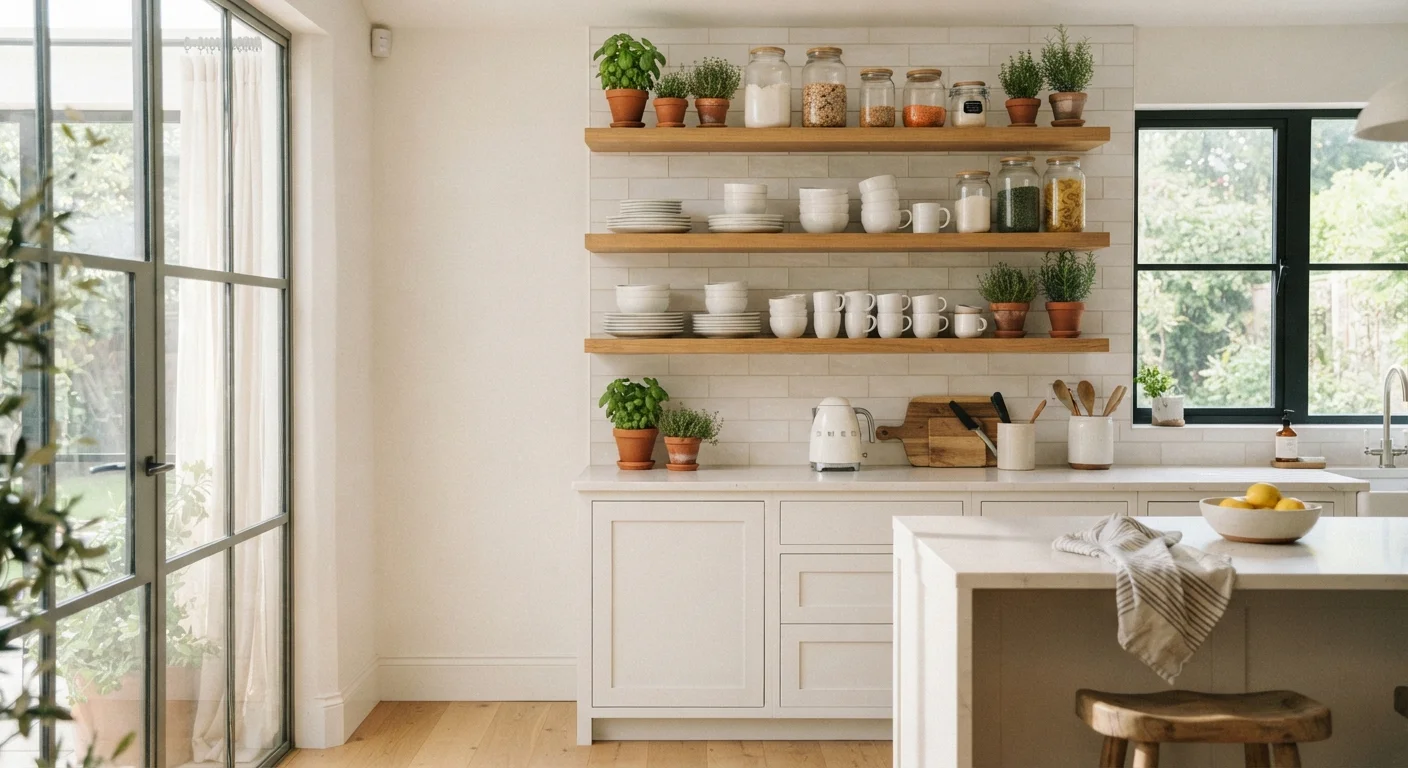
Key Takeaways
Makes small kitchens feel more open and airy
Removing upper cabinet doors eliminates visual bulk and lets the eye travel further, which can make a compact kitchen feel significantly less enclosed.
Encourages intentional, curated organization
When everything is visible, many people find they keep only what they genuinely use and appreciate, reducing kitchen clutter over time.
Easier access to everyday items
Frequently used dishes, glasses, and bowls are faster to grab without doors to open and close, which adds up to a small but real convenience in a busy kitchen.
Lower upfront cost than full cabinetry
Floating shelves cost considerably less than custom or semi-custom upper cabinets, which can free budget for other kitchen upgrades.
Displays personality and style effectively
Attractive dishware, plants, and carefully chosen objects become part of the room's design rather than hidden away — a genuine design advantage when done well.
Grease and dust coat exposed items constantly
Kitchen cooking releases airborne grease that settles on dishes and shelves. Items not used daily will need washing before use, not just rinsing — a real added chore.
Requires consistent tidiness to look good
A single out-of-place item disrupts the curated look. Unlike closed cabinets, there is no door to close on a moment of disorder.
Significantly reduces concealed storage capacity
Upper cabinets hold a large volume of items that don't photograph well. Removing them means finding alternative storage for everything that can't be displayed attractively.
Difficult and costly to reverse
Removing cabinets exposes drywall, paint lines, and sometimes electrical work. Reinstalling cabinets later involves patching, refinishing, and potentially re-running wiring.
Exposed items can fade, warp, or degrade faster
Wooden bowls, certain plastics, and paper-label pantry items can be affected by kitchen heat, steam, and light exposure that closed cabinets would otherwise buffer.
Our Verdict
Open shelving is a genuinely appealing kitchen design choice, but it rewards households that maintain tidy habits and own dishware worth displaying. For most families, a partial approach — replacing one or two upper cabinet runs with shelves — delivers the visual payoff without the daily maintenance burden of a fully open kitchen.
Best suited to organized households with cohesive, attractive dishware who are prepared to wipe down surfaces weekly and embrace display-style storage as part of their daily routine.
Why Open Shelving Keeps Showing Up in Kitchen Inspiration
Scroll through any home design feed and open shelving appears constantly — stacked linen napkins, a row of matching canisters, a trailing pothos. The appeal is real. Removing upper cabinets opens a kitchen visually, makes the room feel larger, and turns everyday objects into decor. For smaller kitchens especially, eliminating bulky cabinet doors can meaningfully change how the space reads.
But what you see in styled photos is a snapshot, not a Tuesday morning. Before committing to open shelves — which typically means removing cabinets that protected your walls and wiring — it helps to weigh what daily life actually looks like with them.
Makes small kitchens feel more open and airy
Removing upper cabinet doors eliminates visual bulk and lets the eye travel further, which can make a compact kitchen feel significantly less enclosed.
Encourages intentional, curated organization
When everything is visible, many people find they keep only what they genuinely use and appreciate, reducing kitchen clutter over time.
Easier access to everyday items
Frequently used dishes, glasses, and bowls are faster to grab without doors to open and close, which adds up to a small but real convenience in a busy kitchen.
Lower upfront cost than full cabinetry
Floating shelves cost considerably less than custom or semi-custom upper cabinets, which can free budget for other kitchen upgrades.
Displays personality and style effectively
Attractive dishware, plants, and carefully chosen objects become part of the room's design rather than hidden away — a genuine design advantage when done well.
The Real Maintenance Demand Nobody Photographs
Kitchens produce grease vapor, steam, and food particles that settle on every horizontal surface. Inside a cabinet, that's contained. On open shelves, it coats your dishes, glasses, and decorative objects. Items you don't use daily will need washing before use, not just rinsing. In households that cook frequently, a weekly wipe-down of shelves and their contents isn't an exaggeration — it's a realistic expectation.
Dust compounds the problem. Kitchens near HVAC vents accumulate dust faster than other rooms, and open shelves offer no barrier. If visual tidiness matters to you, the shelf itself needs to look composed at all times. A single mismatched mug or a stack of takeout containers breaks the effect immediately.
Grease and dust coat exposed items constantly
Kitchen cooking releases airborne grease that settles on dishes and shelves. Items not used daily will need washing before use, not just rinsing — a real added chore.
Requires consistent tidiness to look good
A single out-of-place item disrupts the curated look. Unlike closed cabinets, there is no door to close on a moment of disorder.
Significantly reduces concealed storage capacity
Upper cabinets hold a large volume of items that don't photograph well. Removing them means finding alternative storage for everything that can't be displayed attractively.
Difficult and costly to reverse
Removing cabinets exposes drywall, paint lines, and sometimes electrical work. Reinstalling cabinets later involves patching, refinishing, and potentially re-running wiring.
Exposed items can fade, warp, or degrade faster
Wooden bowls, certain plastics, and paper-label pantry items can be affected by kitchen heat, steam, and light exposure that closed cabinets would otherwise buffer.
What You're Actually Giving Up in Storage
Upper kitchen cabinets store an enormous variety of items that look fine behind a door but chaotic in the open: mismatched plastic containers, appliance manuals, half-used spice packets, the blender you use twice a year. Open shelves force every item on display to earn its place visually — which either means editing your kitchen down to only attractive objects, or finding closed storage elsewhere for the rest.
If your kitchen is already storage-tight, losing cabinet depth is a meaningful trade-off. Lower cabinets and pantry space rarely compensate fully for the cubic footage removed above. This is worth measuring literally before you start pulling screws.
Before You Remove Any Cabinets
Removing upper kitchen cabinets may expose drywall that was never finished or painted, plumbing vents, or electrical boxes — all of which add cost and complexity to the project. Have a contractor or experienced handyperson assess what's behind your cabinets before committing. In some cases, permits may be required depending on your local building codes, particularly if electrical work is affected. Always verify requirements with your local building department.
For guidance on curating what goes on any open shelf so it looks intentional rather than cluttered, these shelf-styling principles translate directly to kitchen contexts.
Making the Trade-Off Work: Practical Approaches
The households most satisfied with open kitchen shelves tend to share a few habits: they own a coordinated set of everyday dishware, they enjoy the ritual of keeping things tidy, and they've retained closed storage for less photogenic necessities. A hybrid layout — open shelves on one wall, closed cabinets on another — is a sensible middle ground that most kitchens can accommodate.
If you're redecorating a first home and weighing every decision carefully, starting with a room-by-room approach helps you prioritize where open shelving makes the most visual impact versus where closed storage earns its keep. Similarly, if you're interested in other display-forward design choices, the same planning discipline that applies to gallery wall layouts applies here — measure, visualize, and plan before you commit.
~40%
Upper cabinet storage lost when going fully open
Industry kitchen designers commonly estimate that switching all upper cabinets to open shelving removes roughly a third to half of a kitchen's accessible closed storage volume.
Weekly
Recommended wipe-down frequency for open shelves
Home organization specialists generally advise wiping open kitchen shelves and their contents at least once a week in households that cook regularly.
One practical test: live with your current cabinets open (doors removed or taped back) for two weeks before making any permanent changes. It's a low-cost way to audit your real tidiness habits under everyday conditions.