

| Country size | Roughly 35,600 sq miles — slightly smaller than Indiana |
| Coastline length | Approximately 1,115 miles of Atlantic coastline |
| Distinct wine regions | 14 officially designated wine regions, including the Douro, Alentejo, and Vinho Verde |
| Peak travel season | June–August for beaches; April–May and Sept–Oct for mild weather and fewer crowds |
| Language | European Portuguese (distinct from Brazilian Portuguese in accent and some vocabulary) |
| Currency | Euro (EUR) |
Why Portugal Rewards a Region-by-Region Approach
Portugal is deceptively compact. Slightly smaller than Indiana, it contains enough geographical and cultural contrast to fill several distinctly different trips — jagged Atlantic cliffs, soft river estuaries, whitewashed hill towns, and vine-terraced valleys that feel nothing like one another. The mistake many first-time visitors make is treating it as a two-city itinerary: fly into Lisbon, take a day trip to Sintra, then finish in Porto. That approach misses what the country quietly does best.
Understanding what each region actually rewards — not just what it's famous for — helps you match your trip to your priorities. Whether you're drawn to dramatic coastal scenery, wine culture, medieval architecture, or warm-water beaches, Portugal has a distinct geography for each. A broader overview of Portugal's major regions can help orient you before you narrow your focus.
| Country size | Roughly 35,600 sq miles — slightly smaller than Indiana |
| Coastline length | Approximately 1,115 miles of Atlantic coastline |
| Distinct wine regions | 14 officially designated wine regions, including the Douro, Alentejo, and Vinho Verde |
| Peak travel season | June–August for beaches; April–May and Sept–Oct for mild weather and fewer crowds |
| Language | European Portuguese (distinct from Brazilian Portuguese in accent and some vocabulary) |
| Currency | Euro (EUR) |
The Algarve: Cliffs, Coves, and More Than Summer
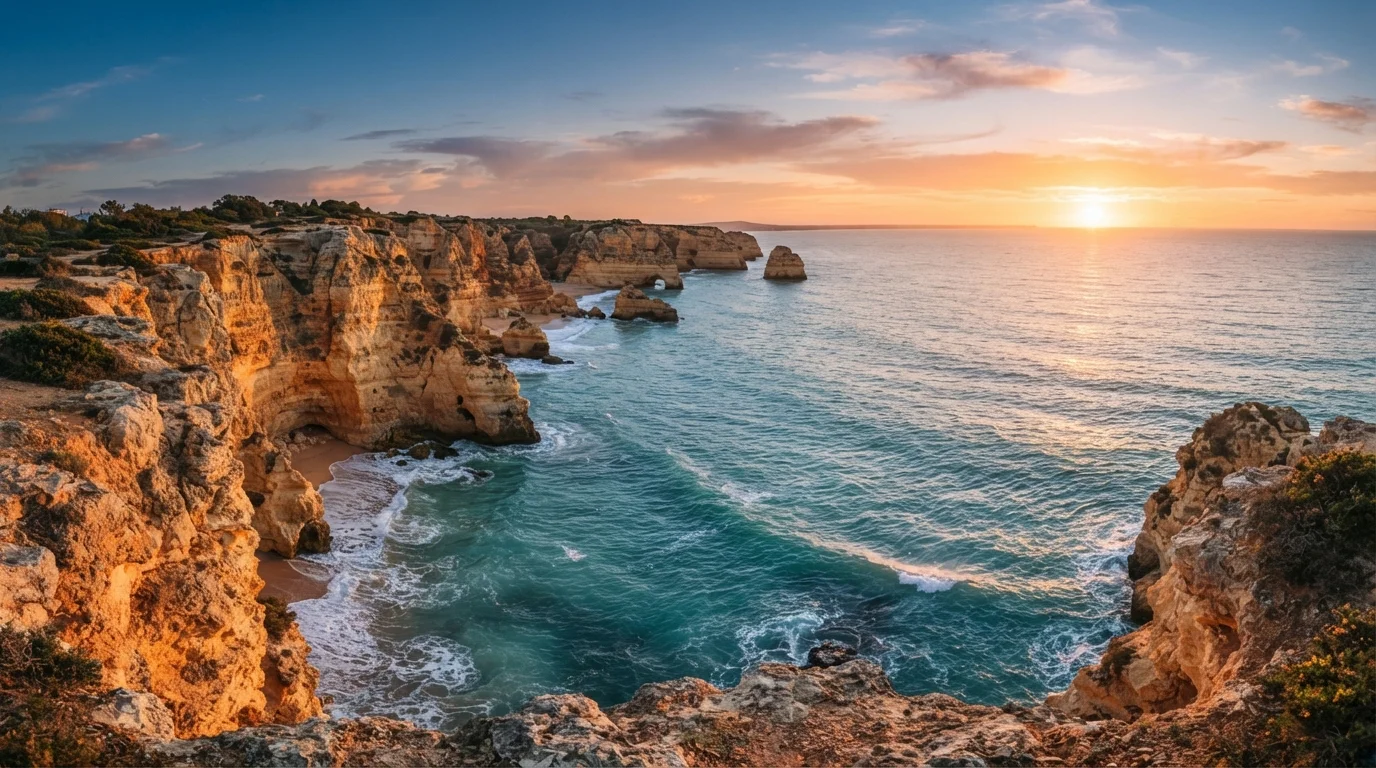
Portugal's southernmost region is the one most US travelers picture when they hear the country's name: golden limestone formations, hidden sea caves, and long sandy beaches facing a warm Atlantic. The Algarve's coastline splits meaningfully between the Sotavento (eastern, calmer, barrier-island lagoons) and the Barlavento (western, wilder, with the iconic stacked-rock formations near Lagos and Sagres). These are two different travel experiences wearing the same regional label.
What the Algarve rewards beyond the obvious: hiking the Rota Vicentina coastal trail, which traces cliffs and fishing villages down to Cape St. Vincent — Europe's southwestern tip — without the beach-resort crowds. The inland Algarve, with its whitewashed villages and almond orchards, is largely overlooked. Shoulder-season visits (April–May, September–October) offer gentler weather and far fewer people. Summers here are reliably hot and dry, which is exactly what many travelers want — just book accommodation early if traveling in July or August.
Sotavento
The eastern Algarve, meaning 'leeward' in Portuguese. This section features calmer, sheltered beaches, lagoons, and barrier islands — notably the Ria Formosa Natural Park.
Barlavento
The western Algarve, meaning 'windward.' Known for dramatic limestone sea stacks, hidden grottoes, and the wild coastal scenery near Lagos and Sagres.
Quinta
A Portuguese wine estate or farm, particularly associated with port wine production in the Douro Valley. Many quintas offer tastings and accommodation.
Rota Vicentina
A network of long-distance hiking trails tracing the southwest coast of Portugal through the Alentejo and Algarve, passing cliffs, dunes, and fishing villages.
Azulejo
The distinctive blue-and-white (and sometimes polychrome) ceramic tile panels used widely in Portuguese architecture, both decorative and narrative in function.
Costa de Prata (Silver Coast)
The stretch of Atlantic coastline running roughly between Lisbon and Porto, named for the silver light on its beaches. Includes destinations like Nazaré, Óbidos, and Peniche.
The Alentejo and Silver Coast: Space, Silence, and a Different Kind of Atlantic
Just north of the Algarve and stretching inland, the Alentejo is Portugal's largest region and its least populated. This is cork-oak savanna, ancient dolmens, walled medieval towns like Évora, and some of the country's most talked-about wine production. It doesn't have a coastline of its own — but its southern edge bleeds into the Alentejo Coast, a stretch of undeveloped Atlantic shoreline that draws surfers and those wanting something rawer than the Algarve's polished coves.
Further north, the Silver Coast (Costa de Prata) runs between Lisbon and Porto through Óbidos, Nazaré, and the university city of Coimbra. Nazaré became internationally known for its extreme surf — waves here can exceed 80 feet during winter swells — but the town itself is a working fishing community with a daily market and a clifftop funicular that predates the surfing fame by decades. This stretch rewards travelers who want authentic Portuguese daily life alongside dramatic scenery, without the tourist infrastructure density of the Algarve.
If you're considering a Mediterranean alternative for dramatic coastal geography, the logistical realities of the Amalfi Coast offer an instructive contrast — Portugal's Atlantic coast tends to be considerably less crowded and more accessible.
80+ ft
Wave heights recorded at Nazaré during winter swells
Nazaré on Portugal's Silver Coast has become internationally recognized for some of the largest surfable waves ever recorded.
~250 km
Length of the Rota Vicentina trail network
The trail system spans two routes through southwestern Portugal, covering coastline and inland cork forest.
14
Officially designated Portuguese wine regions
Portugal's Instituto dos Vinhos do Douro e do Porto and related bodies recognize distinct demarcated wine-producing regions across the country.
Porto and the Douro Valley: Where River, Wine, and Architecture Converge
Porto is often described as grittier, more working-class, and more architecturally layered than Lisbon — all fair characterizations, and all reasons it rewards slower travel. The city's azulejo-tiled facades, iron bridges, and riverside Ribeira district are the obvious draws, but the neighborhoods of Bonfim and Cedofeita offer a lived-in Porto that doesn't feel curated for visitors.
The Douro Valley begins roughly an hour east of Porto by train and unfolds into one of the world's most visually striking wine regions — steep schist terraces dropping toward a slow green river, dotted with quintas (wine estates) that have produced port wine for centuries. The valley rewards those who slow down: boat journeys, quinta stays, and long lunches outpace rushing between viewpoints. Conditions, opening hours, and quinta visit availability vary seasonally, so verify current arrangements with official tourism sources or directly with individual estates before planning a visit.
Portugal's regional diversity echoes patterns found across other compact European destinations. Italy's regional complexity offers a useful parallel — in both countries, understanding geographic and cultural sub-regions transforms the trip.
Verifying Entry Requirements and Travel Conditions
Visa requirements, entry rules, and regional accessibility can change. US citizens should verify current requirements with the official US Department of State travel pages and Portugal's official tourism or government resources before booking. Opening hours for quintas, natural parks, and heritage sites vary seasonally and may require advance reservations.