

Key Takeaways
Scenery that genuinely lives up to its reputation
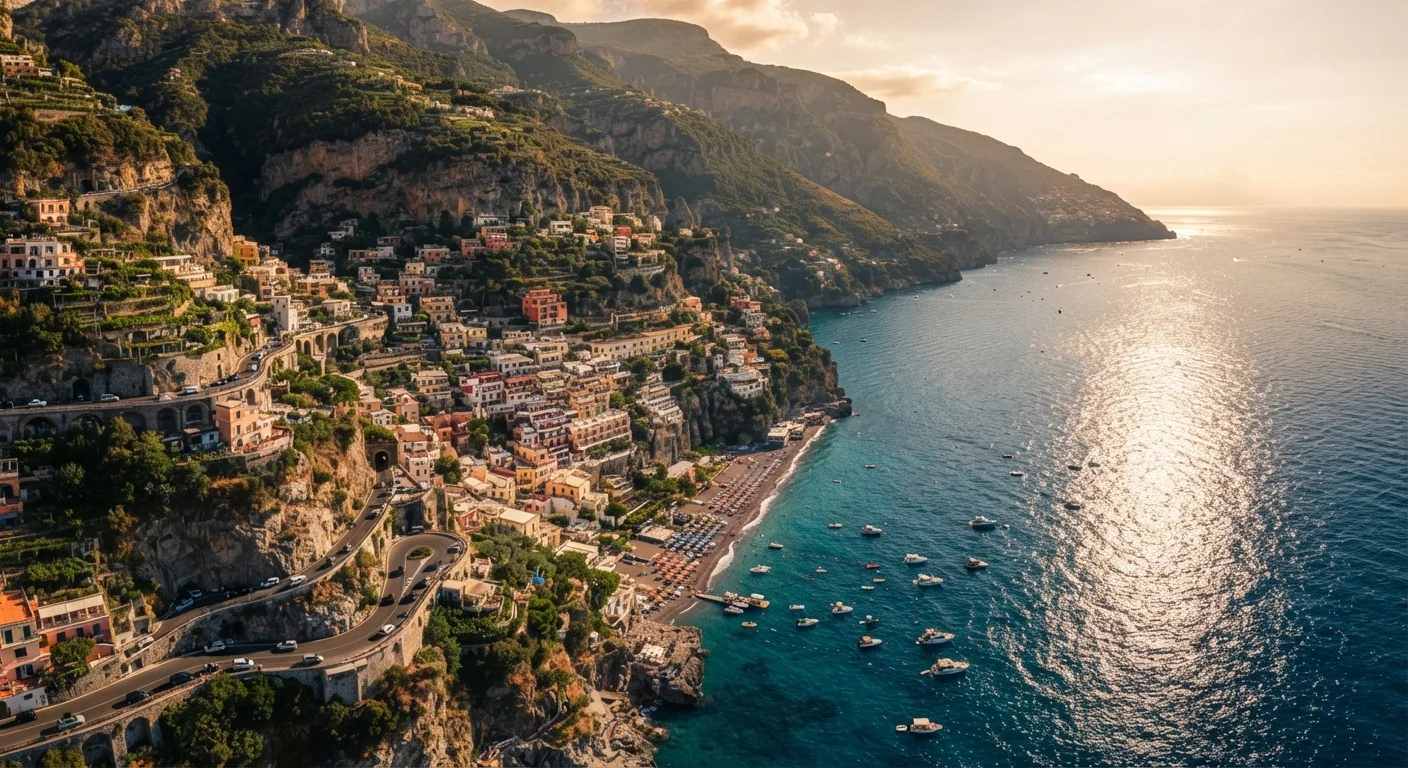
The combination of vertical cliffs, deep-blue sea, and Mediterranean architecture creates a visual environment that is hard to find anywhere else in Europe. The landscape justifies the logistical effort for many travelers.
Distinct and deeply rooted food culture
Campanian cuisine here draws on centuries of local tradition — fresh anchovies, handmade pasta, the region's famous sfusato lemons, and coastal seafood prepared with simplicity. Eating well requires almost no effort.
Compact enough to settle into slowly
The coast's relatively short length means a traveler based in one town can reasonably reach several others by ferry or bus without long journeys, allowing depth without frantic movement.
Rich cultural and historical layers
Amalfi was a powerful maritime republic in the medieval period, and sites like the Amalfi Cathedral and Ravello's Villa Rufolo gardens carry genuine historical weight beyond pure scenery.
Ferry travel offers a unique perspective
Viewing the cliffs and villages from the water provides a perspective entirely different from the road and is often the most memorable part of the visit for first-time travelers.
The coastal road is genuinely difficult
The SS163 is narrow, winding, and heavily trafficked in season. Driving it requires confidence and patience; even experienced drivers find it stressful when tour buses and scooters share the same lane.
Summer crowds fundamentally change the experience
July and August bring visitor numbers that overwhelm narrow village lanes and push hotel prices sharply higher. The atmosphere that makes the coast special can feel inaccessible under peak-season pressure.
Steep terrain limits accessibility
Most towns are built vertically, connected by hundreds of stairs. Travelers with mobility challenges, heavy luggage, or young children in strollers will find significant parts of the coast difficult to navigate.
Accommodation costs are high for the category
The Amalfi Coast commands premium pricing relative to comparable quality elsewhere in southern Italy. Budget travelers often find the area feasible only as a day trip from Naples or Salerno.
Limited "hidden" spots remain
The coast is one of Europe's most photographed destinations. Finding quieter corners requires deliberate planning and an acceptance that even off-the-beaten-path spots here are well-documented online.
Our Verdict
The Amalfi Coast delivers on its visual promise — the sea is that blue, the villages are that dramatic, and the food is that good. But it is also one of Italy's most logistically demanding destinations, where beauty and inconvenience travel as a pair. Visitors who go in with clear expectations, flexible timing, and a willingness to slow down tend to leave satisfied.
Best for travelers who value scenery and atmosphere over efficiency, are comfortable with physical terrain, and can visit outside July and August.
Why the Amalfi Coast Earns Its Reputation
Stretching roughly 30 miles along the southern edge of the Sorrentine Peninsula in Campania, the Amalfi Coast — known in Italian as the Costiera Amalfitana — is a UNESCO World Heritage Site for good reason. The coastline stacks pastel-colored towns like Positano, Ravello, and Amalfi itself against near-vertical cliffs that plunge into the Tyrrhenian Sea. Lemon groves cling to terraced slopes. Medieval churches crown hilltops. The light in late afternoon turns the whole scene amber.
The draw isn't just aesthetic. The food is grounded in a distinct southern Italian tradition — fresh seafood, hand-rolled pasta, sfusato amalfitano lemons used in everything from limoncello to salads. Wandering the flagstone lanes of Ravello or watching fishing boats come in at Atrani gives a sense of place that few European coastlines still manage. To understand why this corner of Italy carries such weight, it helps to read about Italy's distinct regional character — Campania is not interchangeable with Tuscany or the Veneto.
Scenery that genuinely lives up to its reputation
The combination of vertical cliffs, deep-blue sea, and Mediterranean architecture creates a visual environment that is hard to find anywhere else in Europe. The landscape justifies the logistical effort for many travelers.
Distinct and deeply rooted food culture
Campanian cuisine here draws on centuries of local tradition — fresh anchovies, handmade pasta, the region's famous sfusato lemons, and coastal seafood prepared with simplicity. Eating well requires almost no effort.
Compact enough to settle into slowly
The coast's relatively short length means a traveler based in one town can reasonably reach several others by ferry or bus without long journeys, allowing depth without frantic movement.
Rich cultural and historical layers
Amalfi was a powerful maritime republic in the medieval period, and sites like the Amalfi Cathedral and Ravello's Villa Rufolo gardens carry genuine historical weight beyond pure scenery.
Ferry travel offers a unique perspective
Viewing the cliffs and villages from the water provides a perspective entirely different from the road and is often the most memorable part of the visit for first-time travelers.
What the Postcards Leave Out
The same geography that creates the drama also creates the friction. The SS163 — the coastal highway — is a single lane in many sections, threading through tunnels blasted into cliff faces and around hairpin bends where tour buses and delivery trucks negotiate right-of-way with centimeters to spare. Traffic in summer can make a 10-mile journey take over an hour. Parking is either nonexistent or priced accordingly.
Then there are the stairs. Most Amalfi Coast towns are built vertically, connected by stepped lanes that can rise hundreds of feet. Positano's main beach sits at the bottom of a hillside village where every errand involves a climb. Ravello perches high above sea level and requires effort to reach. Travelers with mobility limitations should research specific towns carefully before booking — conditions vary significantly.
Crowds in July and August are not a minor inconvenience; they are the defining condition of the experience. The coastal road becomes a slow procession. Popular viewpoints fill with tour groups. Hotel rates reflect peak demand sharply. To think clearly about timing, it's worth understanding how seasonal complexity works across destinations before committing to dates.
The coastal road is genuinely difficult
The SS163 is narrow, winding, and heavily trafficked in season. Driving it requires confidence and patience; even experienced drivers find it stressful when tour buses and scooters share the same lane.
Summer crowds fundamentally change the experience
July and August bring visitor numbers that overwhelm narrow village lanes and push hotel prices sharply higher. The atmosphere that makes the coast special can feel inaccessible under peak-season pressure.
Steep terrain limits accessibility
Most towns are built vertically, connected by hundreds of stairs. Travelers with mobility challenges, heavy luggage, or young children in strollers will find significant parts of the coast difficult to navigate.
Accommodation costs are high for the category
The Amalfi Coast commands premium pricing relative to comparable quality elsewhere in southern Italy. Budget travelers often find the area feasible only as a day trip from Naples or Salerno.
Limited "hidden" spots remain
The coast is one of Europe's most photographed destinations. Finding quieter corners requires deliberate planning and an acceptance that even off-the-beaten-path spots here are well-documented online.
Getting Around Without a Car
Many experienced Amalfi visitors recommend skipping the rental car entirely. The SITA public bus network connects most towns along the coast and, while crowded in high season, it removes the stress of driving on roads where mirrors frequently get clipped. Ferries — running between Positano, Amalfi, Salerno, and Sorrento — are often the most pleasant way to move, offering sea-level views of the cliffs and bypassing the road entirely.
Ferry Schedules Vary by Season
Ferry services along the Amalfi Coast typically run from spring through early autumn, with reduced or suspended schedules in winter months when sea conditions can be rough. Before planning a ferry-based itinerary, verify current schedules with official or local transport sources rather than relying on prior-year timetables. Weather can also cause last-minute cancellations regardless of season.
Travelers arriving by train typically land in Naples or Salerno, both well-connected to the coast by ferry or bus. Naples itself warrants time — it's one of Italy's most layered cities — and treating it as a base for day trips to the coast is a legitimate strategy that avoids the premium of sleeping in Positano or Ravello.
For those drawn to coastal Europe more broadly, the Adriatic coastline and Portugal's regional coasts offer alternatives with less concentrated tourist pressure, depending on what a traveler is actually after.
Timing, Expectations, and the Case for Going Slower
May and October are widely considered the most workable months. Temperatures are comfortable for walking, the sea is swimmable in early October, and the ratio of visitors to locals shifts enough that spontaneous conversations and unhurried meals become possible again. June and September sit in the middle — still busy, but not at August's peak.
~30 miles
Length of the Amalfi Coast
The Costiera Amalfitana runs approximately 30 miles along the Sorrentine Peninsula — compact but vertically dramatic throughout its length.
1997
Year UNESCO designation was awarded
UNESCO added the Amalfi Coast to its World Heritage List in 1997, recognizing both its exceptional natural landscape and its cultural and historical significance.
The travelers who tend to feel most satisfied with the Amalfi Coast are those who pick one or two towns and actually inhabit them rather than racing to check off every village. A morning walk before the day-trippers arrive, an afternoon in a shaded café, a slow dinner at a family-run restaurant — this pace suits the place. The coast is not designed for efficiency. Visitors who accept that find something the postcards genuinely don't capture: the quiet texture of an extraordinary place lived in, not just photographed.