

Key Takeaways
Our Verdict
Neither organic nor synthetic fertiliser is universally superior — each has a clear role depending on your garden goals. Organic options build lasting soil health over time, while synthetics solve acute nutrient shortfalls quickly. A soil test is the single most useful starting point before committing to either approach.
| Best for | Recommended |
|---|---|
| Gardeners focused on long-term soil improvement | Organic fertilisers |
| Correcting a confirmed, specific nutrient deficiency fast | Synthetic fertilisers |
| Vegetable gardens and edible beds with ongoing amendments | Organic fertilisers |
| Established lawns or ornamental beds needing a seasonal boost | Blended or synthetic fertilisers |
How Each Type Works in the Soil
Understanding the fundamental mechanism behind each fertiliser type helps you match the product to the problem.
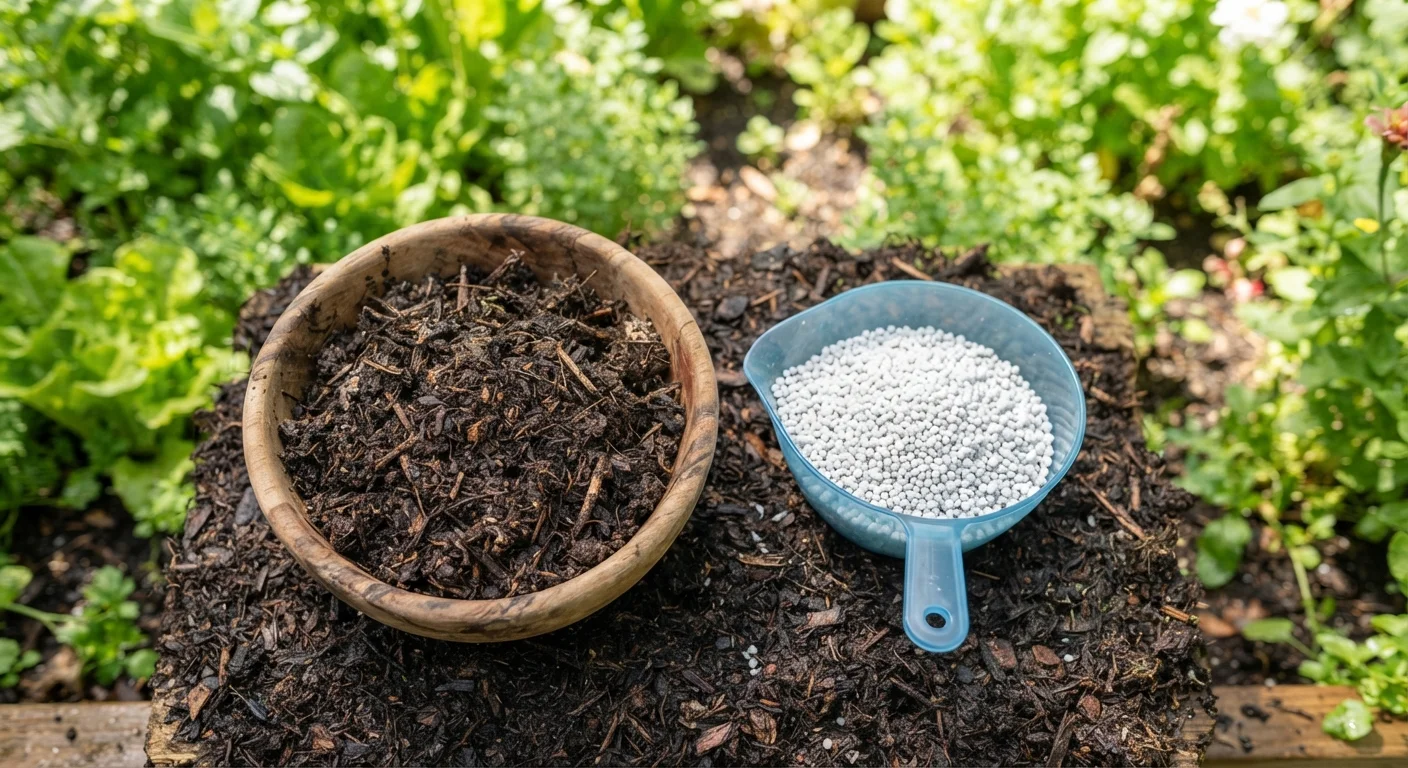
Organic fertilisers — including compost, fish meal, bone meal, and kelp — are derived from plant or animal matter. They release nutrients gradually as soil microbes break down the organic material. This process feeds your plants indirectly by first nourishing the microbial ecosystem that makes nutrients chemically available. The result is a slow, steady nutrient supply that rarely overwhelms plants, along with measurable improvements in soil structure over multiple seasons.
Synthetic fertilisers are manufactured to deliver specific nutrient ratios — typically expressed as an N-P-K number (nitrogen, phosphorus, potassium) — in water-soluble forms that roots absorb almost immediately. This speed is genuinely useful when a soil test confirms a deficiency that is visibly stressing plants. However, because synthetic nutrients bypass the microbial loop, repeated exclusive use does little to improve soil texture or biology. See our guide to soil pH to understand how nutrient availability connects to soil chemistry.
Comparing the Key Trade-Offs
Neither approach is without compromise. The table below summarises how organic and synthetic fertilisers differ across the criteria that matter most to home gardeners.
| Organic Fertilisers | Synthetic Fertilisers | |
|---|---|---|
| Nutrient release speed | Slow, over weeks to months | Fast, often within days |
| Soil biology impact | Feeds and supports microbial life | Minimal direct benefit to microbes |
| Soil structure improvement | Yes, over multiple seasons | Little to none |
| Nutrient precision | Variable, harder to control | High, clearly labelled N-P-K ratios |
| Risk of over-application | Lower risk, slower release | Higher risk, especially nitrogen |
| Cost per application | Moderate to high upfront | Generally lower upfront |
| Environmental runoff risk | Lower with most organic sources | Higher with soluble formulas |
| Ease of use | Requires more planning | Simple, straightforward to apply |
One nuance worth noting: organic fertilisers vary widely in nutrient concentration. A bag of composted manure contains far lower N-P-K values than a synthetic granule, so application rates differ significantly. Always read the product label and, where possible, base decisions on a soil test rather than guesswork.
Soil Health and the Long Game
The most meaningful difference between organic and synthetic programs shows up over years, not weeks. Organic matter — compost, aged manure, cover crop residue — feeds soil microbes, improves water retention, and gradually shifts compacted or sandy soils toward a more workable structure. This mirrors how healthy ecosystems function in the wild.
Synthetic fertilisers, applied in high concentrations or repeatedly without organic amendments, can contribute to salt accumulation in the root zone. Over time, excess soluble salts suppress beneficial microbial activity and can damage plant roots, particularly in container or raised-bed environments where drainage is limited.
Start With a Soil Test
Before buying any fertiliser, invest in a basic soil test through your local cooperative extension service or a mail-in lab. Results will tell you your current pH and nutrient levels, so you only add what is actually missing. This prevents waste, reduces runoff, and often saves money over the course of a growing season.
If you grow edibles, an organic-led approach tends to align well with minimising chemical inputs throughout the garden. That philosophy pairs naturally with chemical-free pest management for a more cohesive growing system. For new plots, consider how your fertiliser choice interacts with bed type — our raised bed vs. in-ground comparison explores how growing medium affects nutrient dynamics.
When to Use Which — Practical Guidance
Most home gardeners benefit from understanding when each type earns its place, rather than treating the choice as all-or-nothing.
- Use organics as a foundation: Incorporate compost or aged manure into beds each season. This builds baseline fertility and soil structure regardless of what else you apply.
- Use synthetics for confirmed deficiencies: If a soil test reveals a phosphorus or iron shortfall causing visible stress, a targeted synthetic amendment corrects it faster than organic sources can.
- Consider slow-release synthetics for lawns: Coated granules that release nutrients over weeks reduce runoff risk and produce more consistent results than quick-release formulas.
- Avoid over-application of either type: More fertiliser is rarely better. Excess nitrogen, whether organic or synthetic, can promote lush foliage at the expense of root development and fruiting.
Watch for Nutrient Runoff
Applying synthetic fertiliser before heavy rain is one of the most common mistakes home gardeners make. Water-soluble nutrients wash off quickly into storm drains and local waterways, contributing to algae blooms. Check your forecast before any application and water lightly by hand if rain is expected within 24 hours.
Gardeners interested in supporting local biodiversity may also find that an organic-led fertility program complements a broader strategy of growing native plants that are naturally adapted to local soil conditions.