

Key Takeaways
The Problem With One Light Source
Walk into a room lit by a single ceiling fixture and you'll feel the problem before you can name it. Every surface is evenly lit — and somehow the space feels both glaring and gloomy at the same time. Shadows pile up in the corners, textures flatten out, and the room loses the depth that makes a space feel lived-in and welcoming.
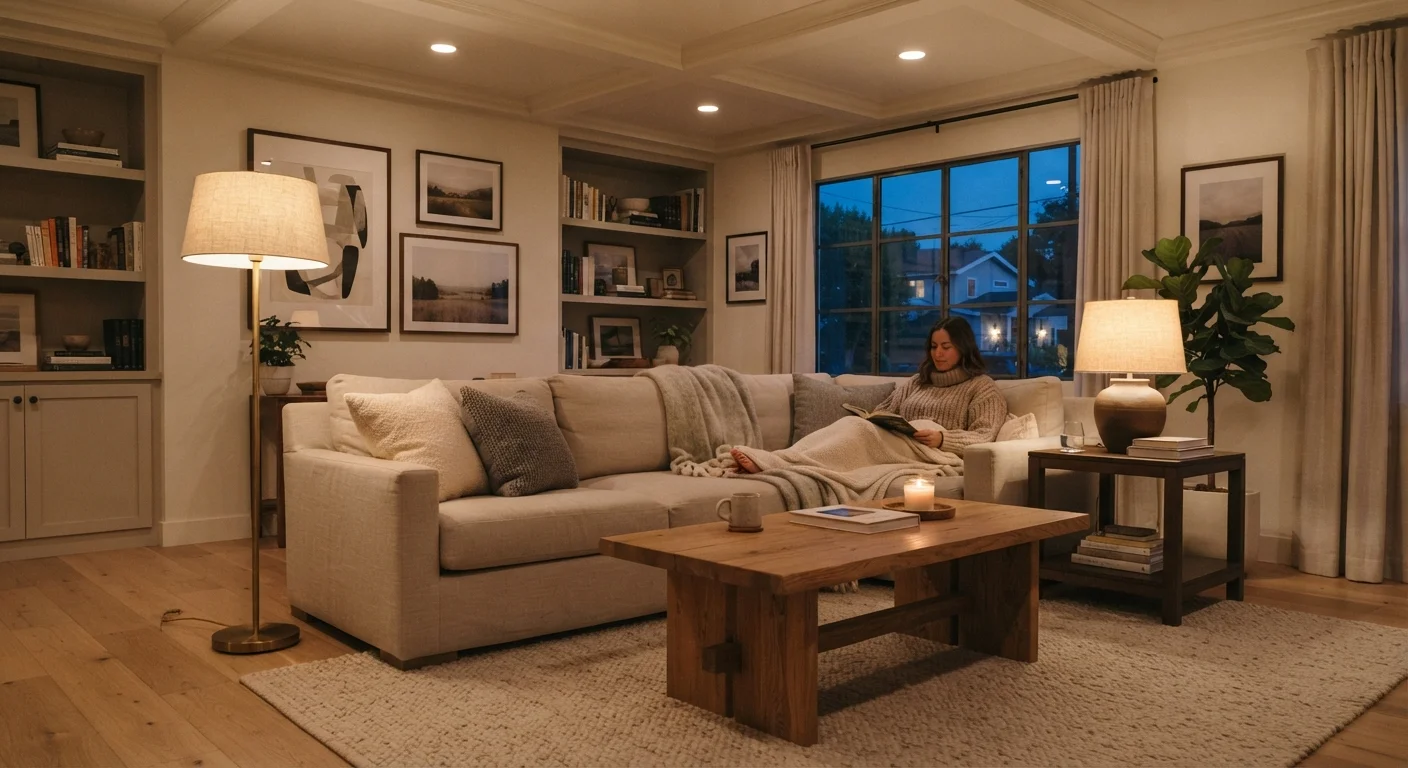
Good lighting design isn't about brightness. It's about layering: combining multiple sources that each serve a distinct role. Designers consistently point to three layers — ambient, task, and accent — as the foundation of any room that feels considered. Once you understand what each layer does, one overhead fixture will never seem like enough again.
This same logic of working in distinct layers applies across design disciplines. Just as the principles behind rooms that feel balanced involve scale and contrast working together, lighting layers work in concert rather than in isolation.
The Three Layers and What They Do
Ambient Light: The Base Layer
Ambient light is your room's general illumination — the light that replaces daylight when the sun goes down. Overhead fixtures, flush-mount ceiling lights, and recessed cans all serve this function. The goal isn't to make the room brightly lit; it's to establish a comfortable baseline brightness without harsh shadows. A dimmer switch on your ambient source is one of the most effective upgrades you can make, allowing you to pull that baseline down in the evenings.
Task Light: The Functional Layer
Task lighting targets specific activities — reading, cooking, desk work, or applying makeup. Table lamps beside a sofa, pendants over a kitchen island, under-cabinet lighting in a kitchen, and a dedicated desk lamp all fall here. Task light needs to be bright enough to reduce eye strain without spilling harshly into the rest of the room. Positioning matters: light that comes from the side or slightly above the work surface almost always outperforms light aimed directly down.
Accent Light: The Sculpting Layer
Accent lighting draws attention to things worth noticing — a piece of artwork, a built-in bookcase, an architectural detail, or a textured wall. Wall sconces, picture lights, directional track lighting, and LED strip lights tucked behind shelving all serve this role. Because accent light creates contrast, it's also what gives a room visual depth after dark. This layer works in close partnership with texture in interior design — a raking accent light can make a brick wall or linen upholstery come alive in ways no overhead fixture ever could.
“Light is not just practical — it is the primary material of interior design. Every other element in a room is defined by how light falls on it.”
— Thierry Despont, Interior architect and designer known for residential and hospitality projects
Practical Layering: Where to Start
If you're starting from a single overhead fixture, you don't need to rewire your home. Most layering happens through plug-in lamps, battery-powered puck lights, and inexpensive LED strip lights — no electrician required for the basics.
Add at least one table or floor lamp to every room currently relying on a single overhead fixture.
Plug-in lamps introduce light at eye level and below, breaking up the flat, top-down illumination that makes rooms feel institutional. They also create pools of warmth that draw the eye and define zones within an open space.
Install a dimmer on every ambient light source you can.
The ability to lower ambient light in the evening is the single biggest quality-of-life upgrade in home lighting. It lets you shift a room from functional daytime brightness to a relaxed evening atmosphere using only a switch.
Use accent lighting to highlight at least one vertical surface or object per room.
Most home lighting is entirely horizontal — everything lit from above. Accent light that hits a wall, shelf, or artwork introduces vertical contrast that adds immediate depth and makes a room feel more intentionally designed.
Match colour temperature (measured in Kelvin) across all light sources in a single room.
Mismatched colour temperatures — one warm bulb, one cool bulb, one daylight bulb — make a room feel chaotic and poorly considered, even when the sources themselves are well-placed. Consistency in tone unifies the layers.
Treat task lighting as a zone-specific tool, not a general room brightener.
Task light works best when it's targeted and positioned close to the work surface. Trying to use a single bright overhead fixture for task purposes forces the whole room into an overly bright state that serves no layer well.
Pay attention to colour temperature as you add sources. Mixing a cool-white task lamp (around 4000K) with warm-white ambient bulbs (around 2700K) can make a room feel incoherent. A consistent warm tone across all three layers creates unity; deliberate variation — cooler task light over a desk, warmer ambient in the seating area — can work beautifully when it's intentional.
Quick Wins to Implement Today
You don't need a full redesign to improve your lighting. Start with the changes that have the most immediate impact and build from there. If you've been doing a broader audit of your space, this pairs well with a room-by-room décor audit to identify other areas holding each space back.
3×
More light sources vs. typical single-fixture rooms
Interior design guidelines commonly recommend a minimum of three light sources per room to achieve proper layering across ambient, task, and accent functions.
2700K
Ideal colour temperature for living spaces
Lighting designers widely recommend bulbs in the 2700–3000K range for residential living and dining areas to achieve a warm, welcoming tone.